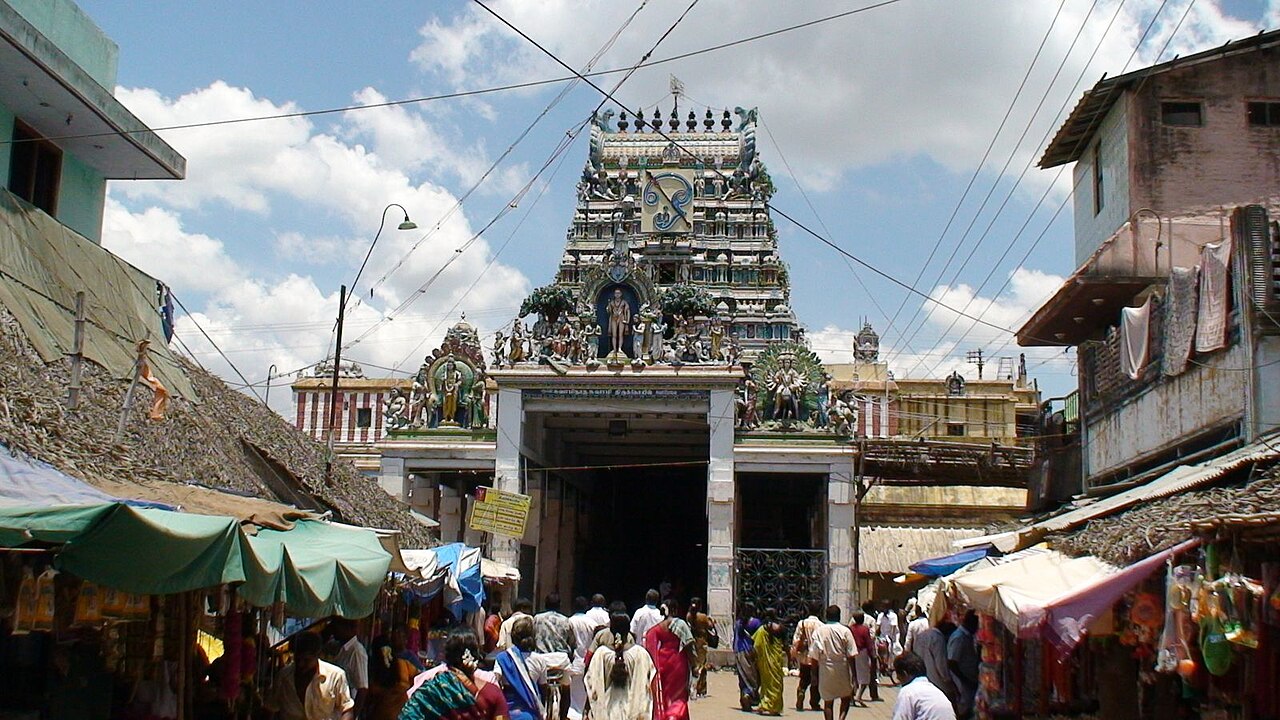
Guide details
Best time to visit
October to March, when the delta is cooler and the temple steps are easier to climb in comfort
How to get there
About 280 to 300 km from Chennai, roughly 5.5 to 6.5 hours by road via Villupuram and Kumbakonam, or by train to Kumbakonam or Thanjavur followed by a short taxi ride
Highlights
Swaminathaswamy Temple on its artificial hillock, the 60 steps of the Tamil year cycle, one of the six Arupadai Veedu of Murugan, traditional lost-wax bronze icon workshops, GI-tagged Swamimalai bronzes, proximity to Kumbakonam and Thanjavur
Good for
Pilgrims and devotees of Murugan, temple architecture enthusiasts, art and craft lovers, travellers doing the Kumbakonam-Thanjavur temple circuit, anyone interested in traditional Indian metalwork
Price range
Free general darshan, with paid special darshan or archana typically a modest sum; bronze icons range widely, from a few thousand Rs for small pieces to well over a lakh for large, finely worked idols
Swamimalai is a small temple town that punches well above its size. It is home to one of the six sacred abodes of Lord Murugan in Tamil Nadu, and it is also where some of the finest bronze icons in India are still cast by hand, using techniques that have barely changed in a thousand years. Few places pack this much religious and artistic significance into such a compact spot.
It is not a place most people stumble upon by accident. Swamimalai sits deep in the Cauvery delta, and visiting it properly means treating it as part of a longer temple trip rather than a quick stop. That is exactly how we would suggest seeing it.
This temple is one of the Arupadai Veedu, the six sacred abodes of Lord Murugan. For the full circuit and the story that links them, see our Arupadai Veedu guide.
About Swamimalai
Swamimalai is a temple town in Thanjavur district, on the outskirts of Kumbakonam, about 5 to 8 km away. It sits in the heart of the Cauvery delta, an area often called the rice bowl of Tamil Nadu, and one that is also, not coincidentally, one of the densest concentrations of old Chola-era temples anywhere in India. The town itself is unhurried. Life here revolves around the temple and the bronze workshops, and there is not a great deal else to distract you, which is rather the point.
Swaminathaswamy Temple: one of Murugan’s six abodes
The Swaminathaswamy Temple is the reason most people come to Swamimalai. It is one of the Arupadai Veedu, the six sacred abodes of Lord Murugan, known also as Kartikeya or Subramanya, in Tamil Nadu. Each of the six sites marks a different chapter of Murugan’s story, and here he is worshipped as Swaminatha, a form that carries particular weight, as we will get to.
The temple’s most distinctive physical feature is its setting. It is built on an artificial hillock, and reaching the main shrine means climbing a flight of about 60 steps. This is not just an architectural quirk. The 60 steps are traditionally said to represent the 60-year cycle of the Tamil calendar, so the climb itself becomes a small, deliberate act of devotion rather than a mere inconvenience. Take it at your own pace, especially in the heat, and allow a little extra time if you are visiting with children or elderly relatives.
The legend: Murugan as the teacher of Shiva
What makes Swaminathaswamy Temple particularly significant among the six abodes is the legend attached to it. It is said that Murugan, while still a child, taught the meaning of the sacred syllable Om, the Pranava mantra, to his own father, Lord Shiva. Because Murugan is believed to have explained this profound concept even to Shiva, he is worshipped here as Swaminatha, literally the teacher or guru of the Lord himself.
This is an unusual and much loved piece of Tamil devotional tradition, since it inverts the usual roles of father and son, teacher and student. It is one of the reasons Swamimalai holds such a special place for Murugan devotees, and why the temple draws steady crowds of pilgrims from across Tamil Nadu and beyond throughout the year.
Swamimalai bronze icons
Alongside the temple, Swamimalai has a second, quite different claim to fame. It is one of the world’s great centres for traditional bronze idol making, produced using the lost-wax or cire perdue casting method. This is a technique of real antiquity, refined over centuries by the sthapathis, the hereditary families of icon-makers who have worked in Swamimalai for generations, passing the craft down from father to son.
The process itself is genuinely fascinating to watch. A wax model of the deity is built up first, then coated in layers of clay to form a mould, and the whole thing is fired so the wax melts and drains away, leaving a cavity that is filled with molten bronze. Once the metal cools, the clay mould is broken open and the finished icon is cleaned, polished and finished by hand. Swamimalai bronzes now carry a Geographical Indication, or GI, tag, recognising them as a product tied specifically to this place and its craftsmen.
Several workshops around the town welcome visitors, and it is well worth setting aside an hour or two to see the process in person rather than treating it as an afterthought. You can watch artisans at work on everything from small table idols to large temple processional icons, and buy directly from the workshops if something catches your eye. Prices vary enormously depending on size, the deity depicted, and the fineness of the work, so it pays to look around a little before deciding, and to ask the workshop about the casting process behind the specific piece you are considering.
Getting there from Chennai
Swamimalai is roughly 280 to 300 km from Chennai, and the drive takes about 5.5 to 6.5 hours depending on traffic and the route. Most people go via Villupuram and Trichy, or head down the ECR before cutting inland, and then approach through Kumbakonam. For a detailed route breakdown, our guide to Chennai to Kumbakonam covers the road options in more depth, since Swamimalai is best reached as a short onward hop from Kumbakonam itself.
By train, the nearest useful stations are at Kumbakonam and Thanjavur, both served from Chennai Egmore, with journey times typically running from 6 to 8 hours depending on the train. From either station it is a short taxi or auto ride out to Swamimalai.
Given all this, we would not recommend treating Swamimalai as a day trip from Chennai. The distance simply does not make sense for a single-day round trip. It works best as one stop within a wider Kumbakonam and Thanjavur temple circuit, where you base yourself in the area for a couple of days and take in several sites without rushing.
Combine it with the temple trail
Once you are in the area, it makes sense to see Swamimalai alongside its neighbours. Kumbakonam itself is a major temple town in its own right, known for its numerous shrines and the sacred Mahamaham tank, which draws enormous crowds during its periodic festival. Thanjavur, a little further on, is home to the Brihadeeswara Temple, a UNESCO World Heritage Site and one of the great achievements of Chola architecture. Our guide to Chennai to Thanjavur is a useful companion piece if you are planning to extend your trip that far.
Together, Swamimalai, Kumbakonam and Thanjavur form a natural loop through the Chola heartland of the Cauvery delta, and spreading your visit across two or three days lets you see all three without feeling rushed.
Visiting: timings, entry and etiquette
Swaminathaswamy Temple is an active place of worship, and general darshan is free, though paid special darshan or archana is usually available for those who prefer a quicker or more personal ritual. Like most Tamil Nadu temples, it typically follows split timings, open in the morning, closed for a few hours around midday, and open again in the evening, so it is worth checking current timings locally or with your hotel before you set off, particularly if you are travelling from some distance.
Dress modestly, and be prepared to remove your footwear before entering the temple precincts, including for the climb up the 60 steps. The steps themselves can get hot underfoot in the middle of the day, so early morning or late afternoon visits are more comfortable. Major festivals connected to Murugan, such as Thaipusam and Skanda Sashti, bring very large crowds and long queues, so plan accordingly if you are visiting around those dates.
Best time to visit and tips
- October to March is the best window, when temperatures in the delta are noticeably cooler and more comfortable for temple visits and walking around.
- April to June can be very hot, and the climb up to the temple is far more tiring in that heat.
- Visit the bronze workshops in the morning or early afternoon, when artisans are typically at work and happy to explain the process.
- Carry cash in small denominations for archana, auto fares and workshop purchases.
- Book accommodation in Kumbakonam or Thanjavur rather than Swamimalai itself, since options in the town are limited.
- Expect Thaipusam and Skanda Sashti to bring heavy crowds, so allow extra time or consider visiting outside those dates if you prefer a quieter darshan.
Swamimalai rewards travellers who are willing to slow down. It is a small town with a large story, and between the climb up to Swaminatha’s shrine and an hour spent watching a bronze icon take shape, it earns its place on any serious Cauvery delta itinerary.