Guide details
Best time to visit
November to February, when the weather is cool and the gardens are at their greenest.
How to get there
About 30 to 45 minutes by cab from Chennai Central, or by MTC bus and auto along the coast.
Highlights
Theosophical Society, the 450 year old Adyar banyan tree, Adyar Eco Park (Tholkappia Poonga), the Adyar river and estuary, nearby Elliot’s Beach, IIT Madras deer campus
Good for
green space, slow walks, culture, birdwatching, families, beach lovers, quiet stays
Price range
Guesthouses and budget hotels from around Rs 2,000 to Rs 4,000 a night, mid range from Rs 5,000 to Rs 9,000, with pricier options nearer the coast.
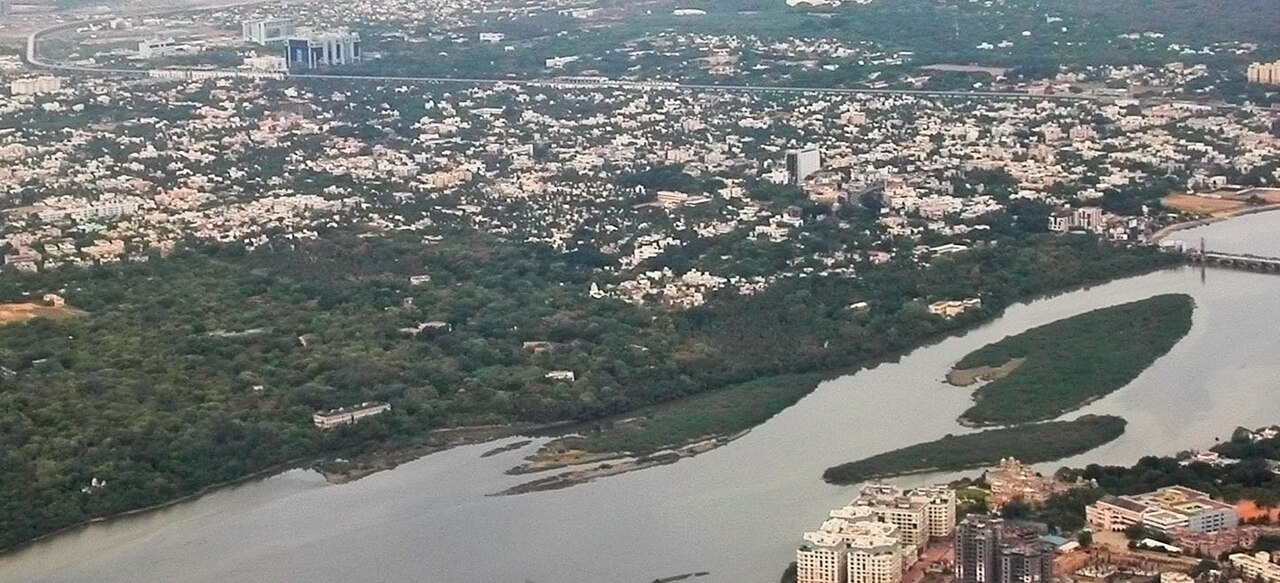
Some parts of Chennai come at you all at once, with horns and heat and crowds pressing in from every side. Adyar is not one of them. Sitting in the south of the city, near the point where the Adyar river slows and spreads out towards the sea, it feels a good few degrees calmer than the centre. The streets are wider, the trees are older, and there is a steady, settled quality to the place that people who live here tend to guard rather fiercely.
It is an affluent, cultured neighbourhood, and it wears that easily rather than loudly. You get grand old bungalows next to newer apartment blocks, good bookshops and coffee, and a handful of green spaces that are genuinely worth planning a day around. If you want the sea, the beach at Besant Nagar is only a short ride away. We think Adyar is one of the nicer bases in the city for anyone who wants culture and quiet without giving up on being close to things.
What Adyar is like
Adyar grew up around the river and the Theosophical Society, and that history still shapes its mood. This is not a nightlife district or a shopping-mall hub, though you will find plenty of both within reach. It is more of a residential, everyday sort of place, the kind where you notice the mornings: filter coffee smells drifting out of houses, older residents out for a walk, kids heading to school under a canopy of rain trees.
The main roads, Lattice Bridge Road and Sardar Patel Road among them, can get busy at rush hour like anywhere in Chennai. Step off them, though, and the side streets quieten down quickly. There is a real spread of people here too, from long-settled Tamil families to academics, artists and a fair few expats drawn by the schools and the greenery. It all makes for a neighbourhood that feels lived in and unhurried, rather than staged for visitors.
The Theosophical Society and the great banyan tree
If you do one thing in Adyar, make it this. The Theosophical Society occupies a huge campus of around 260 acres along the river, and it is open to visitors for quiet walking during set hours, usually in the morning and again in the late afternoon. Entry is free, though you sign in at the gate and are asked to keep things calm and respectful. Photography rules can change, so it is worth checking at the entrance.
The headline attraction is the Adyar Aalamaram, an enormous banyan tree thought to be somewhere around 450 years old. Its central trunk came down in a storm some years back, but the network of aerial roots and secondary trunks still covers a remarkable spread of ground, and standing under it is a genuinely quietening experience. Beyond the tree, the grounds hold gardens, a well regarded library, and shrines and memorials linked to several different faiths, which fits the Society’s long-standing idea of drawing the religions of the world into one conversation. Give it a couple of unhurried hours. Wear comfortable shoes, carry water, and do not expect a slick tourist operation. The appeal is exactly that it is not one.
Adyar Eco Park and the river
Right next door in spirit is the Adyar Eco Park, also known as Tholkappia Poonga. This is a restored wetland, built to bring a stretch of the Adyar estuary back to something like its natural state after years of neglect. It works. Walkways and boardwalks lead you through native trees, reeds and open water, and it has become a reliable spot for birdwatchers, with herons, kingfishers and plenty of migratory visitors in the cooler months.
There is a modest entry fee, usually well under Rs 100, and the park keeps its own opening hours with a weekly closed day, so check before you set out. Early morning is best, both for the light and for the birds. The river and estuary themselves are not a swimming or boating attraction, and parts of the waterway are still recovering, so treat this as a place to walk, watch and breathe rather than to get in the water. On a clear morning, with the city noise held at arm’s length, it is one of the more restorative hours you can spend in Chennai.
Things to do nearby
One of Adyar’s quiet advantages is how close it sits to some of south Chennai’s best bits.
- Besant Nagar and Elliot’s Beach. A short auto or cab ride south brings you to Besant Nagar, home to Elliot’s Beach, which is calmer and more relaxed than the famous Marina. It is a favourite for evening walks, sea breeze and street food. We have written a full Besant Nagar beach guide if you want the detail on where to sit, eat and watch the sunset.
- IIT Madras. The Indian Institute of Technology Madras has a large, wooded campus nearby that doubles as a small wildlife refuge, with spotted deer, blackbuck and monkeys living among the trees. Public access is restricted and usually needs prior permission or a genuine reason to visit, so do not just turn up expecting a safari. If you do get in, it is a lovely green pocket.
- Temples, galleries and bookshops. Adyar and its surrounds have plenty of small temples, cultural centres and independent shops worth a wander, especially if you like poking about rather than ticking off a list.
Where to eat and drink
Adyar eats well, and in a fairly unpretentious way. The neighbourhood does the south Indian staples properly, so this is a good place to seek out crisp dosas, idlis and a solid South Indian thali at lunch, often at very fair prices. Filter coffee is close to a local religion, and there are old-school messes and tiffin spots that have been feeding regulars for decades.
Alongside that you will find the newer Chennai of specialty coffee shops, bakeries and cafes aimed at students and the young professional crowd, plenty of North Indian and Chinese options, and a growing scatter of restaurants doing everything from Kerala seafood to pan-Asian and continental. For a bigger night out or a proper bar, many people drift over to Besant Nagar or towards the star hotels, since Adyar itself leans more homely than hard-drinking. Our honest advice: eat where it is busy with locals, order the regional dishes, and you will rarely go wrong.
How to get there and around
Adyar is well connected to the rest of Chennai, if not always quickly at peak times. From the airport or the city centre, a cab or auto is the simplest option, and reckon on roughly 30 to 45 minutes from Chennai Central depending on traffic. App-based cabs and autos work well across the area and take a lot of the haggling out of the trip.
MTC city buses run frequently along the main roads and are cheap if you are happy to work out the routes. There is not a Metro station right in the heart of Adyar at the time of writing, so most visitors combine a Metro or suburban train leg with a short auto ride at the end. Within the neighbourhood, autos are the everyday workhorse for short hops, and the greener central areas around the Theosophical Society and Eco Park are pleasant to explore on foot. If you are renting a two-wheeler or driving, be ready for busy junctions and limited parking near the popular spots.
Where to stay
Adyar and its neighbours give you a decent range without the central-city price tags. Simple guesthouses and budget hotels typically run from around Rs 2,000 to Rs 4,000 a night, and are fine for a comfortable, no-frills base. Mid-range hotels and serviced apartments tend to sit in the Rs 5,000 to Rs 9,000 bracket, often with better locations and a bit more polish.
For something smarter, or if you want to be right by the sea, look towards the coast at Besant Nagar and along the East Coast Road, where the pricier hotels and resorts push higher again. Prices climb during the December music-and-dance season and other busy periods, so book ahead if you are travelling then. Wherever you land, staying in this part of the city buys you calm, greenery and an easy run to the beach.
Good to know
- The best window is November to February, when Chennai’s heat and humidity ease off and the parks are at their best.
- Check opening hours and closed days for both the Theosophical Society and the Eco Park before you go, as they keep their own schedules.
- Carry water, wear light clothes and comfortable shoes, and start early to beat the midday sun.
- Dress modestly at the Theosophical Society and around temples, and keep noise down in the quieter green spaces.
- Carry some cash for small entry fees and street food, even though cards and UPI are widely accepted.
- The river and estuary are for looking at, not swimming in, so keep water play for the beach at Besant Nagar.
Adyar rewards the sort of traveller who is happy to slow down. Spend a morning under the great banyan, an hour with the birds at the Eco Park, and an evening watching the sea at Elliot’s Beach, and you will have seen a gentler, greener side of Chennai that plenty of visitors miss entirely. It is calm, it is cultured, and the beach is always close. For us, that is a very good combination.
Keep exploring Chennai
- Besant Nagar Beach (Elliot’s Beach), Chennai: Complete Guide
- Ashtalakshmi Temple, Chennai: A Seaside Guide to the Besant Nagar Kovil
- Marina Beach, Chennai: A Complete Visitor’s Guide
- Mylapore, Chennai: Exploring the City’s Oldest and Most Traditional Quarter
- The Best Things to Do in Chennai: A Local’s Guide