Guide details
Best time to visit
Pilgrims visit year round. October to March is cooler and more comfortable for a general visit, while summer is hot and humid. The nine day annual feast, climaxing on 8 September, is the peak period and by far the most crowded time to visit.
How to get there
Velankanni is roughly 310 to 330 km from Chennai, about 6.5 to 7.5 hours by road. It has its own railway station with special trains laid on during the feast, and the nearest airport is Tiruchirappalli (Trichy), around 160 km away. It is about 12 km from Nagapattinam and well connected by bus.
Highlights
Basilica of Our Lady of Good Health, museum of offerings, Velankanni beach, annual Feast of Our Lady of Good Health, tsunami memorial, nearby Nagore Dargah and Karaikal
Good for
Pilgrims and devotees of all faiths, those interested in religious history and architecture, travellers exploring the interfaith coastal belt of the Cauvery delta
Price range
Extensive pilgrim lodging run by the shrine, plus many budget lodges and a smaller number of mid-range hotels. Affordable outside the feast, but fills up completely during the nine day feast, so book well ahead.
Velankanni, often spelled Velanganni, is a small coastal town in Nagapattinam district on the Tamil Nadu coast, and one of the most important Christian pilgrimage centres anywhere in India, or indeed Asia. It is built entirely around one building: the Basilica of Our Lady of Good Health, known locally as Arogya Matha or Annai Velankanni, a shrine so revered that it is commonly called the “Lourdes of the East”, after the famous Marian shrine in France. Every year millions of pilgrims travel here, and what makes Velankanni unusual is that the great majority are not simply tourists ticking off a landmark. They come specifically to pray, to give thanks, or to ask for healing, and many of them are not Catholic, or even Christian, at all. Hindus and Muslims visit in huge numbers alongside Christians, making Velankanni one of the clearest examples in India of a shrine that has genuinely grown beyond its original community.
The town sits directly on the Bay of Bengal, within the fertile Cauvery delta region of Nagapattinam district, a part of Tamil Nadu better known for its rice fields, its old temple towns and its long, flat coastline than for tourism in the conventional sense. Velankanni is the exception, a place whose entire economy and identity revolve around the steady, year-round flow of pilgrims to its basilica.
The Basilica of Our Lady of Good Health
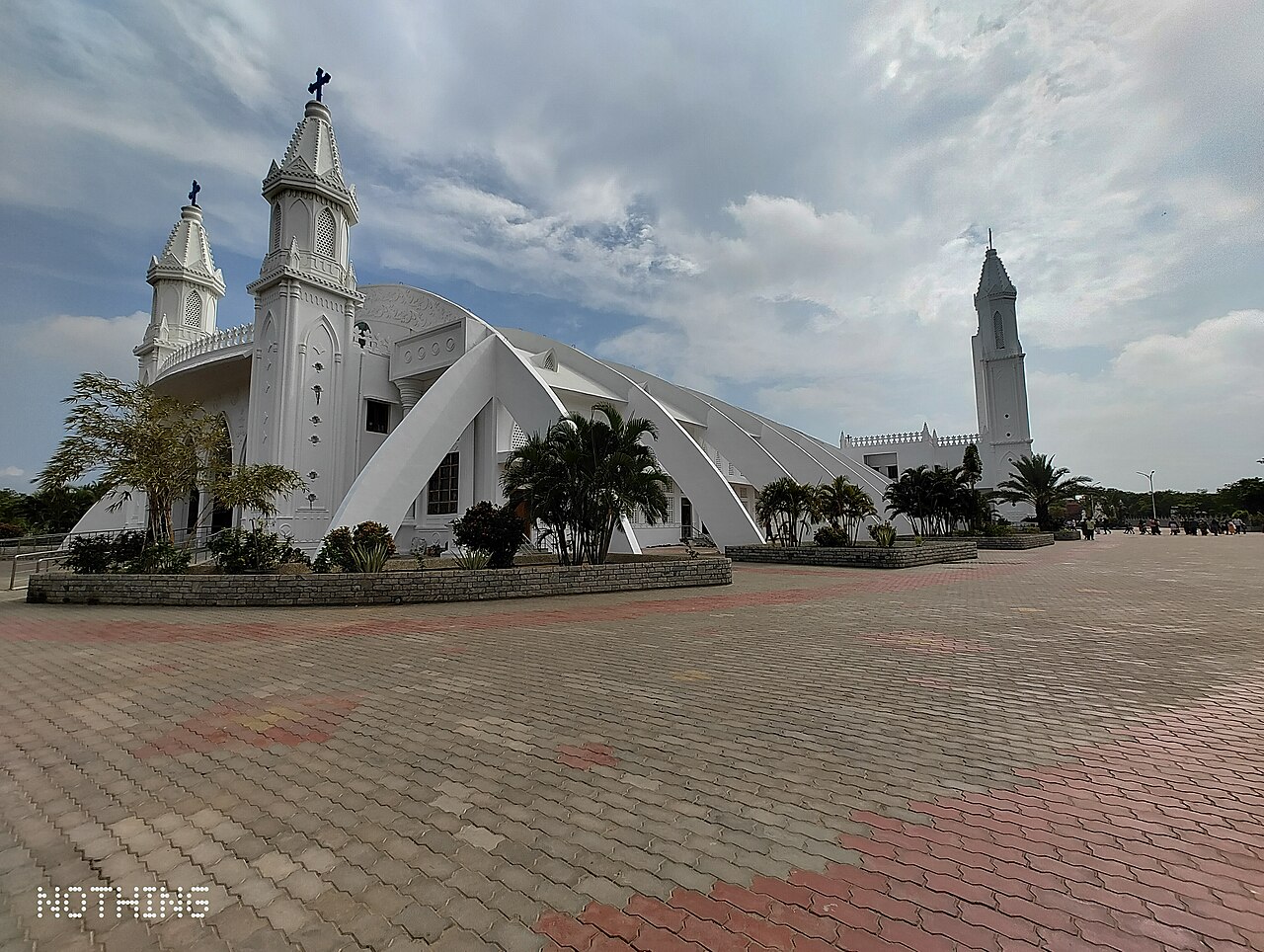
The basilica itself is hard to miss: a striking white church built in a Gothic style, with tall twin spires visible from some distance across the flat delta landscape. Inside, the object of devotion is a statue of Mary holding the infant Jesus, but dressed in a sari, a small detail that says a great deal about how deeply the shrine has been absorbed into Tamil and Indian culture rather than remaining an imported European devotion.
The origins of the shrine are traced to three episodes traditionally said to have taken place in the sixteenth and seventeenth centuries. The first is the apparition of Mary to a young shepherd boy who was carrying milk to sell, near a pond by the roadside. She is said to have asked him for milk for the infant Jesus, and the boy later found his milk pot miraculously full. The second concerns a lame buttermilk vendor boy, who was healed after Mary appeared to him and asked for buttermilk. The third, and the one most directly connected to the church building itself, involves a group of Portuguese sailors whose ship was caught in a violent storm in the Bay of Bengal. They vowed that if they survived they would build a chapel in Mary’s honour, and when they were saved and landed safely near this spot, they kept their promise, building and later expanding the church that stands here today. These three events, the apparition, the healing and the sea rescue, are why the shrine is associated so strongly with health and safety, and why it draws people seeking healing to this day.
Given its importance, the church was raised to the status of a minor basilica, one of a relatively small number of churches in India to hold that title. Within the basilica complex there is also a museum of offerings, displaying the vast array of gifts left by pilgrims over the years, from jewellery to models made of gold and silver, each one a small record of a favour asked for and, in the eyes of the giver, granted.
The pilgrimage: vows, offerings and rituals
What strikes most visitors to Velankanni, whatever their own faith, is the intensity and physicality of the devotion here. Pilgrims arrive throughout the year, not only during the big feast, and many of them are fulfilling a specific vow rather than simply visiting. It is common to see pilgrims who have shaved their heads as an act of tonsure, a tradition also seen at major Hindu shrines in South India, and others wearing plain orange robes for a period as a sign that they are keeping a vow.
The theme of good health runs through almost everything here. Ex-voto offerings, small models in gold, silver or other metals representing the part of the body that was healed or is hoped to be healed, an arm, a leg, an eye, even a heart, are left at the shrine in enormous numbers, a very old and very visual form of prayer. There is a tank or spring on the grounds associated with healing, and candles, sold everywhere around the basilica, are lit constantly, both in dedicated candle areas and outside. Many pilgrims also make a point of visiting the beach right beside the shrine, given the church’s origins in a sea rescue, and it is not unusual to see people entering the water as part of their visit.
The Feast of Our Lady of Good Health
The single biggest event in Velankanni’s calendar, and one of the largest religious gatherings anywhere in South India, is the annual Feast of Our Lady of Good Health. It runs for nine days and builds towards its climax on 8 September, the feast of the Nativity of Mary. During this period the town’s population is utterly transformed, with pilgrim numbers running into the hundreds of thousands, and on the peak days well over a million people are said to pass through.
The feast opens with a flag hoisting ceremony and builds through the following days with processions, prayers and services running almost continuously. Its centrepiece is the car, or chariot, procession, in which the statue of Our Lady is carried through the streets on a large decorated vehicle, drawn or escorted by enormous crowds. The atmosphere during these days is unlike anything else in the region: intense, crowded, noisy and, for those taking part, deeply moving. Anyone planning to be in Velankanni for the feast should be prepared for crowds on a scale that is genuinely hard to picture until you have experienced it.
The 2004 tsunami
Velankanni’s history includes one deeply painful chapter that any honest account of the town has to mention. On 26 December 2004, the Indian Ocean tsunami struck the Tamil Nadu coast, and Velankanni, being directly on the shoreline and crowded with pilgrims that day, suffered a heavy loss of life, with a great many people on or near the beach caught by the waves. It remains one of the most painful episodes associated with the shrine, and there is a memorial in the town to those who died.
What many pilgrims regard as significant is that the basilica itself, though close to the sea, was largely spared serious damage in the disaster. For a shrine whose founding legend already includes a story of protection from the sea, this has understandably taken on real meaning for many who visit. The event is remembered soberly in Velankanni rather than dwelt on, and visitors will find the town has moved on while still holding the memory with care.
The beach and the town
Velankanni beach sits directly beside the shrine complex, a wide stretch of Bay of Bengal coastline that is as much a part of the pilgrimage experience as the basilica itself, given the sea-rescue origins of the church. It is a working, well-used beach rather than a resort one, often busy with pilgrims rather than sunbathers.
The town around the basilica exists almost entirely to serve pilgrims. The streets nearest the church are lined with stalls selling candles, rosaries, small statues, framed pictures, garlands and every kind of religious article imaginable, along with the metal and wax ex-voto offerings pilgrims buy to leave at the shrine. It is a simple, unpretentious sort of place, busy and functional rather than polished, and that straightforwardness is part of its character.
An interfaith stretch of coast
One of the most striking things about Velankanni is how naturally it sits within a wider interfaith landscape. Hindus and Muslims visit the basilica in large numbers alongside Christians, often for exactly the same reasons, to give thanks for good health or to ask for it. This is not an isolated case along this part of the coast either. A short distance away is Nagore, home to the Nagore Dargah, an important Sufi Muslim shrine that likewise draws worshippers of multiple faiths, and the whole delta region is dotted with old Hindu temple towns. Further down the coast lies Karaikal, a former French enclave with its own distinct character and the notable Thirunallar temple nearby. Taken together, this stretch of the Nagapattinam coast, Velankanni, Nagore and Karaikal, forms one of the more remarkable multi-faith religious corridors anywhere in India, and it rewards travellers willing to see it as a whole rather than visiting Velankanni in isolation.
Nagapattinam itself, the district headquarters and an old port town about 12 km away, is worth a brief mention too, useful as a transport hub and as a base if Velankanni’s pilgrim accommodation is full.
A short way up the coast is the Nagore Dargah, a major Sufi shrine that, like Velankanni, draws pilgrims of every faith, and the two are easily combined.
Where to stay
Accommodation in Velankanni is built almost entirely around the pilgrimage trade. The shrine authorities themselves run pilgrim lodging, often referred to locally as matha koils or church guest houses, which are simple, affordable and geared towards large numbers of visitors rather than comfort in a conventional hotel sense. Beyond that there is a wide spread of budget lodges throughout the town, and a smaller number of mid-range hotels for those wanting more comfort.
Whatever category of stay you choose, it is worth understanding that Velankanni’s accommodation exists to absorb enormous swings in demand. Outside the feast period, finding a room is usually straightforward. During the nine-day feast in late August and early September, however, the town fills to capacity and beyond, and pilgrim lodges, budget rooms and hotels alike are booked out well in advance. If your visit falls anywhere near that period, book your accommodation as early as you possibly can.
Best time to visit
Velankanni receives pilgrims all year round, so there is no wrong time to come from a religious point of view. For a general visit, the cooler months from October to March are the most comfortable, with more manageable heat and humidity for walking around the basilica and town. The summer months are hot and humid, as is typical of this coastal stretch of Tamil Nadu, and can be tiring for visitors not used to the climate.
The one period that genuinely stands apart is the annual feast, running for nine days and climaxing on 8 September. This is the peak of the pilgrimage calendar, and also the most crowded time by a wide margin, with visitor numbers on a scale that dwarfs any other time of year. It is an extraordinary experience for those prepared for the crowds, but it is not the moment to visit if you are hoping for a quiet, unhurried look at the basilica.
Getting there
Velankanni lies roughly 310 to 330 km from Chennai, and the journey by road typically takes around six and a half to seven and a half hours depending on route and traffic. Full details of the journey, including road options and other ways to travel, are covered in our separate guide to Chennai to Velankanni.
Velankanni also has its own railway station, which functions essentially as a pilgrimage railhead, with regular services and a significant number of special trains laid on especially during the feast period to cope with the extra demand. For those flying, the nearest airport is at Tiruchirappalli (Trichy), around 160 km away, with Puducherry also sometimes used as an alternative access point. The town is well connected by bus services from across Tamil Nadu, and it lies about 12 km from Nagapattinam, the nearest sizeable town.
Tips for visiting
- Dress modestly and respectfully, particularly inside the basilica. This is an active place of worship, not a sightseeing attraction, and pilgrims of all backgrounds are expected to behave accordingly.
- If your visit coincides with the feast in late August or early September, expect exceptional crowds and book transport and accommodation as far ahead as you can.
- The beach beside the shrine can have strong currents and gets very crowded at times, so take care if you go into the water.
- Candles, rosaries and other offerings are sold at countless stalls around the basilica. Buying and offering a candle is a simple way to take part in the tradition respectfully.
- Remember that Velankanni is visited by Hindus and Muslims as well as Christians, and treat it as the shared, living place of worship that it is.
- Consider combining your visit with nearby Nagore, Nagapattinam and Karaikal to see more of this unusual interfaith stretch of coast.
Velankanni is, in the end, one of India’s most significant and genuinely moving pilgrimage places, a town that has grown up entirely around a single act of devotion and continues to welcome people of every faith who come seeking health, comfort or simply an experience of something larger than themselves. Combined with the temples, dargahs and delta towns that surround it along this stretch of the Tamil Nadu coast, it offers visitors a rare and valuable glimpse of how differently rooted faiths can share the same small stretch of shoreline.