Guide details
Best time to visit
October to March is the most comfortable period, with cooler and less humid weather for temple and dargah visits. The Kanduri Urs festival, whose dates shift each year according to the Islamic calendar, is the busiest and most crowded time to visit. Thursdays and Fridays are considered auspicious for dargah visits and draw larger crowds than other weekdays. Summer months are hot and humid, so mornings and evenings are more pleasant for a visit then.
How to get there
Nagore is roughly 300 to 320 km from Chennai, around 6.5 to 7 hours by road via the East Coast Road and NH32. Nagore has its own small railway station, and the larger Nagapattinam junction is only about 4 to 5 km away with wider rail connections. The nearest major airport is Tiruchirappalli (Trichy), with Puducherry airport also within reach. Regular buses connect Nagore with Nagapattinam, Karaikal, Thanjavur, Chennai and other Tamil Nadu towns. Velankanni is only about 10 to 12 km away, so the two are very easy to combine in a single trip.
Highlights
the dargah of Hazrat Syed Shahul Hamid, the five minarets, Peer Kulam tank, sandhanakoodu procession, Kanduri Urs festival, qawwali and devotional music, chadar and flower offerings, Nagore town and coast, interfaith pilgrimage atmosphere
Good for
pilgrims and devotees of all faiths, spiritual and heritage travellers, festival visitors during the Kanduri Urs, those combining a Tamil coast interfaith trail with Velankanni and Karaikal, culture and architecture enthusiasts
Price range
Nagore itself has simple, budget pilgrim lodges near the dargah, sufficient for an overnight stay. Many visitors instead base themselves in nearby Velankanni or Nagapattinam, both of which have a wider range of budget and mid-range hotels, and make Nagore a short day trip. Exact tariffs vary by season and should be checked locally or with the accommodation directly, especially around the Kanduri festival when rooms fill up quickly.
On the Coromandel coast of Tamil Nadu, in the quiet fishing town of Nagore in Nagapattinam district, stands one of the most important Sufi Muslim shrines in South India. The Nagore Dargah, also spelled Nagoor Dargah, is the tomb shrine of the revered saint Hazrat Syed Shahul Hamid, a spiritual figure whose memory has drawn devotees for close to five centuries. What makes Nagore especially remarkable, much like the Basilica at Velankanni a short distance down the coast, is that it is not visited by Muslims alone. Hindus and Christians come here too, in large numbers, to pray, to seek blessings, and to fulfil vows made in times of difficulty. Few sites in Tamil Nadu express the state’s shared religious culture as visibly as this one, and a visit to Nagore is as much an encounter with that living tradition as it is a piece of history or architecture.
The saint of Nagore
Hazrat Syed Shahul Hamid was a Sufi saint of the Qadiriyya order, a lineage of Islamic mysticism that traces its spiritual descent to the great saint Abdul Qadir Jilani of Baghdad. Tradition holds that Shahul Hamid was himself a descendant of this line. He is believed to have travelled widely before settling in Nagore in the sixteenth century, where he became known for his humility, his learning and, in local memory, for miracles of healing and compassion towards the sick and the suffering. Over time he came to be known by the honorific Nagore Andavar, meaning roughly “the lord of Nagore”, and by other titles such as Qadir Wali Sahib. After his death his tomb became the heart of the dargah complex that stands today, and the devotion he inspired in his lifetime has, if anything, grown stronger with the centuries.
The dargah and its architecture
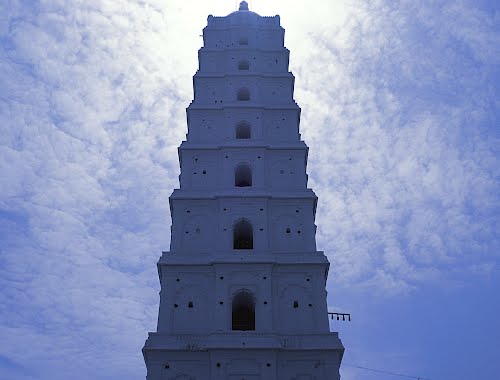
The Nagore Dargah complex has grown over generations into a substantial cluster of structures around the saint’s tomb, and its skyline is unmistakable from a distance thanks to its minarets, known locally as manaras. There are five of these towers in total, each built at different times and by different patrons, and their number and height have made the dargah a landmark visible well out to sea, historically useful to fishermen navigating the coast. What is particularly striking is that not all of these minarets were built by Muslim patrons. One of the most celebrated is said to have been constructed with the patronage of Pratap Singh, the Maratha ruler of Thanjavur, a Hindu king whose devotion to the saint led him to contribute to the shrine. Nagore has a long and well documented tradition of Hindu patronage and donation, and that shared investment in the shrine’s upkeep is part of what makes it such a powerful symbol of interfaith regard rather than mere tolerance.
Within the complex, alongside the tomb chamber itself, is the Peer Kulam, a tank used for ritual ablutions and regarded as sacred by pilgrims. The buildings around the main shrine include prayer halls and courtyards, with domes and gilded, ornately finished surfaces that catch the light, especially around the inner sanctum where the saint’s tomb is covered with rich cloth. The atmosphere inside is one of quiet intensity, a mix of devotion, murmured prayer and the scent of incense and sandalwood that pilgrims of every background seem to respond to in the same way.
Pilgrimage and everyday practice
Pilgrims come to Nagore for many reasons: to give thanks for a prayer answered, to ask for healing for themselves or a family member, to seek blessings before a marriage or a new undertaking, or simply out of long habit of devotion passed down through a family. Common offerings include chadars, the embroidered cloth palls laid over the saint’s tomb, along with flowers and sweets distributed among those present. A distinctive local tradition is the sandhanakoodu, a ceremonial procession in which sandalwood paste, prepared with elaborate ritual, is carried to the dargah as an offering, a practice with echoes in both Islamic and Hindu devotional custom. Qawwali and other devotional music is performed at the shrine on significant occasions. Some pilgrims also observe the practice of tonsure, shaving the head as an act of humility and thanksgiving, a custom more commonly associated with Hindu temples but performed here too, underlining how thoroughly the boundaries between traditions blur at Nagore.
The Kanduri Urs festival
The high point of the pilgrimage calendar at Nagore is the annual Kanduri Urs, a festival that commemorates the death anniversary of the saint, understood in Sufi tradition as his union with the divine rather than simply an occasion of mourning. Kanduri is a substantial festival, traditionally spread across roughly fourteen days, and it draws enormous crowds from across Tamil Nadu and beyond. The proceedings typically open with a flag hoisting ceremony and build through a sequence of rituals, including the sandhanakoodu procession, towards its most crowded days. Qawwali performances, devotional singing and continuous streams of pilgrims mark the festival period, and the town of Nagore itself is transformed, with stalls, lights and a palpable sense of collective celebration. Because the festival follows the Islamic lunar calendar, its dates shift from year to year, so anyone planning to attend should check the current dates locally well in advance.
An interfaith coast
Nagore does not stand alone in this respect. It sits within a genuinely remarkable stretch of the Tamil coast where different faiths have, for centuries, shared devotion, patronage and pilgrimage routes. A short distance south is Velankanni, the Christian shrine of Our Lady of Good Health, whose basilica draws pilgrims of all religions in numbers that rival any site in the country. Further along the coast is Karaikal, with its own French colonial heritage and the important Shani temple at nearby Thirunallar, along with numerous other Hindu temple towns scattered across the Cauvery delta. Taken together, this coastal belt, running through Nagapattinam district and its neighbours, forms one of the most striking examples anywhere in India of religious traditions coexisting not merely side by side but genuinely intertwined, with worshippers moving between mosque, church and temple as a matter of ordinary practice.
Nagore town and a maritime legacy
Nagore itself is a modest, unhurried town, organised almost entirely around the rhythms of the dargah and the sea. Its economy has long depended on fishing, and the fishing community remains a visible and vital part of daily life along the shore, particularly in the early morning when boats return with their catch. One especially interesting facet of Nagore’s story is its maritime reach far beyond Tamil Nadu. Tamil Muslim traders and migrants carried devotion to the saint with them across the Indian Ocean, and branches of the Nagore Dargah exist today in Singapore and in Penang, Malaysia, tangible reminders of a long history of Tamil Muslim seafaring and settlement across South East Asia.
The 2004 tsunami
It would be incomplete to write about this coast without acknowledging the Indian Ocean tsunami of December 2004, which struck Nagapattinam district with devastating force. The district was among the worst affected anywhere in India, with a heavy loss of life concentrated in its coastal fishing communities, Nagore among them. The dargah and the town have since rebuilt, and life along the coast has resumed its familiar patterns, but the tsunami remains part of the region’s recent history and is remembered soberly by local communities to this day.
Nearby places
Nagapattinam, the district headquarters, lies only a few kilometres away and is a natural base for exploring the area. Velankanni is close enough to visit in the same day, and many pilgrims combine the two shrines as a single trip. Karaikal, with its distinctive French quarter and the Thirunallar temple, is a little further but easily reached. The temple town of Sikkal and other delta shrines are also within a manageable radius, making this stretch of coast well suited to a longer, unhurried exploration.
Where to stay
Nagore itself offers simple, no frills pilgrim lodges close to the dargah, adequate for those who want to stay near the shrine, particularly if attending the Kanduri festival or an early morning prayer. Many visitors, however, choose to base themselves in Velankanni or Nagapattinam, both of which have a broader spread of budget and mid range hotels, and treat Nagore as a focused day visit. Karaikal is another reasonable base if combining the trip with a wider look at the delta. It is worth booking ahead during the Kanduri period, when accommodation across the area fills quickly.
Best time to visit
The cooler months from October to March make for the most comfortable visit, avoiding the heavy heat and humidity of the Tamil Nadu summer. The single busiest time is the Kanduri Urs festival itself, when the dargah and the town are at their most crowded and most atmospheric, though visitors who prefer a quieter experience may wish to avoid it. Thursdays and Fridays are traditionally considered auspicious days for dargah visits generally and tend to be busier than midweek days even outside the festival season.
Getting there
Nagore lies roughly 300 to 320 km from Chennai, a road journey of around 6.5 to 7 hours along the East Coast Road and connecting highways. The town has its own railway station, with the larger Nagapattinam junction just 4 to 5 km away offering broader rail links. Tiruchirappalli, commonly known as Trichy, has the nearest major airport, with Puducherry also a workable alternative. Regular bus services connect Nagore to Nagapattinam, Karaikal, Thanjavur and Chennai, and given that Velankanni is only 10 to 12 km away, the two sites are very easily combined in one journey.
Practical tips for visiting
- Dress modestly and respectfully; covering the head is appropriate at the shrine, as at many dargahs, and simple, modest clothing is advisable for all visitors.
- Footwear must be removed before entering the shrine areas, as is customary at dargahs across India.
- The dargah welcomes people of every faith, but it remains an active place of worship, so visitors should behave with the same quiet respect they would show at any working religious site.
- Stalls near the entrance sell chadars, flowers and other offerings for those who wish to make one.
- Expect very large crowds during the Kanduri Urs festival and on Thursdays and Fridays; plan timings accordingly and be prepared for queues.
- Consider combining the visit with the wider delta towns for a fuller sense of this coast’s shared religious heritage.
Nagore Dargah stands today as one of South India’s great Sufi shrines, a place where five centuries of devotion have left their mark on the coastline in stone, in ritual and in the quiet daily presence of pilgrims from every community. It is, in the end, less a monument to visit than a living act of faith to witness respectfully, set within a remarkable stretch of the Tamil coast where mosque, church and temple continue, side by side, to draw pilgrims of every faith.