Guide details
Best time to visit
October to March, when the weather is cooler and more comfortable for temple visits and walking around the city. April to June is very hot and better avoided for extended sightseeing.
How to get there
Thanjavur is around 320 to 350 km from Chennai, about 6 to 7 hours by road. It is a major railway junction with regular trains from Chennai and other cities. The nearest airport is at Tiruchirappalli (Trichy), roughly 55 to 60 km away.
Highlights
Brihadeeswarar Temple (Big Temple), Thanjavur Maratha Palace, Saraswathi Mahal Library, Tanjore painting workshops, Schwartz Church, Sivaganga Park, day trips to Gangaikonda Cholapuram, Darasuram and Kumbakonam
Good for
History and architecture enthusiasts, temple and heritage travellers, art and classical music lovers, families on a Tamil Nadu cultural circuit, and travellers using it as a base to explore the Cauvery delta
Price range
Thanjavur is generally an affordable place to visit. Budget lodges near the bus stand and railway station are the cheapest option, mid range hotels offer more comfort, and a small number of heritage and upscale hotels sit at the top end. Food, local transport and most sightseeing are inexpensive, though a few sights may involve small entry or camera charges.
Thanjavur, still widely known by its older name Tanjore, is one of the few Indian cities where a visitor can genuinely stand inside a thousand-year-old empire’s capital and feel the weight of it. This was the seat of the medieval Chola dynasty, the power that built temples across South India, sent naval expeditions overseas and turned the Cauvery delta into one of the richest agricultural tracts on the subcontinent. Today Thanjavur is a UNESCO World Heritage city built around the Great Living Chola Temples, and it remains the cradle of Tamil temple architecture, bronze casting, classical painting and Carnatic music. It sits in the heart of the fertile Cauvery (Kaveri) delta, long called the rice bowl of Tamil Nadu, surrounded by paddy fields, canals and a dense cluster of ancient temple towns.
For anyone travelling through Tamil Nadu with an interest in history, art or architecture, Thanjavur is close to essential. It is compact enough to explore comfortably over a day or two, yet rich enough to reward a longer stay, especially if it is used as a base for exploring the wider delta.
Two of the town’s glories have guides of their own: the Brihadeeswarar Temple, the great Chola masterpiece, and Tanjore painting, the classic gold-leaf art born here.
Brihadeeswarar Temple, the Big Temple
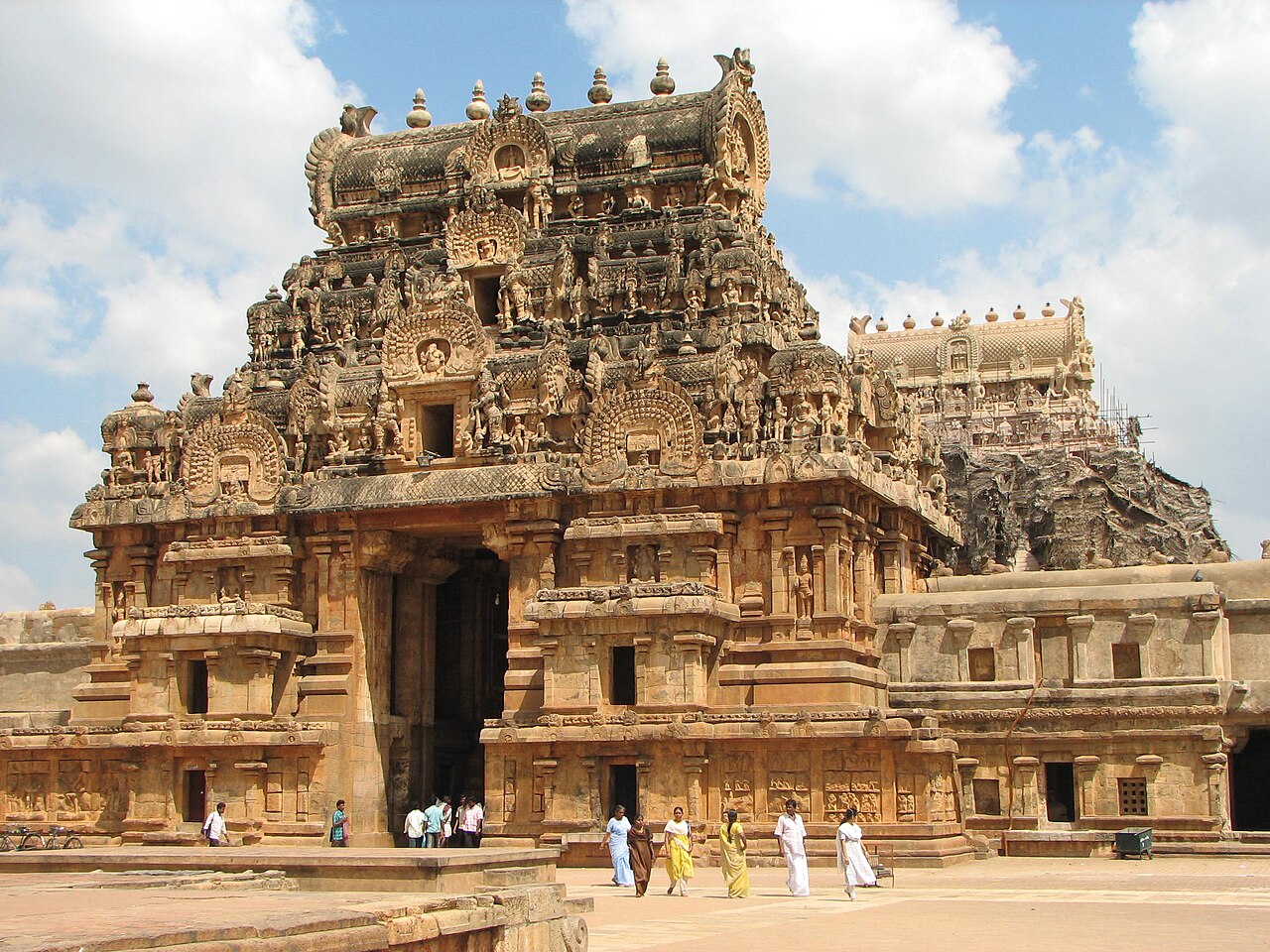
Everything in Thanjavur radiates outward from the Brihadeeswarar Temple, also known as the Big Temple, Peruvudaiyar Kovil or Rajarajeswaram. It was built by the Chola emperor Rajaraja I around 1010 CE and has stood, remarkably intact, for over a thousand years. The temple is dedicated to Shiva and remains an active place of worship, not a museum piece, which is part of what makes a visit here feel alive rather than purely academic.
The temple’s defining feature is its vimana, the pyramidal tower rising above the main sanctum, which reaches roughly 66 metres and is among the tallest of its kind anywhere in India. It is topped by a single monolithic capstone, an engineering feat that still puzzles visitors given the weight involved and the construction methods available a thousand years ago. The entire structure is built of granite, quarried and transported from some distance away, then carved with inscriptions, sculpture and painted panels that have survived monsoons, wars and centuries of change. In the temple courtyard sits a huge monolithic Nandi, the bull that serves as Shiva’s mount, itself an imposing carved mass of stone. The scale of the whole complex, the precision of the carving and the sheer ambition of the project explain why it was one of the first sites in India to be inscribed as a UNESCO World Heritage Site.
The Great Living Chola Temples
Brihadeeswarar Temple is the centrepiece of a UNESCO group known collectively as the Great Living Chola Temples, which also includes the temple at Gangaikonda Cholapuram, built a little later by Rajaraja’s son Rajendra I, and the Airavatesvara temple at Darasuram, near Kumbakonam. Together the three sites trace the evolution of Chola temple architecture over roughly a century, from the monumental confidence of Thanjavur through the refined detailing seen at Darasuram. Visiting all three in one trip gives a fuller sense of how Chola builders developed their craft, and Thanjavur is the natural starting point and base for reaching the other two.
Thanjavur Maratha Palace
A short distance from the Big Temple stands the Thanjavur Maratha Palace, a sprawling complex begun under the Nayak rulers and later expanded by the Marathas who governed Thanjavur from the seventeenth century onward. The palace is less about a single dramatic structure and more about a layered campus of halls, courtyards and towers that together tell the story of the city’s later royal history.
The Durbar Hall, once used for royal audiences, retains a sense of faded grandeur with its painted ceilings and formal proportions. Within the same complex is the Saraswathi Mahal Library, one of the oldest libraries in Asia, holding a remarkable collection of palm leaf manuscripts and rare texts covering subjects from medicine to music. The palace’s Art Gallery is one of the best places in India to see Chola era bronze and stone sculpture up close, including exquisite bronze images of Nataraja and other deities cast using the lost wax method the Cholas perfected. Rising above the complex is the bell tower, sometimes called Sarjah Madi, which offers views out over the old town and its rooftops.
Tanjore Painting and the Arts
Thanjavur gave its name to one of India’s most recognisable devotional art forms, the Tanjore painting. These are richly coloured works, typically depicting Hindu deities, built up with gesso relief work, gold leaf and inset gemstones or glass, producing a distinctive glowing, almost jewelled surface. The style developed under Nayak and Maratha patronage and continues to be practised by artist families in the town today. Visitors can watch the painstaking process in small workshops and studios around the city and buy original works or reproductions directly from the artists, which is generally a better experience than buying from generic tourist shops.
Alongside painting, Thanjavur is known for its metal art plates, decorative repousse work in copper and bronze depicting deities, flora and courtly scenes, often given as gifts or used in home shrines. Both crafts make for genuinely local souvenirs, rooted in techniques passed down for generations rather than mass produced elsewhere.
Carnatic Music, Veena and Bharatanatyam
Thanjavur’s cultural importance extends well beyond visual art. The city was a major centre of Carnatic classical music, home to the Thanjavur Quartet, four brothers whose compositions and choreography shaped the codified form of bharatanatyam still taught today. The Thanjavur veena, a stringed instrument central to Carnatic music, is made here using traditional methods and carries a Geographical Indication tag recognising its craftsmanship. Even a short walk through the older parts of town can turn up workshops where veenas are still built by hand, and the city’s temples and cultural institutions continue to host music and dance events, particularly during festival season.
The Cauvery Delta and Nearby Temple Towns
Thanjavur sits at the centre of a delta so fertile it has been called the rice bowl of Tamil Nadu since Chola times, when the dynasty invested heavily in irrigation tanks and canal systems that are still in use. This agricultural wealth funded the temple building that makes the region so remarkable today, and it also means the countryside around Thanjavur is green, well watered and dotted with smaller shrines, tanks and villages worth a detour.
Within easy reach are Gangaikonda Cholapuram, the former Chola capital with its own grand temple, and Darasuram, home to the Airavatesvara temple. A little further on is Kumbakonam, a temple town with its own dense concentration of shrines and a lively local atmosphere, and nearby Swamimalai, known for traditional bronze icon casting using the same lost wax technique seen in the Chola era sculptures at Thanjavur’s palace museum. Thiruvaiyaru, on the banks of the Cauvery, is famous as the site of the annual Thyagaraja Aradhana, a major Carnatic music festival honouring the composer Thyagaraja. Together these towns form a natural extension of a Thanjavur visit, ideal for a two to three day loop through the delta.
Food and Filter Coffee
Thanjavur’s food reflects its delta setting, with rice at the centre of most meals. Classic Tamil vegetarian thalis, dosas, idlis and a range of local specialities are widely available, often served on banana leaf in traditional eateries around the temple and market areas. As with much of Tamil Nadu, filter coffee is close to a local institution here, and the delta towns take real pride in their version of it, sometimes referred to as degree coffee, a nod to older methods of testing the milk’s richness. Sitting down to a strong filter coffee after a morning at the Big Temple is very much part of the Thanjavur experience. Local sweets are also worth seeking out from the town’s older shops.
Schwartz Church and Sivaganga Park
Not far from the temple and palace complex stands Schwartz Church, built in memory of the missionary Reverend Christian Friedrich Schwartz, who served the Thanjavur court in the eighteenth century. It is a quieter, more low key stop, but a useful reminder of the many layers of history that have passed through this city. Nearby, Sivaganga Park and the tank around which it is built offer a green, relaxed space to rest between sightseeing stops, particularly welcome given how much walking a full temple and palace visit involves.
Where to Stay
Accommodation in Thanjavur covers a wide range. Budget lodges cluster around the bus stand and railway station area, convenient for travellers moving on quickly or watching costs closely. A good number of mid range hotels offer more comfortable rooms with modern amenities, and are generally the most practical choice for most visitors. A smaller number of heritage properties and upscale hotels round out the top end, some trading on colonial or palace era character. Because the city is compact, most accommodation is within easy reach of the main sights, and Thanjavur works well as a comfortable base for day trips into the surrounding delta temple towns.
Best Time to Visit
The most pleasant months to visit are October to March, when temperatures are cooler and walking around the Big Temple complex or the palace grounds is far more comfortable. Summer, roughly April to June, brings intense heat that can make midday sightseeing genuinely uncomfortable, particularly on the stone courtyards around the temple. Whatever the season, it is worth planning temple visits for early morning or late afternoon to avoid the harshest sun, and to keep in mind that both the Big Temple and other shrines expect modest dress and bare feet inside the premises.
Getting There
Thanjavur is roughly 320 to 350 km from Chennai, a journey of about 6 to 7 hours by road. For a fuller breakdown of routes, driving time and transport options, see this guide to travelling from Chennai to Thanjavur. The city is also a major railway junction, well connected by regular trains from Chennai and other parts of Tamil Nadu, which makes the train a genuinely comfortable alternative to driving. For those flying in, the nearest airport is at Tiruchirappalli, commonly known as Trichy, about 55 to 60 km away, with onward road connections into Thanjavur. Given its central position in the delta, Thanjavur makes an excellent base for a two to three day trip covering the wider network of temple towns.
Practical Tips
- Dress modestly for temple visits and be ready to remove footwear before entering; carrying a small bag for shoes helps.
- Photography rules vary by sanctum and site, so check locally before photographing deities or interiors.
- Start early in the day to avoid both crowds and the worst of the heat, especially on the stone courtyards.
- Allow a full day to properly cover the Big Temple and the Maratha Palace complex together, rather than rushing both.
- Combine Thanjavur with Darasuram and Kumbakonam for a fuller picture of Chola era temple architecture.
- Carry water, especially between March and June, and pace sightseeing around the midday heat.
- Remember that Brihadeeswarar Temple and most other sites here are active places of worship, not open air museums, so a respectful approach goes a long way.
Thanjavur rewards anyone with an interest in history, temple architecture, classical art or music with a depth that few Indian cities can match. It is, quite simply, the single best place to understand what the Chola empire built and why its legacy still shapes Tamil culture today.