Guide details
Best time to visit
November to February, early mornings or early evenings when the temples are cool and busy with worship.
How to get there
Most temples sit in central or coastal neighbourhoods reachable by bus, metro, autorickshaw or a short taxi ride.
Highlights
Kapaleeshwarar Temple, Parthasarathy Temple, Vadapalani Murugan Temple, Ashtalakshmi Temple, ISKCON ECR, Marundeeswarar Temple
Good for
first time visitors, culture and heritage lovers, photographers of architecture, families, solo travellers, anyone interested in Chennai’s religious mix
Price range
Almost all temples are free to enter. Carry small change, roughly Rs 10 to Rs 100, for offerings, special darshan queues or shoe minding.
Chennai is a temple city in the plainest sense of the phrase. Its temples are not tucked away as monuments to look at from behind a rope. They are working places of worship, woven into the daily rhythm of the neighbourhoods around them, with flower sellers at the gates, bells ringing at dusk and families arriving in their best clothes. Some are more than a thousand years old. Others were built in living memory. Together they tell you more about the character of the city than almost anything else.
You do not need to be religious to find them worth your time, but it helps to visit them on their own terms. Go early or late rather than in the flat heat of the afternoon, move slowly, and follow what everyone around you is doing. Below we have gathered the temples we think are most worth your while, whether you have a single free morning or several days to wander. A few practical basics apply to all of them, and we have set those out at the end.
Kapaleeshwarar Temple
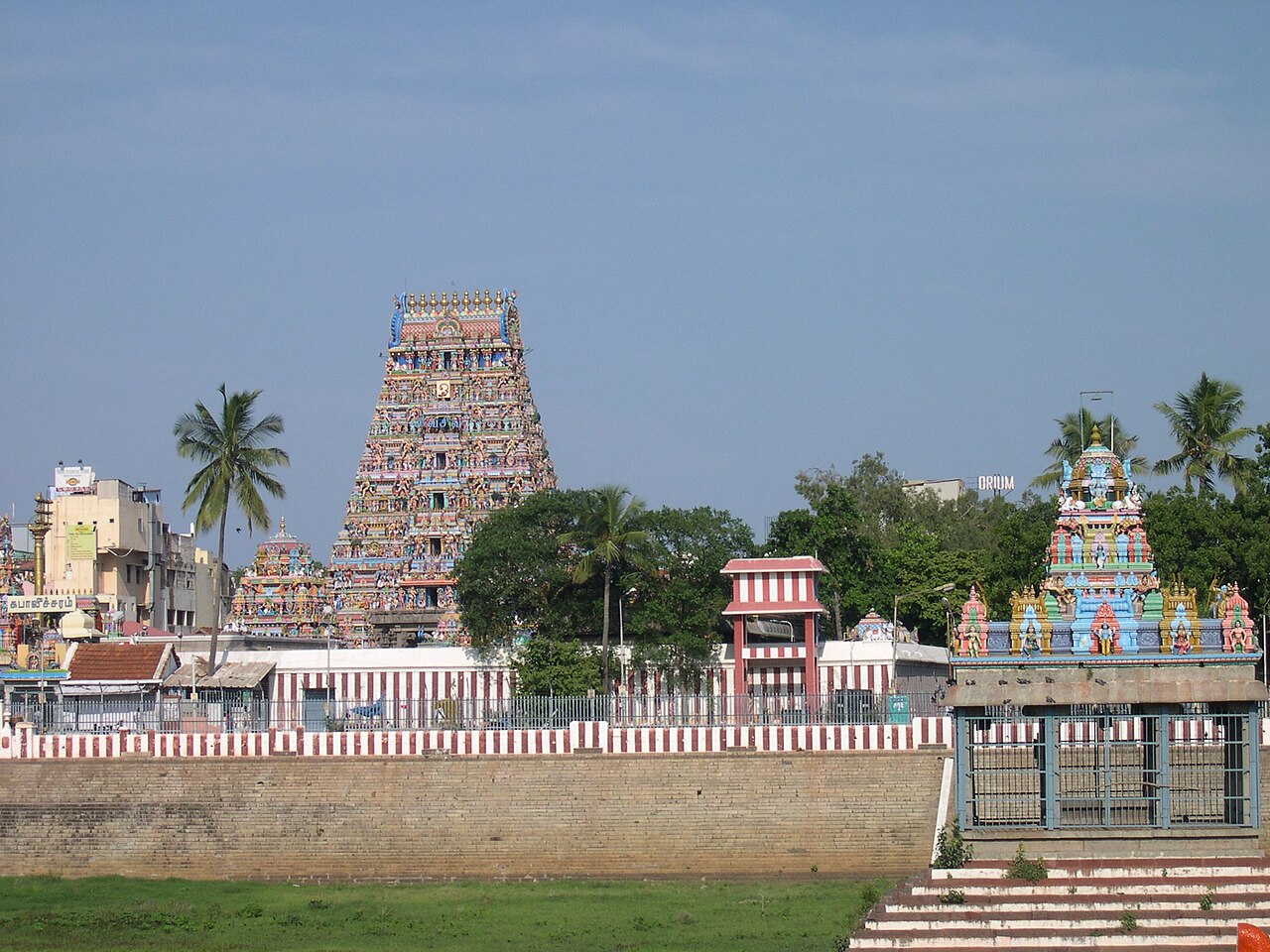
If you visit only one temple in Chennai, most people would point you here. Kapaleeshwarar is the classic Dravidian Shiva temple, dedicated to Shiva in his form as Kapaleeshwarar and to his consort Karpagambal. It sits in Mylapore, one of the oldest parts of the city, and its towering gopuram, painted in dense tiers of figures, rises above the surrounding streets and the temple tank. The present structure is generally dated to around the sixteenth or seventeenth century, though worship on the site is far older.
It is busy, colourful and completely alive, especially around the Panguni festival in spring, when the temple deities are carried through Mylapore in a huge procession. The area around it, with its market, silk shops and coffee houses, rewards a wander of its own. It suits absolutely everyone, from first time visitors to anyone who wants to understand what a South Indian temple town feels like. We have a full guide to Kapaleeshwarar if you want the detail.
Parthasarathy Temple
A short distance north in Triplicane, the Parthasarathy Temple is one of the oldest in the city and a very different mood from Kapaleeshwarar. It is a Vaishnavite temple, dedicated to Vishnu, and its name comes from Krishna in his role as Parthasarathy, the charioteer of Arjuna in the Mahabharata. Parts of the temple trace back to Pallava times, well over a thousand years ago, which makes it a rare survival in a fast changing city.
The atmosphere is quieter and more devotional than the big showpiece temples, with worn stone pillars and a strong sense of continuity. It suits travellers interested in history and in the Vaishnavite tradition, and anyone who wants a temple that feels lived in rather than staged. A full guide to Parthasarathy Temple is available if you want to go deeper.
Vadapalani Murugan Temple
Vadapalani, in the west of the city, is one of Chennai’s largest and most popular temples, dedicated to Murugan, the much loved Tamil god of war and wisdom. It draws enormous crowds, and it is especially known as a wedding temple. On auspicious days you may see dozens of marriages taking place, and the mood is celebratory rather than solemn.
The temple is comparatively modern, having grown from a small nineteenth century shrine into the large complex you see today, and it is one of the easier temples to reach on the metro. It suits anyone curious about Tamil devotional life at full volume, and travellers who do not mind crowds. We have a dedicated guide to Vadapalani if you are planning a visit around a festival or a wedding season.
Ashtalakshmi Temple
Out at Besant Nagar, right beside Elliot’s Beach, the Ashtalakshmi Temple is one of the most photogenic in the city. It is dedicated to the eight forms of Lakshmi, the goddess of wealth and wellbeing, and the eight are spread across a multi storey structure so that you climb and descend through the different shrines. Built in the 1970s, it is modern by Chennai standards, but its setting is hard to beat, with the Bay of Bengal directly behind it.
The sea breeze, the open upper levels and the relative calm make it a gentle temple to visit, particularly in the early evening. It suits families, first time visitors and anyone who wants to pair a temple with a walk on the beach and a snack from the stalls nearby. A full guide to Ashtalakshmi Temple is available.
ISKCON Temple, ECR
Along the East Coast Road heading south of the city, the ISKCON temple is a modern Radha Krishna temple run by the international Hare Krishna movement. It is clean, calm and well organised, with landscaped grounds, and it makes an easy stop on a drive down the coast towards Mahabalipuram. Evening aarti, with its singing and music, is the moment most visitors aim for.
Because it is used to receiving visitors from all backgrounds, it is one of the more approachable temples if you are new to the tradition and unsure what to do. It suits travellers already heading down the ECR, families, and anyone who prefers a quieter, more contemplative setting. We have a full guide to the ISKCON temple as well.
Marundeeswarar Temple
In Thiruvanmiyur, in the south of the city, the Marundeeswarar Temple is an old Shiva temple with a long history and a particular association with healing. The name links to the idea of Shiva as a giver of medicine, and the temple has traditionally been visited by people praying for health and recovery. Its origins are ancient, with expansions under the Chola kings, and it carries the weathered dignity of a temple that has stood for centuries.
It sees fewer overseas visitors than the headline temples, which is part of its appeal. It suits travellers who want an older, less crowded temple and are staying towards the southern beaches and IT corridor. Being close to the coast, it pairs naturally with Thiruvanmiyur beach.
Thousand Lights and Chennai’s wider religious mix
Beyond the big names, Chennai rewards anyone who simply keeps their eyes open. The Thousand Lights area, named after a historic mosque, sits in the heart of the city and is a reminder that Chennai’s spiritual life is not only Hindu. Mylapore itself repays a slow half day, with smaller shrines, the temple tank and the surrounding streets all part of the experience.
For a sense of the full picture, two other places are worth knowing. The Sri Ramakrishna Math, a peaceful ashram with well kept gardens, offers a calmer, more reflective kind of visit that is welcoming to everyone. And the San Thome Basilica, near the Mylapore shore, is a Roman Catholic church rather than a temple, built over what is believed to be the tomb of the apostle Thomas. We include it here purely for context, because Chennai’s religious variety, Hindu temples alongside old churches and mosques, is a real part of the city. A full guide to San Thome is available if the history draws you in.
Temple etiquette in Chennai
The basics are simple and apply almost everywhere. A little awareness goes a long way.
- Dress modestly. Cover your shoulders and knees. Light, loose clothing is comfortable and appropriate for men and women alike.
- Remove your footwear. You leave shoes at the entrance, often with a minder for a rupee or two. Socks can help on stone that gets very hot by midday.
- Time it well. Mornings and evenings are best, both for the cooler air and because that is when the temples are at their most active. Many close for a few hours in the middle of the day.
- Ask before photographing. Photography is often restricted or forbidden inside, especially near the inner sanctum. Look for signs and follow them.
- Mind access rules. Some inner sanctums may be limited to Hindus. This varies by temple, so watch what others do and do not push past a barrier.
- Carry small cash. Keep a little change for offerings, flowers, camera or shoe fees and special darshan queues. Many temples take only cash for these.
Best time to visit
Chennai is hot for most of the year, so the cooler months from November to February are the most comfortable time to be out and about, and they also coincide with the city’s music and dance season. Whatever the month, aim for early morning or early evening. That is when the light is kind, the stone is cool underfoot and the temples come to life with worship, bells and music.
Festival times are extraordinary but crowded. Panguni at Kapaleeshwarar in spring, and the wedding seasons at Vadapalani, are worth planning around if you want the full spectacle, though you should expect long queues and dense crowds. If you prefer a calmer visit, a weekday morning outside festival dates is ideal.
You could spend a lifetime in Chennai and not see every temple, and that is rather the point. Pick two or three that suit your interests and your part of the city, go with time to spare, and let the pace of the place carry you. Done that way, the temples stop being a checklist and become the best window you will find into how this old, warm, unhurried city actually lives.
Keep exploring Chennai
- Kapaleeshwarar Temple Guide: History, Timings and the Mylapore Neighbourhood
- Parthasarathy Temple Chennai: History & Visitor Guide
- Vadapalani Murugan Temple, Chennai: Timings, Weddings and Visitor Guide
- Ashtalakshmi Temple, Chennai: A Seaside Guide to the Besant Nagar Kovil
- ISKCON Temple Chennai: Timings, Aarti and ECR Visitor Guide
- San Thome Basilica Chennai: History and Visitor Guide