Guide details
Best time to visit
October to March is the most comfortable period, with cooler weather across the Cauvery delta. Sundays are busier due to their association with the Sun, and the Ratha Saptami festival in January or February is a particularly significant time to visit, though it draws larger crowds. Summers from April onward can be very hot.
How to get there
Suryanar Kovil is roughly 290 to 310 km from Chennai, about 6 to 6.5 hours by road. It is around 15 km from Kumbakonam, which is the practical base and has its own railway station. The nearest airport is Tiruchirappalli (Trichy), about 90 km away. Most visitors travel by car or auto from Kumbakonam.
Highlights
Nine Navagraha shrines under one roof, Chola-era Surya sanctum, Surya Pushkarni temple tank, historic gopuram and inscriptions, Ratha Saptami festival, starting point of the Navagraha circuit
Good for
Temple and heritage visitors, pilgrims following the Navagraha circuit, those interested in Chola-era architecture, travellers combining a trip with Kumbakonam and the delta temples
Price range
Suryanar Kovil is a small temple village with very limited facilities. Most visitors stay in nearby Kumbakonam, which has hotels and lodges across a range of budgets. Check locally for current temple timings and any fees.
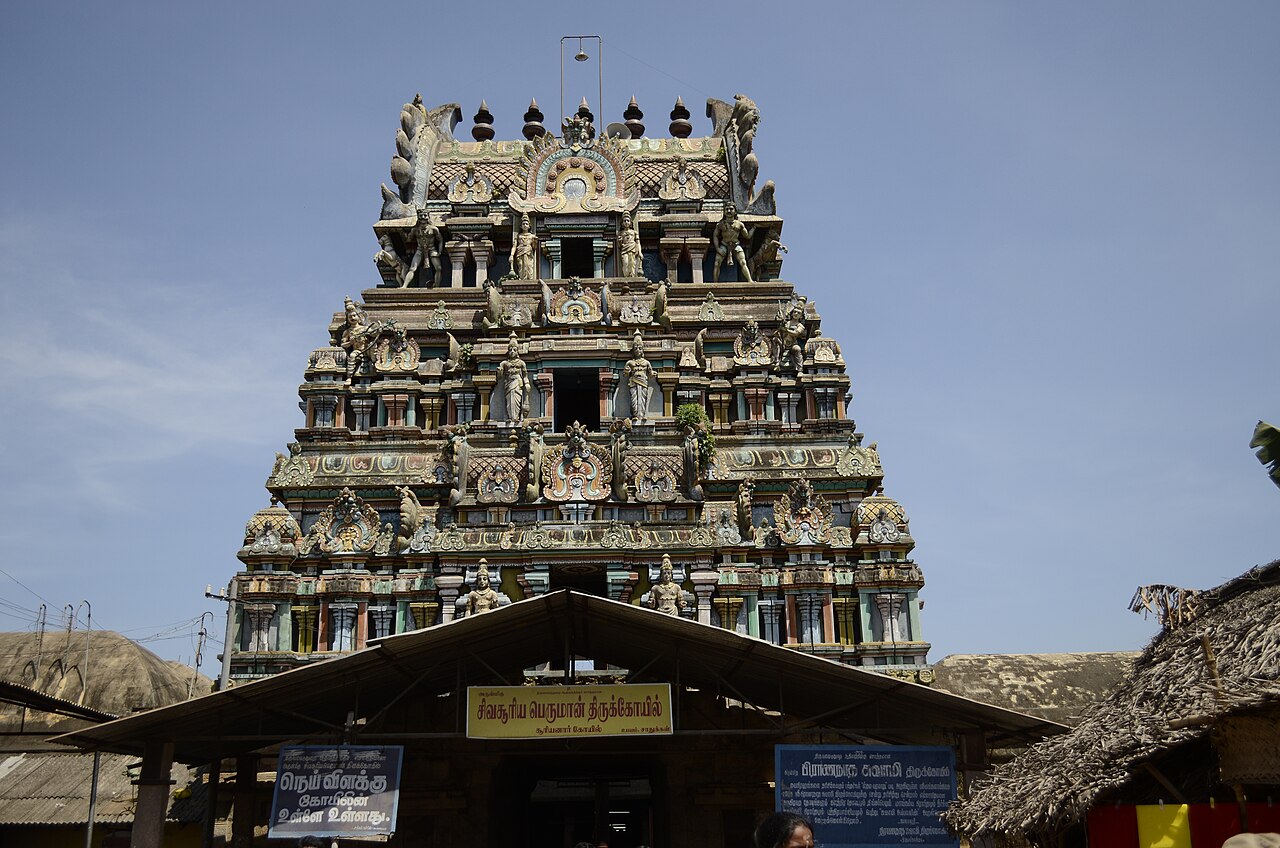
Suryanar Kovil, also known as Suryanar Temple, sits in a small temple village about 15 km from Kumbakonam, close to Aduthurai, in the fertile Cauvery delta of Tamil Nadu. It is dedicated to Surya, the Sun God, who is worshipped here not as a minor figure attached to a larger shrine but as the principal deity of the temple itself. That makes Suryanar Kovil genuinely unusual. Temples built specifically for Surya are rare across India, the most famous being the great Sun Temple at Konark in Odisha, and dedicated Surya shrines of this scale are hard to find further south. Suryanar Kovil is the Sun temple among the nine Navagraha temples of the Cauvery delta, a set of shrines each linked to one of the nine celestial bodies of traditional Hindu astrology. Tradition and temple inscriptions place its construction in the later Chola period, roughly the 11th to 12th century, with patronage often associated with rulers such as Kulottunga Chola I.
A Chola-era temple built around the sun
Like much of the temple architecture scattered across the Kumbakonam region, Suryanar Kovil reflects the confidence and craftsmanship of the later Chola period. The temple has a gopuram at its entrance, a walled enclosure, and a temple tank known as Surya Pushkarni or Surya theertham, used traditionally for ritual bathing before darshan. Inscriptions on the temple walls record grants and endowments from the Chola era, evidence of sustained royal and local patronage over centuries. The stonework, though on a modest scale compared with some of the larger Chola temples nearby, has a distinct dignity, understated rather than showy, in keeping with a temple built for quiet, disciplined worship rather than grand spectacle.
The one place where all nine grahas stand together
What sets Suryanar Kovil apart from the other eight Navagraha temples is its layout. Elsewhere in the circuit, each temple is dedicated to a single graha, with the others appearing only as minor subsidiary images if at all. At Suryanar Kovil, uniquely, all nine planetary deities, Surya, Chandra (Moon), Angaraka (Mars), Budha (Mercury), Guru (Jupiter), Sukra (Venus), Sani (Saturn), Rahu and Ketu, are enshrined together, each in its own small sub-shrine arranged around the main sanctum of Surya. Pilgrims can therefore pay respects to all nine grahas within a single visit, even though the fuller tradition still calls for travelling to each of the nine individual temples across the delta. This is why many people treat Suryanar Kovil as the natural starting point of a Navagraha pilgrimage, offering prayers here first before setting out to the remaining temples, or, for those short on time, treating a visit here as a condensed version of the full circuit.
Surya, his consorts and the temple layout
The presiding deity, Sri Suryanar, is depicted with his two consorts, Usha Devi and Pratyusha Devi (also referred to as Chaya), representing the dawn and dusk aspects of the sun’s daily journey. A form of Shiva is also present within the temple complex, as is customary in Tamil Nadu, where Navagraha worship is generally folded into the wider Shaiva temple tradition rather than standing apart from it, along with a goddess shrine. The nine planetary sub-shrines are arranged in a defined sequence around the main sanctum, and pilgrims typically circumambulate them in a set order as part of their visit. The overall effect, of nine small shrines gathered quietly around a Chola-era Sun sanctum, gives the temple a compact, contemplative atmosphere quite different from the sprawl of some larger Tamil Nadu temples.
Worship, belief and the idea of parihara
Within Hindu astrological tradition, Surya is associated with vitality, health, authority, leadership, self-confidence and eyesight, and is considered one of the most influential of the nine grahas in a person’s horoscope. Devotees who believe their horoscope shows Surya placed unfavourably, or who simply wish to seek the Sun’s blessings for these areas of life, come to Suryanar Kovil to perform prayers and rituals believed to ease such influences, a practice generally called parihara. This is best understood as a matter of personal faith and long-standing custom rather than a claim that can be verified, and visitors of all backgrounds are welcome to observe the temple’s atmosphere and architecture regardless of what they believe about astrology. Sundays, associated with the Sun in Hindu tradition, tend to see larger crowds of devotees. The festival of Ratha Saptami, which usually falls in January or February and marks the sun’s northward turn, is one of the temple’s most significant occasions, drawing pilgrims from across the region for special rituals and processions.
Suryanar Kovil and the Navagraha circuit
Because it is both the Sun temple and the only one of the nine to house all the grahas together, Suryanar Kovil is often treated as the first stop on a tour of the Navagraha temples of the Cauvery delta. From here, pilgrims typically move on to nearby shrines such as Thirunageswaram, associated with Rahu, and Kanjanur, associated with Venus, along with the remaining temples spread across villages within a couple of hours’ drive of Kumbakonam. Travelling the full circuit in a single day is possible with an early start and a hired car or auto, though many visitors prefer to spread it across two days, based out of Kumbakonam, to avoid rushing between shrines during the hottest part of the day.
Getting there
Suryanar Kovil lies roughly 290 to 310 km from Chennai, a road journey of around 6 to 6.5 hours depending on traffic and the route taken through the delta towns. Most visitors approach it from Kumbakonam, which is only about 15 km away and serves as the practical base for the area, with its own railway station and reasonable connectivity to major Tamil Nadu cities. The nearest airport is at Tiruchirappalli (Trichy), roughly 90 km away, which has domestic flight connections. From Kumbakonam, Suryanar Kovil is usually visited by car or auto-rickshaw, either as a standalone trip or combined with the other Navagraha temples in the same outing.
Where to stay and eat
Suryanar Kovil itself is a small temple village with limited facilities, so almost all visitors choose to stay in Kumbakonam, which has a good range of hotels and lodges to suit different budgets, and use it as a base for day trips to the temple and the wider Navagraha circuit. Food options near the temple are simple, with small local eateries serving traditional South Indian meals, idli, dosa and filter coffee. For a wider choice of restaurants, Kumbakonam is the better option, and most pilgrims plan their meals around their base there rather than at the temple village itself.
Best time to visit
The cooler months from October to March are generally the most comfortable time to visit, as the Cauvery delta can get uncomfortably hot in the summer months. Sundays tend to be busier than weekdays given the association with the Sun, so visitors seeking a quieter experience may prefer another day of the week. The Ratha Saptami festival, usually held in January or February, is a particularly significant time to visit for those interested in seeing the temple at its most active, though it also means larger crowds and longer waits for darshan.
A few practical tips
- Since all nine planetary shrines are here, many pilgrims begin their Navagraha circuit at Suryanar Kovil before visiting the other eight temples individually.
- Standard South Indian temple dress codes generally apply, and footwear is left outside before entering the temple premises.
- Expect larger crowds on Sundays and during the Ratha Saptami festival period.
- It pairs naturally with a Kumbakonam base and a wider tour of the delta’s Chola temples.
- Whatever one’s personal view of astrology, it is worth approaching the temple’s rituals and beliefs as a living tradition rather than judging them by outside standards.
Suryanar Kovil is one of a small number of temples in India built specifically for the worship of the Sun, and the only one of the nine Navagraha temples where all nine planetary deities share a single sanctum. That combination, a Chola-era temple of genuine architectural interest and the natural starting point for a wider pilgrimage, makes it an easy and rewarding stop for anyone spending a few days around Kumbakonam. Quiet, unhurried and steeped in centuries of tradition, it offers visitors a chance to see a distinctive corner of Tamil Nadu’s temple heritage that many travellers to the region never get around to visiting.