Guide details
Best time to visit
October to March is the most comfortable period for a multi-day circuit, avoiding the summer heat. Each temple also has its own significant day, such as Saturdays for the Saturn temple and Tuesdays for the Mars temple. Shani peyarchi periods bring very large crowds to Thirunallar, so expect longer queues if your visit falls during one.
How to get there
The Cauvery delta region is roughly 280 to 340 km from Chennai, about 5.5 to 7 hours by road. Most visitors base themselves in Kumbakonam, Mayiladuthurai or Thanjavur. The nearest airport is at Tiruchirappalli (Trichy), and the region is also well connected by rail and long-distance bus. The nine temples lie close together within the delta and are best covered by hired car over 2 to 3 days.
Highlights
Suryanar Kovil (Sun), Thingalur (Moon), Vaitheeswaran Koil (Mars), Thiruvenkadu (Mercury), Alangudi (Jupiter), Kanjanur (Venus), Thirunallar (Saturn), Thirunageswaram (Rahu), Keezhperumpallam (Ketu)
Good for
Pilgrims performing parihara for astrological beliefs, devotees on the Navagraha yatra, families visiting during significant life events, and travellers interested in Tamil Nadu’s temple architecture and living religious traditions.
Price range
Base in Kumbakonam, Mayiladuthurai or Thanjavur, where budget to mid-range hotels are available. Most visitors hire a car and driver for 2 to 3 days to cover the circuit, or join an organised Navagraha tour package. Check current hotel, car hire and tour package rates locally, as these vary by season and operator.
Scattered across the green, temple-studded farmland of the Cauvery delta in Tamil Nadu is one of the more unusual pilgrimage circuits in India: nine separate temples, each built around one of the Navagraha, the nine celestial bodies of traditional Hindu astrology. Together the Sun, Moon, Mars, Mercury, Jupiter, Venus, Saturn, Rahu and Ketu are believed to govern much of the rhythm of a person’s life, and for centuries pilgrims have travelled through this delta, roughly between Kumbakonam, Mayiladuthurai and Thanjavur, to visit each planetary deity in turn. The circuit is widely known as the Navagraha sthalam or Navagraha yatra, and it draws worshippers from across Tamil Nadu and further afield, especially those hoping to perform parihara, or remedial worship, for a difficult planetary period in their horoscope.
What sets this circuit apart is scale. In most temples across India, the nine planets are represented by a single small shrine, usually a modest panel of nine sculpted figures tucked near the main sanctum. Here in the delta, each graha instead has its own full temple, complete with gateway tower, sanctum, tank and resident priests. Nowhere else in the country will you find nine grand, independent temples built specifically around the nine planets. That alone makes the Navagraha circuit worth understanding, whether you approach it as a devotee seeking parihara or simply as a traveller curious about a genuinely distinctive strand of Tamil religious life.
What the Navagraha represent
In traditional Hindu astrology, the Navagraha are nine graha, a word usually translated as “planet” though it also covers the two lunar nodes, Rahu and Ketu, which are not physical bodies but points calculated from the Moon’s orbit. The nine are Surya (Sun), Chandra (Moon), Angaraka or Chevvai (Mars), Budha (Mercury), Guru or Brihaspati (Jupiter), Sukra (Venus), Sani (Saturn), Rahu and Ketu. According to this belief system, the position of these nine at the moment of a person’s birth, and their ongoing movement afterwards, shapes tendencies in health, career, relationships and fortune. When a particular graha is thought to be poorly placed or to be moving into a difficult phase, such as the roughly seven-and-a-half-year period associated with Saturn known as Sade Sati, many people choose to perform parihara: prayer, offerings, fasting or specific rituals meant to ease that influence.
It is worth being clear about how to hold this belief. Astrology of this kind is a matter of faith and cultural tradition rather than an empirically established fact, and this guide describes the practice neutrally, as something that matters deeply to the people who observe it, without asserting that planetary positions actually cause life events. Many visitors come to these temples during genuinely difficult periods in their lives, and the devotion on display is sincere and often moving. A respectful visitor treats that sincerity with courtesy, regardless of their own personal beliefs about astrology.
The nine temples of the circuit
The nine Navagraha temples lie fairly close together within the delta, most of them a short drive from one another. Each is dedicated primarily to Lord Shiva under a local name, with the planetary deity worshipped in a subsidiary but prominent shrine within the same complex.
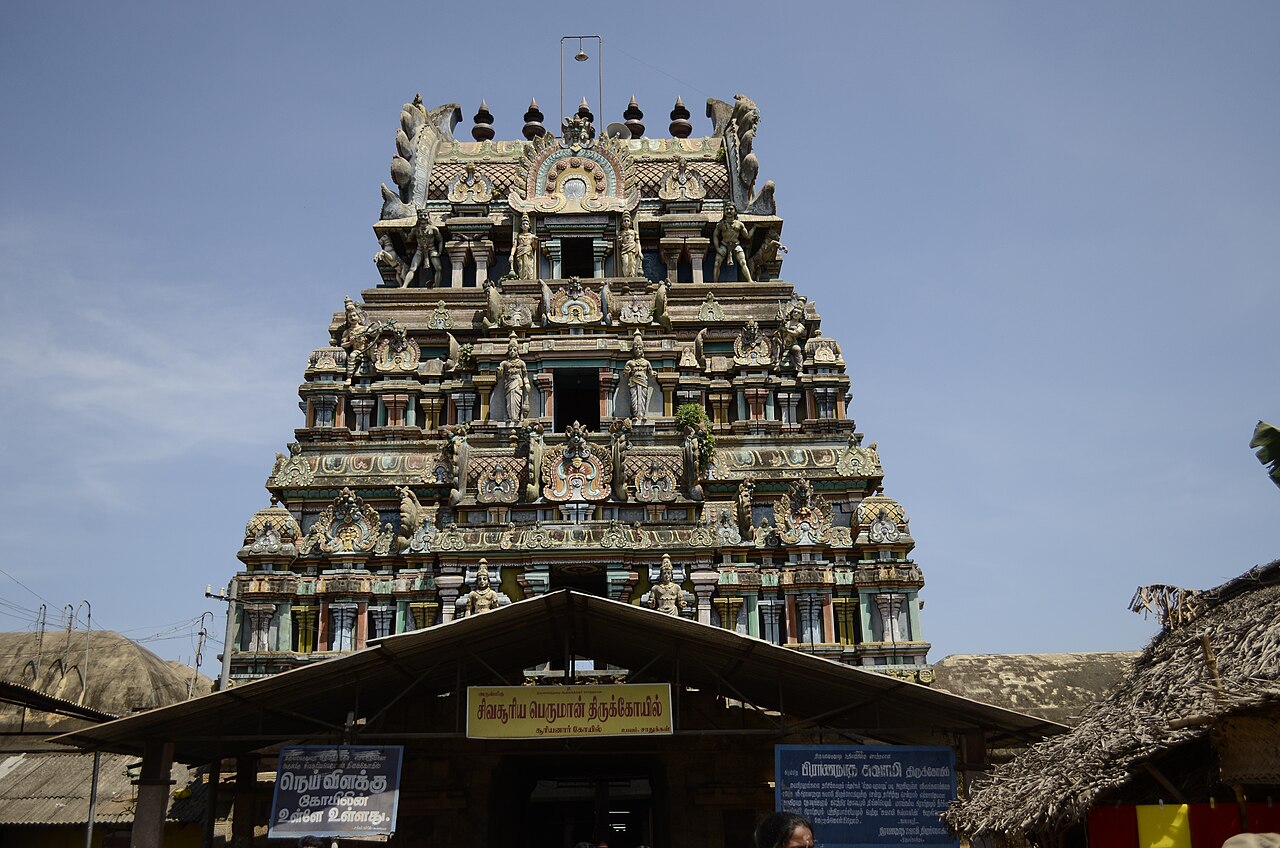
- Suryanar Kovil (Sun / Surya), near Kumbakonam. This is considered the starting point of the circuit by many pilgrims and is unusual in that shrines to all nine grahas are said to surround the main Surya shrine here, in addition to Suryanar Kovil’s own status as the Sun temple.
- Thingalur, Kailasanathar temple (Moon / Chandran), near Thiruvaiyaru in Thanjavur district. Chandra is worshipped here alongside the presiding Shiva, and the temple is associated with easing worries connected to the mind and emotional wellbeing.
- Vaitheeswaran Koil (Mars / Angaraka), near Sirkazhi and Mayiladuthurai. Dedicated to Vaidyanathaswamy, “the physician among gods”, this temple is closely associated with healing prayers as well as Mars worship, and the town is also well known for practitioners of Naadi astrology, the palm-leaf reading tradition.
- Thiruvenkadu, Swetharanyeswarar temple (Mercury / Budhan), near Sirkazhi on the coastal side of the delta. Budhan is associated with intellect and communication, and the temple’s tank and old bronze collection are notable in their own right.
- Alangudi, Apatsahayeswarar temple (Jupiter / Guru), near Kumbakonam. Guru, or Brihaspati, is one of the most revered of the nine in Hindu tradition, associated with wisdom, teachers and good fortune, and this shrine draws a steady stream of visitors seeking his blessing.
- Kanjanur, Agneeswarar temple (Venus / Sukran), close to Suryanar Kovil, also near Kumbakonam. Sukra here is linked to prosperity, relationships and material comfort.
- Thirunallar, Dharbaranyeswarar temple (Saturn / Sani), near Karaikal. This is by far the most visited of the nine, since Sani is widely regarded as the graha with the greatest potential for hardship, and pilgrims arrive in very large numbers, particularly on Saturdays and during a Shani peyarchi, the period when Saturn is believed to change zodiac sign.
- Thirunageswaram, Naganathaswamy temple (Rahu), near Kumbakonam. The temple is known for its Rahu kala pooja, during which the milk abhishekam poured over the Rahu deity is traditionally said to take on a bluish or violet tinge, a phenomenon that has become one of the best-known features of the entire circuit and draws large crowds at the appointed hour.
- Keezhperumpallam, Naganathaswamy temple (Ketu), near Poompuhar on the Sirkazhi coast. This closes the circuit for most pilgrims, completing worship of the lunar nodes alongside Thirunageswaram.
Planning the circuit
All nine temples sit within a fairly compact stretch of the delta, loosely bounded by Kumbakonam, Mayiladuthurai, Thanjavur and Karaikal. Distances between individual temples are generally short, often well under an hour’s drive, which is what makes visiting all nine in a single trip practical. Some pilgrims follow a traditional sequence, commonly beginning at Suryanar Kovil and working outward from there, though there is no single fixed order that everyone follows, and priests or local guides can advise on the sequence considered auspicious for a particular purpose. Each temple also has its own recommended offering, colour and direction of approach associated with its graha, and these details are best confirmed with the temple’s priests on the day, since practices can vary slightly between temples.
Good base towns for the circuit are Kumbakonam, which sits roughly at the centre of the nine temples and is the most convenient base for most visitors, along with Mayiladuthurai, Thanjavur and Karaikal, the last being particularly useful if Thirunallar is the priority.
How to do it
The most common approach is to hire a car and driver for two to three days, which allows a comfortable pace with time for darshan and any parihara rituals at each temple without rushing. A number of travel agents and temple tour operators in Kumbakonam, Thanjavur and elsewhere in the region run organised Navagraha tour packages that cover all nine temples over a set itinerary, and these can be a convenient option if you would rather not plan the route yourself. Public buses and shared autos do connect the towns near each temple, but the connections between temples are not direct, and covering all nine this way takes considerably longer and requires patience.
Each individual temple visit tends to be relatively quick, generally involving darshan of the main deity followed by prayer or a brief ritual at the graha shrine, so the time-consuming part of the day is usually travel between temples rather than time spent at any one of them. The exception is Thirunallar, where queues for Sani parihara can be lengthy, so it is worth allowing extra time there and, where possible, planning the visit around quieter days.
Best time to visit
The cooler months from October to March are generally the most comfortable for a multi-day circuit through the delta, avoiding the heavy heat of the Tamil Nadu summer. Each graha also has particular days considered significant, for instance Saturdays for Saturn and Tuesdays for Mars, and pilgrims with a specific parihara in mind often plan their visit to coincide with the relevant day. Be aware that a Shani peyarchi, when Saturn is believed to shift sign, brings exceptionally large crowds to Thirunallar for weeks at a stretch, so if your visit falls during one, expect longer queues and plan accordingly.
Getting to the region
The Cauvery delta towns that anchor this circuit lie roughly 280 to 340 kilometres from Chennai, which typically works out to five and a half to seven hours by road depending on the route and traffic. The nearest airport is at Tiruchirappalli (Trichy), from where the delta is a shorter onward drive. The region is also well served by rail and long-distance bus services connecting Chennai, Trichy and other major Tamil Nadu towns to Kumbakonam, Mayiladuthurai and Thanjavur. Most visitors base themselves in Kumbakonam or Mayiladuthurai and then travel out to the nine temples by hired car over the following two to three days.
A few practical tips
A driver or guide who already knows the Navagraha circuit and its parihara customs is genuinely useful, since he or she will know current road conditions, the quieter times to visit each temple and the local etiquette around offerings. Standard temple dress codes apply throughout: modest clothing, and shoes removed before entering, so comfortable footwear that is easy to slip on and off makes the day considerably smoother. Graha-specific offerings, such as particular grains, cloth or oil linked to each planet, can usually be bought from shops right outside each temple, so there is rarely any need to carry them from home.
Thirunallar and Thirunageswaram in particular can get very crowded, so patience is worth building into the schedule at those two stops. As with any pilgrimage site, it is sensible to use your own judgement about paid poojas or priests who approach you directly, and to remember throughout that astrology here is a matter of personal faith rather than a scientific claim; treating it that way, with neither mockery nor uncritical certainty, is simply the respectful way to engage with a tradition that matters enormously to the people practising it.
The Navagraha temple circuit is one of the more distinctive pilgrimages in Tamil Nadu: nine grand, individually built planetary temples strung across the fertile green of the Cauvery delta, each with its own history, architecture and devotional character. Whether you arrive as a devotee seeking parihara for a difficult period, or simply as a traveller drawn to a living tradition found nowhere else quite like this, the circuit rewards a few unhurried days spent moving between its temples, tanks and quiet delta villages.