Guide details
Best time to visit
October to March, when the delta heat eases and coastal breezes make walking around comfortable
How to get there
About 250 to 290 km from Chennai, 5.5 to 6.5 hours by road via the ECR through Pondicherry and Chidambaram, or the inland NH route
Highlights
Silappathikara Art Gallery, Cauvery river mouth, Pallavaneswaram temple, Kannagi statue, submerged ancient port site
Good for
history lovers, Tamil literature enthusiasts, quiet coastal walks, offbeat heritage trips
Costs
Very low cost. Entry to the town and beach is free, the art gallery has only a nominal ticket, and a day\u2019s food and local travel typically comes to a few hundred Rs per person
There are places you visit for the view, and there are places you visit because of what once stood there. Poompuhar is the second kind. On the Tamil Nadu coast, where the Cauvery finally gives up its long journey to the Bay of Bengal, a modest fishing town sits over the remains of what was, two thousand years ago, one of the great port cities of the ancient world.
It will not overwhelm you with things to do. What it offers instead is a slow, strange feeling of standing on ground that literature and legend have been talking about for centuries, while the sea that swallowed most of the evidence keeps rolling in as if nothing happened.
About Poompuhar
Poompuhar goes by a few names. Locals and old texts also call it Kaveripoompattinam, and in classical Tamil literature it appears simply as Puhar. All three refer to the same place, a small town in Mayiladuthurai district where the Cauvery river meets the Bay of Bengal. That meeting point of river and sea is really the reason the town exists at all, both historically and today.
In the early centuries of the Chola dynasty, long before the Cholas built the great temples of Thanjavur and Gangaikonda Cholapuram, Puhar was their capital and chief port. It sat at the mouth of the delta, which made it a natural gateway for river trade flowing down from the interior and sea trade coming in from across the Bay of Bengal.
The lost city of the Cholas
What made ancient Puhar remarkable was not just its size but its reach. This was a working international port, sending and receiving goods from the Roman world and from South East Asia, at a time when such maritime trade networks were still rare and remarkable. Roman coins and other trade evidence found along this stretch of coast point to just how far Puhar’s commercial links extended.
Much of that ancient city, though, is no longer above ground. Coastal erosion and shifting sea levels over the centuries are believed to have submerged large parts of old Puhar, and marine archaeology surveys off this coast have identified submerged structures on the seabed. Nobody can hand you a neat map of the lost city, and that is part of its pull. What you are looking at from the shore is a coastline that has quietly taken something significant with it, leaving behind fragments, inscriptions and a great deal of speculation for archaeologists to work through.
Poompuhar and the Silappatikaram
If the archaeology is uncertain, the literature is not. Poompuhar is central to the Silappatikaram, one of the great epics of classical Tamil literature, and this is arguably the town’s strongest claim on anyone with an interest in India’s literary history. Much of the story unfolds here, in the streets and harbour of ancient Puhar.
The epic follows Kannagi and Kovalan, a married couple whose life in Puhar turns to tragedy after Kovalan is wrongly executed in Madurai on a false charge of theft. Kannagi’s grief and fury, and her eventual vindication, form the emotional core of the poem, and Puhar is where their story begins. For Tamil readers, the town is not an abstract ruin. It is the setting of a story many grew up with, which gives a visit here a different texture from an ordinary historical site.
What to see today
Poompuhar today is unhurried, and its sights are best approached with that in mind. Nothing here demands a full day, but each stop rewards a bit of patience.
- The Silappathikara Art Gallery, a distinctive seven storey building where each level uses sculpture to depict scenes and characters from the Silappatikaram, working from the ground floor upward through the epic’s story.
- The beach and the point where the Cauvery meets the sea, a good spot to sit and take in the setting that gives the town its whole reason for being.
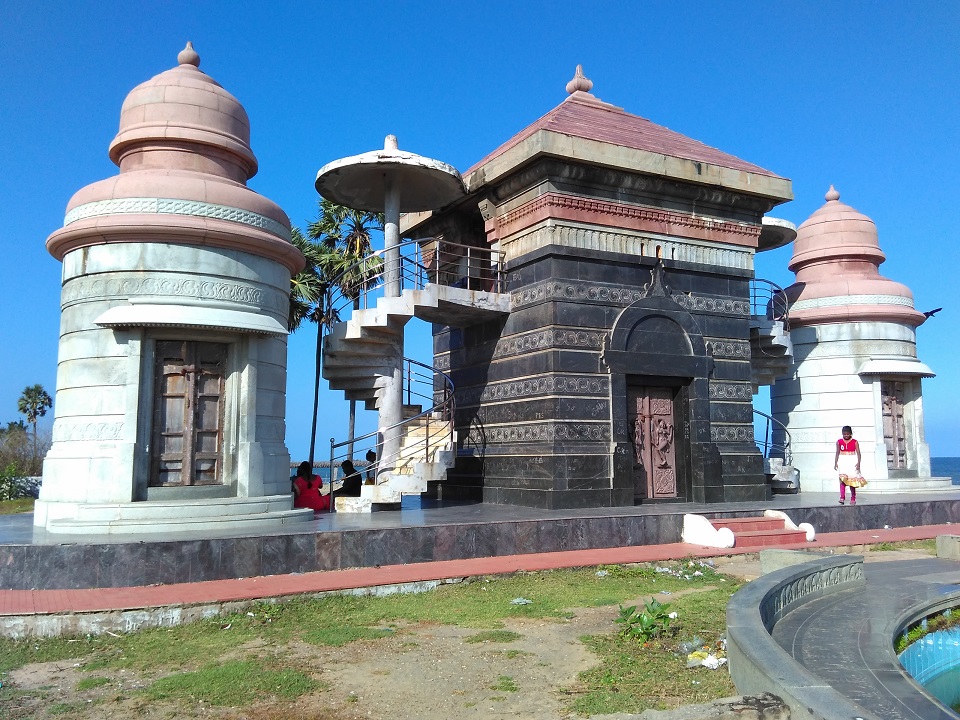
- The Pallavaneswaram temple, a quieter, more local stop away from the main gallery complex.
- A statue of Kannagi, a small but meaningful marker of the epic’s presence in the town.
- The general sense of place, standing where a legendary port once stood, is arguably the real attraction here more than any single building.
Getting there from Chennai
Poompuhar is roughly 250 to 290 km from Chennai, and the drive takes about 5.5 to 6.5 hours depending on the route and traffic. Most people go via the ECR, the coastal road that runs down through Pondicherry and on to Chidambaram, though there is also an inland NH option. Either way, this is not a trip you casually add to a day already spent elsewhere.
The nearest towns of any size are Sirkazhi and Chidambaram, both about 20 to 40 km away, and the nearest railheads are at Sirkazhi, Mayiladuthurai and Chidambaram. Given the distance, we would not recommend treating Poompuhar as a day trip from Chennai. It works far better as part of a longer Chennai to Chidambaram route, or as an overnight built around exploring the wider Cauvery delta.
Combine it with the delta coast
Because Poompuhar sits at the edge of a longer stretch of coastline worth exploring, it makes most sense as one stop among several rather than a destination on its own. Chidambaram, with its famous Nataraja temple, is the obvious anchor for a trip in this direction, and Poompuhar fits naturally as a half day detour from there.
If you have more time, the delta coast further south has its own quieter draw at Pichavaram, where boat rides through dense mangrove channels offer a completely different kind of coastal experience from the open beach at Poompuhar. Together, these stops make for a rounded couple of days along the delta rather than a single, isolated outing.
Best time to visit and tips
The best window is October to March, when the coastal delta climate is at its most bearable. Outside these months, the heat and humidity in this part of Tamil Nadu can be considerable, and there is little shade or infrastructure to shelter under.
- Poompuhar is a modest, quiet coastal town, not a polished resort destination, so keep expectations realistic and enjoy it for its history and atmosphere rather than for facilities.
- Facilities are limited. Do not expect a wide choice of restaurants or hotels, and plan meals and fuel stops accordingly, ideally in Chidambaram or Sirkazhi.
- The sea here has strong currents. This is not a beach for swimming, and it is best enjoyed as a place to walk and sit rather than to bathe.
- Carry water, sun protection and cash, since ATMs and shops are sparse once you are away from the main road.
Poompuhar will not compete with Tamil Nadu’s grander temple towns for sheer spectacle. What it offers instead is quieter and, for the right traveller, more affecting: a stretch of coast that carries both a literary epic and a genuinely lost city within it, and asks you to fill in the rest with your own imagination.