Guide details
Best time to visit
October to March is the most comfortable season, with cooler mornings and evenings for temple visits and, where relevant, hill circumambulation. Karthigai Deepam at Tiruvannamalai, usually in November or December, is spectacular but extremely crowded, so plan carefully if visiting then. Maha Shivaratri is another major festival across all five temples and draws large crowds. Early mornings are best at any time of year, both for a calmer darshan and to avoid the heat.
How to get there
The five Pancha Bhoota Sthalam temples are spread across northern Tamil Nadu and into southern Andhra Pradesh. Kanchipuram and Srikalahasti (near Tirupati) can be grouped in the north, Tiruvannamalai and Chidambaram sit in the central belt of Tamil Nadu, and Thiruvanaikaval lies further south near Tiruchirappalli. Most pilgrims cover the circuit over a multi-day trip by car or hired vehicle, though many visit the temples across several separate journeys rather than in one continuous trip.
Highlights
Ekambareswarar Temple Kanchipuram (Earth), Jambukeswarar Temple Thiruvanaikaval near Tiruchirappalli (Water), Arunachaleswarar Temple Tiruvannamalai (Fire), Srikalahasti Temple (Air), Thillai Nataraja Temple Chidambaram (Space)
Good for
devout pilgrims undertaking a multi-temple circuit, families with an interest in Tamil temple architecture and Shaivite tradition, travellers combining temple visits with wider South India itineraries, and anyone curious about Hindu cosmology and the pancha bhoota concept
Price range
Each temple town offers budget to mid-range lodging and simple local eateries, with more comfortable options in larger towns such as Kanchipuram, Tiruvannamalai and Tirupati. Since this is typically a staged or multi-day pilgrimage rather than a single visit, overall cost depends on how the trip is planned and how many locations are covered at once. No fixed entry fees or donation amounts should be assumed without checking directly with each temple.
Among the many sacred temple circuits of South India, few carry the depth of meaning found in the Pancha Bhoota Sthalam. These are five ancient and revered Shiva temples, each dedicated to one of the five great elements, or pancha bhoota, that Hindu cosmology holds to be the building blocks of all creation: earth, water, fire, air and space. In each temple, Shiva is worshipped in a form that embodies one of these elements, so that together the five sites represent nothing less than the material universe rendered in stone, ritual and living tradition. Four of the five temples lie within Tamil Nadu, while the fifth, representing air, sits just across the border in Andhra Pradesh. For devotees, completing the circuit is considered one of the most spiritually significant pilgrimages in the Shaivite tradition, and even for the simply curious traveller, it offers a rare way to understand how ancient South Indian thought wove philosophy directly into architecture and worship.
What Pancha Bhoota Means
The term pancha bhoota refers to the five elements that classical Indian thought believed to compose everything in existence: Prithvi (earth), Appu or Jala (water), Agni or Tejas (fire), Vayu (air) and Akasha (space or ether). This is not simply a poetic idea. In each of the five temples, the element is not just symbolised but physically present and central to worship. The lingam, the aniconic form in which Shiva is worshipped, is understood in each place to be made of, or to manifest as, that particular element, whether that means an earthen lingam, a lingam bathed by an underground spring, a hill regarded as a column of fire, a flame that flickers without wind, or a sanctum where the deity is worshipped as formless space itself. Visiting all five in sequence is traditionally seen as a way of honouring the entire structure of creation, and of approaching Shiva through each of the fundamental forces that sustain it.
Earth: Ekambareswarar Temple, Kanchipuram
The earth temple is the Ekambareswarar Temple in Kanchipuram, one of the great temple towns of Tamil Nadu and a place already rich in religious history. Here Shiva is worshipped as the Prithvi lingam, an earth or sand lingam, and the temple’s founding legend tells of the goddess Kamakshi, a form of Parvati, who is said to have fashioned a lingam from the earth beneath a mango tree and worshipped it with such devotion that Shiva appeared before her. That ancient mango tree, said to be many centuries old, still stands within the temple complex and remains one of its most cherished features. Ekambareswarar is one of Kanchipuram’s largest and most important temples, with soaring gopurams and expansive corridors that reflect its long history as a centre of Shaivite worship.
Water: Jambukeswarar Temple, Thiruvanaikaval
Close to Tiruchirappalli, in the temple town of Thiruvanaikaval, also known as Thiruvanaikoil, stands the water temple, Jambukeswarar. Here Shiva is worshipped as the Appu, or water, lingam, and the sanctum contains an underground spring from which water perpetually seeps, keeping the lingam continually moist regardless of the season. The temple’s name and founding legend are tied to a story involving an elephant and a spider, both devoted worshippers of Shiva under a jambu, or jamun, tree, whose devotion is honoured in the temple’s very name, Jambukeswara. As part of the wider Tiruchirappalli temple landscape, Jambukeswarar is often visited alongside other major sites in the region, making it a natural anchor for the southern leg of the pancha bhoota journey.
Fire: Arunachaleswarar Temple, Tiruvannamalai
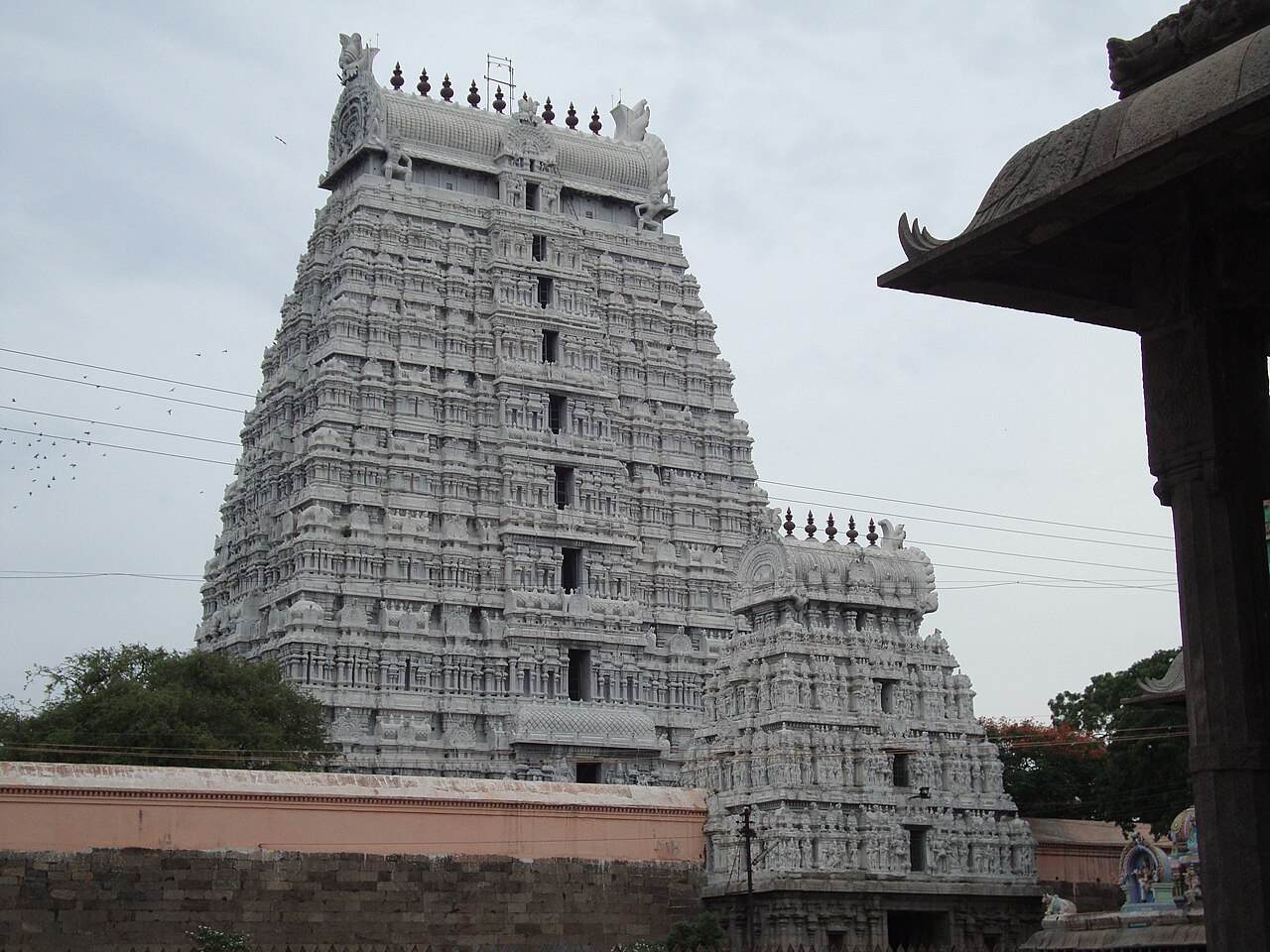
The fire temple is found in Tiruvannamalai, where the Arunachaleswarar Temple sits at the base of the sacred hill known as Annamalai or Arunachala. Here Shiva is worshipped as the Agni, or fire, lingam, and the hill itself is regarded as a direct manifestation of Shiva in the form of a column of fire. This connects to the lingodbhava legend, in which Shiva is said to have appeared as an infinite pillar of flame to settle a dispute between Brahma and Vishnu over who was the greater god, with neither able to find its beginning or its end. This story is dramatically reenacted each year during Karthigai Deepam, when a vast beacon is lit atop the hill, visible for miles around and drawing enormous crowds of devotees. The hill is also central to the practice of Girivalam, the circumambulation of Arunachala on foot, and to the teachings of the sage Ramana Maharshi, whose ashram at the base of the hill continues to draw seekers from around the world.
Air: Srikalahasti Temple
Just across the Tamil Nadu border into Andhra Pradesh, not far from Tirupati, lies the air temple, Srikalahasti. Here Shiva is worshipped as the Vayu, or air, lingam, and the most striking physical sign of this is a flame kept within the sanctum that is said to flicker continuously even though there is no draught to explain the movement, taken as a visible expression of the air element itself. The temple’s name is drawn from a legend involving three devoted creatures, a spider, a snake and an elephant, whose Tamil and Telugu names combine to form Srikalahasti: Sri for the spider, Kala for the snake or cobra, and Hasti for the elephant. Beyond its place in the pancha bhoota circuit, Srikalahasti is also widely known as a centre for Rahu-Ketu sarpa dosha parihara rituals, drawing pilgrims specifically for this purpose as well as for the element temple itself.
Space: Thillai Nataraja Temple, Chidambaram
The fifth and final temple, representing Akasha, or space and ether, is the Thillai Nataraja Temple in Chidambaram. This is perhaps the most philosophically striking of the five, since here Shiva is worshipped not through a physical lingam of any element but as formless space itself. The temple holds the famous Chidambara Rahasyam, the secret of Chidambaram, an empty space within the sanctum concealed behind a curtain, understood to represent the formless, all pervading nature of the divine. Chidambaram is equally renowned for its bronze image of Shiva as Nataraja, the cosmic dancer, whose dance is traditionally understood to represent the rhythm of creation, preservation and dissolution. Where the other four temples ground an element in physical form, the space temple asks the pilgrim to contemplate the element that cannot be seen or touched at all, only inferred as the space in which everything else exists.
The Cosmos as a Circuit
Taken together, the five Pancha Bhoota Sthalam temples represent the entirety of material creation as understood in Hindu philosophy, earth, water, fire, air and space, each honoured in its own sacred setting. Geographically, the circuit spans a broad stretch of southern India, with Kanchipuram in the north, Tiruvannamalai and Chidambaram in the north-central belt of Tamil Nadu, Thiruvanaikaval near Tiruchirappalli further south, and Srikalahasti just over the border in Andhra Pradesh near Tirupati. Completing all five is regarded by many devotees as a spiritually complete pilgrimage, a way of paying respect to Shiva through every fundamental element that sustains the universe, and the physical distance between the sites is itself part of the undertaking, requiring genuine commitment and planning.
Planning the Pilgrimage
Because the five temples are spread across such a wide area, most pilgrims approach the circuit as a multi-day journey by car, or complete it across several separate trips rather than in one continuous sweep. A practical way to think about it is in three groups: Kanchipuram and Srikalahasti, which can be combined with a visit to Tirupati in the north; Tiruvannamalai and Chidambaram, which sit closer together in the central belt of Tamil Nadu; and Thiruvanaikaval, which is naturally paired with a visit to Tiruchirappalli further south. Each of these five temples is a major, actively functioning place of worship in its own right, with its own rituals, darshan timings and festival calendar, so each deserves substantial time rather than being treated as a quick stop on a longer route.
What to Expect and How to Prepare
As with any major South Indian temple, modest dress and appropriate footwear etiquette apply at all five sites, and visitors should be prepared to remove footwear before entering. Each temple is a living centre of worship, not a museum, so it is worth moving through respectfully and being mindful of ongoing rituals and the devotees who have come specifically for darshan. Part of what makes this circuit so memorable is that the element each temple represents is not an abstract idea but something you can actually observe: the earthen lingam and the ancient mango tree at Kanchipuram, the ever seeping water in the sanctum at Thiruvanaikaval, the towering fire-associated hill and its annual beacon at Tiruvannamalai, the flickering flame at Srikalahasti, and the empty, curtained space at Chidambaram. Arriving early in the day generally means a calmer, less crowded darshan, and many travellers choose to combine each element temple with the wider temple circuits and heritage sites of its surrounding town.
The Pancha Bhoota Sthalam stands as one of the most profound temple circuits in South India, five great Shiva temples that together embody the elements from which all creation is believed to arise. Whether approached as a devout pilgrimage or as a journey into one of the richest threads of South Indian religious thought, visiting all five is a deeply rewarding undertaking, one that rewards patience, respect and genuine curiosity in equal measure.