Guide details
Best time to visit
October to March, weekday mornings
How to get there
About 2 hours by road or train from Chennai
Highlights
Ekambareswarar Temple, Kamakshi Amman Temple, silk weaving
Good for
Culture trips, saree shopping, temple architecture
Price range
Mostly free entry, silk sarees from Rs 3,000 up
Kanchipuram is one of those places that quietly humbles you. Walk through its ordinary looking streets, past silk shops and idli stalls, and you keep running into gopurams that rise thirty or forty metres into the sky, guarding temples that have stood for over a thousand years. It is not a single monument you tick off in an hour. It is a whole city built around worship, and it rewards a full day of unhurried visiting.
Most people in Chennai know Kanchipuram for two things: its temples and its silk. Both deserve the reputation, but there is more to the city than a quick stop for sarees on the way somewhere else. This guide walks through the temples worth prioritising, what makes the silk genuinely special, what to eat, and how to plan a sensible day trip from Chennai.
This temple is one of the Pancha Bhoota Sthalam, the five Shiva temples of the elements. See our Pancha Bhoota Sthalam guide for the full circuit and what each element temple represents.
Kanchipuram is as famous for silk as for its temples: see our guide to the Kanchipuram silk saree for the weaving tradition and how to buy a genuine one.
The city of a thousand temples
Kanchipuram, also spelt Kancheepuram and known historically as Kanchi, has long been called the City of a Thousand Temples. That is not just a marketing line. Over many centuries, successive dynasties built, expanded and endowed temples here until the city became one continuous sacred landscape, with shrines tucked into almost every street.
Hindu tradition ranks Kanchipuram among the Sapta Puri, the seven cities considered capable of granting moksha, or liberation. That puts it in the same category as Varanasi, which gives some sense of how seriously pilgrims take this place. Locally, the city is split into two zones that reflect its two great traditions. Shiva Kanchi is the older, western part of the city, home to the great Shaivite temples. Vishnu Kanchi lies to the east and centres on the Vaishnavite shrines. Knowing this split helps when you are planning your route, because the two halves of the city are a fair distance apart and you do not want to zigzag between them all day.
A Pallava capital
Kanchipuram’s importance is not only religious. For centuries it was the capital of the Pallava dynasty, the rulers who also built the shore temples and rock cut monuments at Mahabalipuram, which served as the Pallavas’ port on the coast. While Mahabalipuram was where the Pallavas experimented with rock carving right by the sea, Kanchipuram was where they governed, and where their structural temple building really matured.
After the Pallavas, the city passed to the Cholas, who were prolific temple builders in their own right, and later to the Vijayanagar empire. Each dynasty left its mark, adding halls, gopurams, shrines and inscriptions rather than replacing what came before. That layering is part of what makes Kanchipuram so rewarding to explore. A single temple complex can show you Pallava sandstone carving from the eighth century sitting alongside a soaring Vijayanagar era gopuram from centuries later.
Ekambareswarar Temple
Ekambareswarar is the largest and most important Shiva temple in the city, and it is one of the Pancha Bhoota Sthalams, the five temples across South India each associated with one of the five elements. Here, the presiding deity represents prithvi, the earth element. Its sister temple for the wind element is far to the north at Srikalahasti, and visiting both over time gives you a real sense of how this ancient system of elemental worship spans the region.
The temple’s gopuram is one of the tallest in South India and dominates the skyline of this part of the city long before you reach the entrance. Inside, a thousand pillared hall stretches out with row after row of carved columns, each slightly different if you look closely. But the detail most visitors remember is the ancient mango tree in the temple courtyard. Local legend holds that Parvati worshipped Shiva beneath this very tree, and the tree itself is said to be extraordinarily old, with different branches traditionally associated with different flavours of fruit. Whatever you make of the legend, standing under it after walking through the vast pillared halls is a genuinely calming moment.
Kamakshi Amman Temple
Kamakshi Amman Temple is dedicated to the goddess Kamakshi, a form of Parvati, and it is one of the principal Shakti temples in India. This is very much a living centre of goddess worship, not a museum piece, and you will usually find a steady flow of devotees here rather than the more tourist heavy crowds at some of the larger sites.
The temple’s golden gopuram and the quieter, more intimate scale of its inner shrines make it a good contrast after the scale of Ekambareswarar. Because it sits in the Shiva Kanchi part of the city, it pairs naturally with a visit to Ekambareswarar on the same leg of your day.
Varadaraja Perumal Temple
Over in Vishnu Kanchi, Varadaraja Perumal Temple is the city’s great Vaishnavite shrine and one of the 108 Divya Desams, the sacred Vishnu temples celebrated in early Tamil devotional poetry. The temple complex is enormous, and its hundred pillared hall is worth slowing down for. The carvings here are unusually intricate, with rearing horses and mythical figures worked into the stone with real flourish.
One of the temple’s quieter curiosities is a pair of lizard figures on the ceiling near one of the shrines, one in silver and one said to be gilded, which devotees touch as part of a long standing local tradition. The temple’s most famous feature, though, is the Athi Varadar, a wooden idol of Vishnu that normally stays submerged in the temple tank and is brought out for public darshan only once every forty years. It was last displayed in 2019, so if you are visiting now you are unlikely to see it, but it is well worth asking your guide or local temple staff about, since the story of the idol’s preservation underwater is remarkable in itself.
Kailasanathar Temple
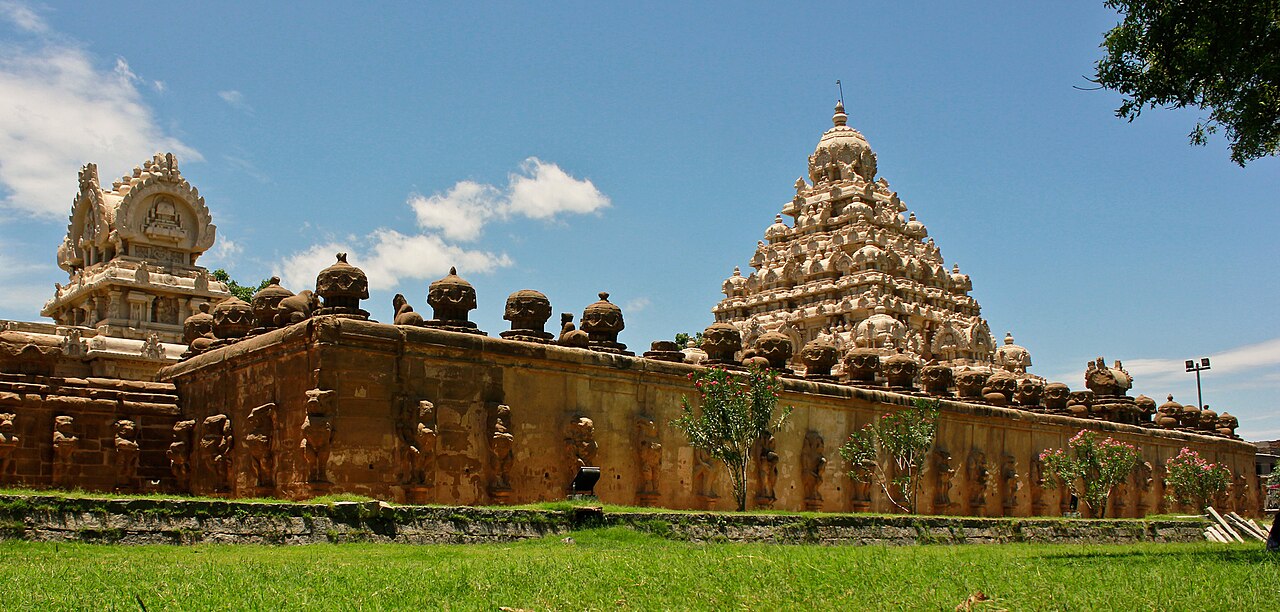
If Ekambareswarar and Varadaraja Perumal represent the grand, actively thronged end of Kanchipuram’s temple life, Kailasanathar Temple sits at the other end. This is the oldest surviving temple in the city, built in the early eighth century by the Pallava king Rajasimha, also known as Narasimhavarman II.
Built from sandstone rather than the harder granite used later, Kailasanathar has a softness and delicacy to its carving that later temples do not quite match, though the same softness means erosion has taken its toll on some of the finer detail over thirteen centuries. Small shrine cells line the courtyard wall, each with its own carved panel. Because it is no longer a major site of daily worship in the way the other temples are, it tends to be far quieter, and it is a genuine favourite among visitors interested in architecture and history rather than active pilgrimage. If you only have time for one quiet temple in Kanchipuram, make it this one.
Other temples worth a look
Beyond the big four, Kanchipuram has dozens of smaller shrines that reward a bit of wandering if your schedule allows it. Kumarakottam, dedicated to Murugan, is a pleasant stop with its own distinct atmosphere and is conveniently placed within the Shiva Kanchi area. Ulagalantha Perumal, a Vishnu temple associated with Vishnu’s Trivikrama form striding across the universe, has a striking tall image of the deity and is worth a short detour if you are already in Vishnu Kanchi visiting Varadaraja Perumal.
Kanchipuram silk sarees
Kanchipuram’s silk sarees are famous well beyond Tamil Nadu, and once you have seen a handloom weaver at work, it is easy to understand why. These sarees are handwoven, typically with heavy zari, the gold or silver thread work that gives them their characteristic shine and weight. What sets a genuine Kanchipuram silk saree apart structurally is the korvai technique, where the body of the saree and its border are woven separately, often in contrasting colours, and then interlocked together on the loom rather than simply stitched. This is painstaking work, and it is part of why these sarees are known for their durability as much as their beauty.
Kanchipuram silk carries a Geographical Indication, or GI, tag, which legally protects the name for sarees genuinely woven in and around the city using the traditional techniques. Visiting a weaving cooperative or a small workshop is one of the best things you can do in the city. Watching the weavers work the shuttle back and forth, often with two people coordinating on wider looms, gives you a proper appreciation for the hours that go into a single saree.
A word of honest advice on buying. Prices vary enormously depending on the weight of silk used and how much zari, and whether that zari is real or imitation, so treat very low prices with some suspicion. Fakes and machine made imitations do circulate, sold as handwoven when they are not, so it is worth buying from an established cooperative, a government emporium, or a shop with a solid local reputation rather than the first stall you pass. Ask about silk mark certification and GI authenticity if you are spending a significant amount, and do not feel embarrassed about asking a shop to show you the difference between a handloom piece and a power loom one. A good shopkeeper will be happy to explain it.
What to eat
Kanchipuram has its own well loved contribution to South Indian breakfast tables, the Kanchipuram idli. It is a larger, denser idli than the everyday version, seasoned with pepper, cumin and sometimes curry leaves, and traditionally associated with temple offerings. It has a firmer texture and a savoury depth that makes it a satisfying meal on its own rather than just a side for chutney.
Beyond that speciality, expect the usual excellent temple town food: filter coffee, crisp dosas, a variety of vadas, and simple vegetarian thali meals served on banana leaf in the small eateries around the main temple areas. None of it is fancy, and that is rather the point.
How to get there from Chennai
Kanchipuram sits roughly 70 to 75 kilometres south west of Chennai, and the drive typically takes about 2 to 2.5 hours by road, depending on traffic and which route you take. Most visitors travel via the Chennai to Bengaluru highway corridor, which is well maintained and makes for a straightforward drive whether you are self driving or hiring a car with a driver.
If you would rather not drive, Kanchipuram railway station has regular train connections from Chennai, and there are also frequent state and private buses running throughout the day. Trains and buses are perfectly workable if you are comfortable navigating local transport, though a car does give you far more flexibility for the day, especially once you are moving between temples within the city itself.
Planning your day and temple etiquette
Kanchipuram’s temples are spread across a fairly large area, and Shiva Kanchi and Vishnu Kanchi in particular are not within easy walking distance of each other. Hire an auto rickshaw for the day, or keep your car and driver with you, rather than trying to walk the whole circuit. A sensible route usually groups Ekambareswarar, Kamakshi Amman and Kailasanathar together on one side of the city, with Varadaraja Perumal and the silk weaving areas on the other, though a good local driver will be able to suggest the most efficient order based on where you are starting from.
These are active places of worship, not tourist attractions in the theme park sense, and it is worth treating them accordingly. Dress modestly, covering shoulders and knees. You will need to remove your footwear before entering most temple compounds, so wear something easy to slip on and off, and be ready for a fair amount of walking on bare stone floors that can get hot in the sun. Photography is often restricted inside the inner sanctums, so look for signage or ask temple staff if you are unsure. Temples generally follow a split schedule, opening in the morning, closing around midday, and reopening in the evening, so do check current timings locally before you set off rather than relying on any fixed hours, since these do shift. Weekends and festival days bring much larger crowds, so build in extra time if your visit falls on one.
If temples are not the only thing on your mind for the trip, it is worth reading up on other tourist places near Chennai so you can decide whether to combine Kanchipuram with another stop or keep the day focused purely on the temple city.
Best time to visit and tips
The best window for visiting Kanchipuram runs roughly from October to March, when temperatures are more forgiving. Outside those months, the heat can be intense, and combined with the amount of walking involved, especially on stone temple floors, it makes for a much more tiring day.
- Start early, ideally by mid morning, to make the most of cooler temperatures and to beat the midday closing at several temples.
- Carry water and wear comfortable, easily removable footwear since you will be taking shoes off frequently.
- General darshan is free at these temples, with paid special darshan or archana options available at some, so carry small change if you want those.
- Confirm opening times locally before you travel, as schedules can vary by temple and by season.
- Set aside a proper block of time, at minimum half a day, if you want to see the four main temples without rushing.
- If silk shopping is on your list, allow at least an hour at a reputable shop or cooperative, since choosing a saree properly takes time.
Kanchipuram rewards patience. Rush it and you will come away with a handful of photographs of gopurams. Give it a full, unhurried day, and you leave with a real sense of a city that has been at the centre of South Indian religious and artistic life for well over a thousand years.