Guide details
Best time to visit
Kanchipuram silks can be seen and bought throughout the year, since weaving and showroom visits do not depend on season. The cooler months from October to March are the most pleasant for combining a visit to weaving showrooms with sightseeing among the town’s temples. Demand for sarees rises sharply during the wedding season, so it is worth allowing extra time to browse and choose during these busy months.
How to get there
Kanchipuram silk sarees are made in Kanchipuram, roughly 70 to 75 km from Chennai and about 2 hours away by road, making it an easy day trip for anyone wanting to buy directly from weavers or cooperative showrooms. For those unable to make the journey, genuine Kanchipuram silks are also stocked by reputable silk stores in Chennai.
Highlights
pure mulberry silk, real gold and silver zari, korvai contrast borders, temple-border and peacock motifs, bridal sarees, weavers’ cooperatives
Good for
those buying a special saree or gift, textile and craft lovers, brides and wedding shoppers, culture travellers, anyone visiting Kanchipuram
Price range
Genuine Kanchipuram silk sarees made with pure silk and real gold and silver zari are expensive, and that cost reflects the value of the materials and the many hours of skilled handloom labour involved, which is why they are often treated as heirlooms rather than everyday purchases. Simpler designs with lighter zari work tend to cost less than heavily worked bridal pieces. Imitations made from art silk or powerloom fabric with fake zari are considerably cheaper but are not genuine handloom Kanjivarams, so it is worth buying from trusted weavers, cooperatives or reputable stores and asking for Silk Mark certification.
Among India’s many textile traditions, the Kanchipuram silk saree, also known as the Kanjivaram, holds a place of particular reverence. Woven in the temple town of Kanchipuram, a short distance from Chennai, it is recognised as one of the country’s most prestigious handloom fabrics and carries a Geographical Indication tag that protects its name and origin. What sets a genuine Kanjivaram apart is the marriage of pure mulberry silk with real gold and silver zari thread, worked into rich, contrasting colours and the temple-inspired borders that give the saree its unmistakable character. It is heavy, lustrous and remarkably durable, qualities that have made it the quintessential South Indian bridal and festive saree for generations. A well-kept Kanjivaram is rarely just a garment bought for one occasion; it is often a treasured heirloom, folded away and passed from mother to daughter as a piece of family history as much as fashion.
The town and its weaving tradition
Kanchipuram is sometimes called the city of a thousand temples, a former capital of the Pallava and later the Chola dynasties, and its long association with silk weaving runs just as deep as its temple architecture. Weaving here is said to stretch back many centuries, and local tradition links the craft to Sage Markanda, described in legend as the master weaver of the gods, whose descendants are believed to have carried the skill down through generations. In practice, the weaving community of Kanchipuram has traditionally included the Devanga and Saligar, or Padma Saliyar, communities, families for whom the handloom has long been both livelihood and inheritance. Even today, weaving in Kanchipuram remains very much a household and community industry. Walk down some of the town’s quieter lanes and you will still hear the rhythmic clack of pit looms coming from open-fronted homes, with thousands of families and looms sustaining a craft that has outlasted empires.
What makes a Kanjivaram distinctive
Several things combine to give the Kanchipuram silk saree its particular character. The silk itself is pure mulberry silk, traditionally sourced from silk-producing regions further south, prized for being thick, strong and slightly textured rather than thin and slippery. This is part of why a Kanjivaram has such noticeable weight and body compared with many other silk sarees.
Then there is the zari, the metallic thread woven through the borders, pallu and often the body of the saree. Genuine zari traditionally consists of fine silver wire dipped in gold, and it is this real metal content that gives an authentic Kanjivaram its particular lustre, weight and value. Zari is one of the most expensive components of the saree, and its quality is one of the clearest markers of authenticity.
The weaving technique itself is equally distinctive. Rather than being woven as a single continuous piece, the body, the border and the pallu, the decorative end of the saree, are often woven separately, sometimes in contrasting colours, and then joined using an interlocking technique known as korvai. It is painstaking, skilled work, and a properly executed korvai join is so strong that the fabric itself is more likely to tear than the join is to give way. This is also why so many Kanjivarams have a body in one colour and a border and pallu in a bold, contrasting shade, a signature look immediately recognisable to anyone familiar with South Indian silks.
The motifs woven into the saree draw heavily on the temple architecture and natural world around Kanchipuram: the zigzag gopuram or temple-tower pattern along borders, checks and stripes, peacocks and parrots, mango and paisley shapes, the mythical yaali creature, and sun and moon motifs, many taken directly from temple sculpture. Traditional colour combinations tend to be bold and contrasting, mustard against maroon, deep red against green, blue set off with gold, chosen as much for how they catch the light as for their symbolism.
The weaving process
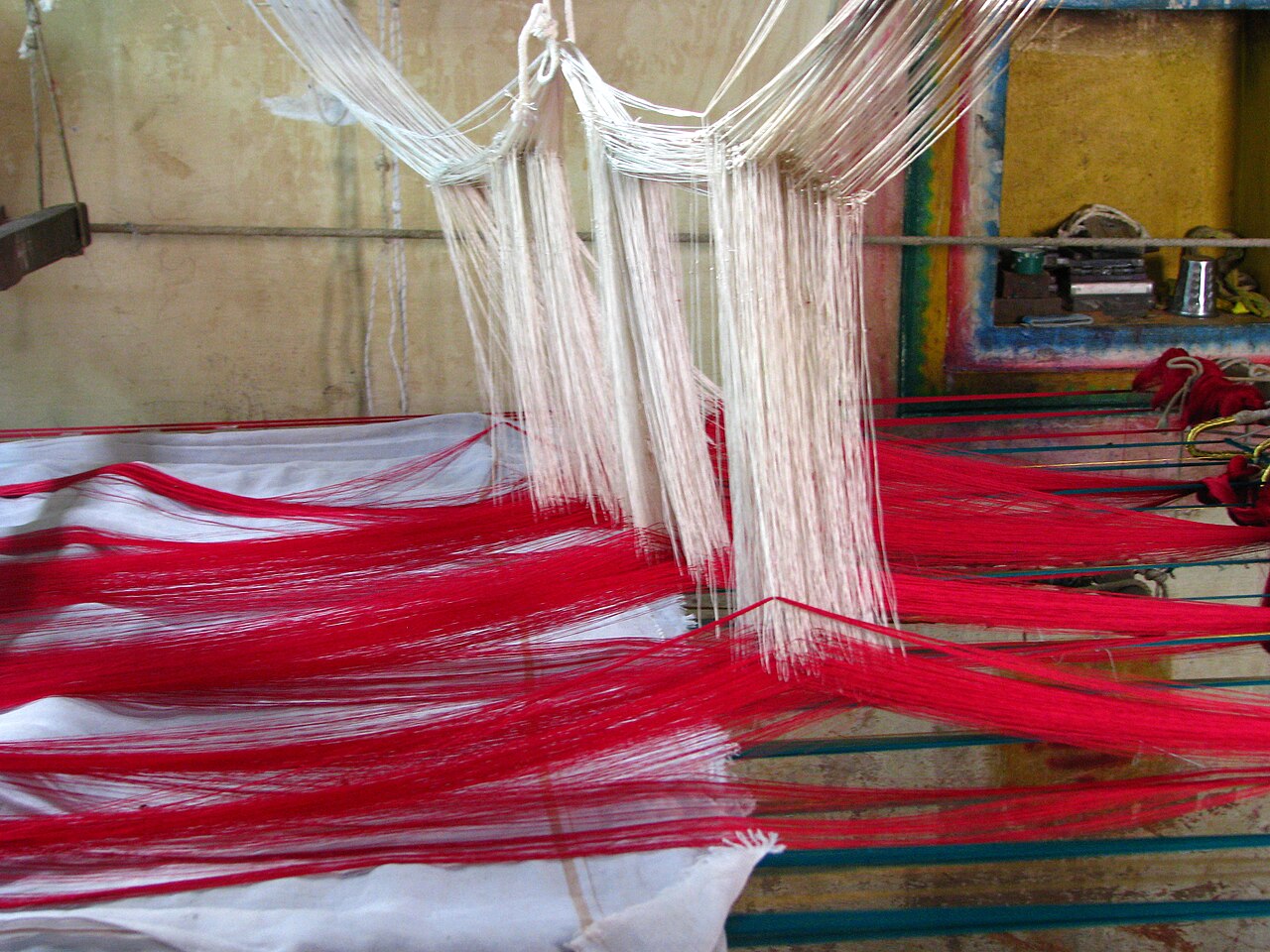
Making a Kanchipuram silk saree is a slow and skilled process from start to finish. The silk yarn is first dyed in the desired colours, then the warp is carefully set on the loom, a task that itself takes time and precision. The weaving proceeds on traditional pit looms, with the weaver working the zari and silk threads together by hand, and the separately woven border and pallu joined to the body using the korvai technique described above. Depending on the complexity of the design, the amount of zari work involved and the fineness of the silk, a single saree can take anywhere from several days to several weeks to complete. This is genuinely labour-intensive handloom work, often carried out by more than one pair of hands within a weaving family, and it is this human skill and time, as much as the raw materials, that gives a Kanjivaram its value.
The saree in Tamil culture
It is difficult to overstate how central the Kanjivaram is to Tamil life, particularly around weddings. A Kanchipuram silk saree, ideally in a rich colour with a contrasting border, is considered essential bridal wear across much of South India, and buying or receiving one is often one of the significant rituals of preparing for a wedding. Beyond weddings, the Kanjivaram is brought out for festivals, temple visits and other special family occasions, worn with obvious pride rather than treated as everyday clothing. It also functions as a marker of status and taste, and as a gift of real significance, given by parents to daughters, by mothers-in-law to new brides, or kept for decades and eventually handed down. Few garments manage to combine everyday cultural meaning with genuine heirloom value quite so completely.
Buying a genuine Kanchipuram silk saree
For anyone hoping to buy an authentic Kanjivaram, the most reliable option is to buy it in Kanchipuram itself, either from the weavers’ cooperative showrooms or from established silk shops in the town, many of which work directly with local weaving families. Reputable stores in Chennai also stock genuine Kanchipuram silks for those who cannot make the trip.
Look out for the Geographical Indication tag associated with Kanchipuram silk, along with the Silk Mark label, a certification that verifies the fabric is genuine silk. Beyond official labels, there are practical signs of authenticity: the weight and slightly stiff, substantial feel of the fabric, a korvai border join that feels seamless rather than stitched or glued, and zari that has real heft and a soft, warm sheen rather than a flat, bright shine. Tests that involve burning a thread or rubbing off the zari are destructive and best avoided, so it is far wiser to buy from a trusted, established source than to rely on such methods.
Unfortunately, imitations are widespread, ranging from art silk and powerloom copies to sarees finished with fake zari made from synthetic metallic thread. These can look convincing at a glance but lack the weight, durability and craftsmanship of the real thing. A genuine pure-silk Kanjivaram with real zari is expensive, and that price reflects the cost of the silk, the gold and silver content of the zari and the many hours of skilled handloom labour involved, not simply a mark-up. If a price seems remarkably low for what is described as pure silk and real zari, it is worth asking careful questions, or asking to see the Silk Mark certification, before buying.
The weavers today
Behind every Kanjivaram is a weaving family, and that community faces real pressures. Competition from powerloom sarees, which can be produced far faster and sold far more cheaply, has made it harder for handloom weavers to compete on price, even though they cannot match that speed without sacrificing the qualities that define a true Kanjivaram. The rising cost of genuine zari adds further strain, and many weaving families report that younger generations are less inclined to take up a craft that demands years to master and offers uncertain financial reward. Weavers’ cooperatives, along with the protection offered by the Geographical Indication status, play an important role in supporting the community, helping to guarantee fair prices and preserve traditional techniques. For visitors and buyers, choosing a genuine handloom Kanjivaram over a machine-made imitation is a small but meaningful way of supporting these weaving families and helping to keep the craft alive for future generations.
A living part of Tamil Nadu’s craft heritage
The Kanchipuram silk saree does not stand alone. It belongs to a wider tapestry of living crafts found across Tamil Nadu, alongside the intricate textiles of Chettinad, the gold-leafed devotional Tanjore paintings and the centuries-old tradition of bronze casting practised in towns such as Swamimalai. Together these crafts form one of the richest living heritage landscapes in India, and the Kanjivaram remains perhaps the most widely recognised and celebrated of them all, a craft still practised much as it always has been, on wooden looms in family homes.
For visitors
For travellers, a visit to Kanchipuram is a genuinely rewarding cultural experience, easily combined with exploring the town’s magnificent temples. Some showrooms and cooperatives welcome visitors to watch weavers at work, offering a rare glimpse of the patience and skill that goes into every saree, from the setting of the warp to the final korvai join. Even for those with no immediate occasion to wear one, a Kanchipuram silk saree makes a special, if undeniably pricey, souvenir or gift, a piece of Tamil Nadu’s living heritage that will only grow more valued with time.
In the end, the Kanchipuram silk saree is a masterpiece of Indian handloom, woven from pure silk and gold in a temple town of a thousand looms and a thousand temples. It is a garment of celebration, of family and of memory, and in every fold of silk and every gleam of zari, it carries centuries of Tamil craft, still being woven, thread by careful thread, today.