Guide details
Best time to visit
October to March, when the weather across Tamil Nadu and the south is cooler and more comfortable for temple visits. Vaikunta Ekadashi, usually falling in December or January, is the single most important occasion in the Sri Vaishnavite calendar and draws very large crowds, especially at Srirangam.
How to get there
The 108 Divya Desams are spread across India, but the greatest concentration by far is in Tamil Nadu, particularly the Cauvery delta around Kumbakonam and Srirangam, the Kanchipuram cluster, and the Pandya region near Madurai and Tirunelveli, along with Tirupati in neighbouring Andhra Pradesh. Because they are so widely spread, most travellers explore them region by region over several trips, moving between towns by car or train and basing themselves in a temple town for a day or two at a time.
Highlights
Srirangam, Tirupati, Kanchipuram cluster, Kumbakonam and Sarangapani temple, the Nava Tirupati near Tirunelveli, Vaikunta Ekadashi
Good for
devout pilgrims and Sri Vaishnavites undertaking a staged or lifelong Divya Desam yatra, families visiting on festival occasions such as Vaikunta Ekadashi, and travellers with a genuine interest in Tamil temple architecture, Alvar poetry and South Indian religious history
Price range
Each Divya Desam town offers a range of budget to mid range lodging and simple vegetarian dining nearby. Most temples do not charge a general entry fee, though special or express darshan queues at busier shrines may involve a ticket cost. This is best approached as a staged or lifelong pilgrimage rather than a single trip, so travellers typically spread costs across multiple visits over months or years.
Scattered across the map of India, from the temple towns of the Cauvery delta to the Himalayan reaches of the north, are 108 shrines that Sri Vaishnavites regard as the holiest ground on earth. These are the Divya Desam, the sacred abodes of Lord Vishnu that were praised by name in the devotional hymns of the Alvars, the twelve Tamil poet saints whose verses form the bedrock of Sri Vaishnavism. For anyone travelling through Tamil Nadu with an interest in temple heritage, understanding what a Divya Desam is, and where the principal ones lie, opens up an entire dimension of the region’s spiritual and cultural landscape.
What Is a Divya Desam?
The word Divya Desam translates roughly as divine place or sacred abode. In Sri Vaishnavism, it refers specifically to a fixed list of 108 temples and holy sites dedicated to Vishnu that were sung about by the Alvars in their Tamil hymns. Of these 108, 106 are considered earthly, meaning they can be visited as physical temples, while the remaining 2 are regarded as celestial and lie beyond the earthly realm altogether, namely Vaikuntam, the eternal abode of Vishnu also known as Paramapadam, and Thiruparkadal, the Ocean of Milk on which Vishnu is said to recline. Among the 106 earthly sites, the tradition also counts one temple beyond India’s present borders, Muktinath in Nepal, known in Tamil as Saligramam, which is honoured as a Divya Desam despite lying outside Tamil Nadu or even South India.
What sets a Divya Desam apart from the countless other Vishnu temples across India is not size or antiquity alone, but the fact that it received mangalasasanam, meaning it was specifically sung about and blessed in verse by one or more of the Alvars. A temple can be ancient and magnificent, but if it does not appear in the hymns, it is not counted among the 108. This is what makes the list a literary and devotional canon as much as a geographic one.
The Alvars and the Nalayira Divya Prabandham
The Alvars were twelve Tamil saints, poets and mystics who lived in South India in the centuries before the medieval period, though their exact dating remains debated among scholars. Each was considered to be so absorbed in devotion to Vishnu that they were said to be immersed, or alvar, in divine love. Their combined output of hymns, some four thousand verses in total, was later compiled into a single collection known as the Nalayira Divya Prabandham, literally the four thousand divine compositions. This collection is treated with a reverence in Sri Vaishnavism that is often compared to that given to the Vedas themselves, and its recitation remains central to worship at Vishnu temples across Tamil Nadu to this day.
It was the great acharya Ramanuja, the eleventh and twelfth century philosopher who systematised Sri Vaishnavism as a distinct theological tradition, who did much to formalise the veneration of these hymns and the temples they named. Under his influence and that of the acharyas who followed him, the list of 108 Divya Desams became fixed as the definitive roll call of sacred Vishnu sites, a status it retains among Sri Vaishnavites everywhere.
Where the 108 Divya Desams Are Found
Although the 108 Divya Desams are scattered across a vast geography, their distribution is far from even. Tamil Nadu holds by far the largest share, with the greatest density found in the Cauvery delta, sometimes called the Chola country, where dozens of Divya Desams cluster within a fairly compact stretch of fertile land. Further south, in the old Pandya kingdom around Madurai and Tirunelveli, another significant group awaits, including the well known set of nine temples known as the Nava Tirupati. Kanchipuram, in the north of the state, forms its own remarkable cluster. Beyond Tamil Nadu, a smaller but important group lies in Kerala, in what is traditionally called the Malainadu region, while a scattering of Divya Desams are found in Andhra Pradesh, most famously at Tirupati. The remaining sites lie far to the north, at places of pan-Indian significance such as Ayodhya, Mathura, Dwarka and Badrinath, as well as the celestial and Himalayan sites already mentioned. For a traveller based in Chennai or elsewhere in Tamil Nadu, it is this southern concentration, above all the delta and Kanchipuram, that offers the most practical and rewarding way to encounter the tradition firsthand.
The Foremost Divya Desams to Visit
Among the 108, a handful stand out as the ones most travellers and pilgrims come to know first, both for their historical importance and their sheer scale as living temple complexes.
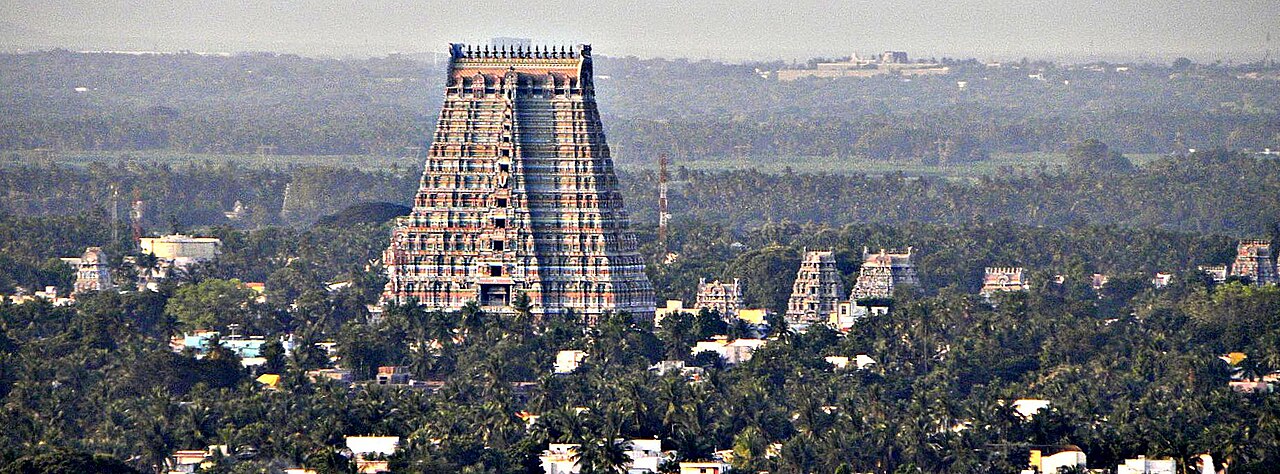
Srirangam holds pride of place as the first and foremost of all 108 Divya Desams. Home to the Sri Ranganathaswamy temple, one of the largest functioning temple complexes in the world, it is often described as Bhooloka Vaikuntam, meaning heaven on earth, and enshrines Lord Ranganatha in his reclining form. For Sri Vaishnavites, a visit here is considered the natural starting point of any Divya Desam pilgrimage.
Tirupati, and specifically the hill shrine of Tirumala, is home to the Venkateswara temple, one of the most visited and most revered of all the Divya Desams. Here Vishnu is worshipped as Lord Venkateswara, also affectionately known as Balaji, and the temple draws pilgrims in vast numbers throughout the year, making it one of the most significant living centres of Vaishnavite devotion anywhere in India.
Kanchipuram deserves special mention because it is home to a cluster of around fourteen or fifteen Divya Desams, more than any other single town in the entire list. Alongside its famous Shaivite shrines, Kanchipuram’s Vaishnavite heart is the Varadaraja Perumal temple, and the town as a whole is often called the city of a thousand temples, reflecting just how central it has been to South Indian religious life for well over a thousand years.
In the heart of the Cauvery delta, Kumbakonam is home to the Sarangapani temple, one of the more prominent Divya Desams in the region, and sits within easy reach of several others nearby, including the temples at Thirunaraiyur and the Oppiliappan temple. The delta as a whole holds so many Divya Desams within such a small area that it is, alongside Kanchipuram, one of the very best places to see a meaningful number of them within a single, well planned trip.
Beyond these four hubs, the list continues to unfold. The Nava Tirupati, nine temples near Tirunelveli, form their own well known pilgrimage circuit, while Alagar Koil near Madurai and Thirukoshtiyur further south are both cherished stops for serious pilgrims. In Kerala, the Malainadu group preserves a distinct regional character within the broader tradition. And beyond the reach of any road trip lie the celestial abodes of Paramapadam and Thiruparkadal, together with the great northern and Himalayan sites of Badrinath, Muktinath, Ayodhya, Mathura and Dwarka, each carrying its own place in the full count of 108.
Undertaking the Divya Desam Pilgrimage
For devout Sri Vaishnavites, visiting all 108 Divya Desams is considered a profound, often lifelong aspiration rather than something to be ticked off in a single journey. Given how widely the sites are spread, most pilgrims complete the circuit gradually, region by region, over years or even decades, fitting visits around family life, work and festival calendars. Some choose to join organised Divya Desam yatras, group pilgrimages that plan out efficient regional routes and handle much of the logistics, while others prefer to travel independently, building their own itinerary one cluster at a time.
Since only the 106 earthly Divya Desams can actually be visited in person, most pilgrims plan their journeys around the natural regional groupings: the Cauvery delta, the Kanchipuram cluster, the Pandya region in the deep south, the Malainadu group in Kerala, and finally the more distant temples of North India, which are often saved for dedicated trips of their own given the distances involved.
Festivals and Sacred Occasions
No time in the Sri Vaishnavite calendar carries more weight than Vaikunta Ekadashi, which typically falls in December or January. At Srirangam in particular, this occasion centres on the opening of the Paramapada Vasal, literally the gateway to heaven, a specific entrance through which devotees pass believing it grants a symbolic passage to Vaikuntam itself. The crowds on this day are immense, and the atmosphere is unlike almost any other temple occasion in South India.
Alongside Vaikunta Ekadashi, most major Divya Desams hold their own annual Brahmotsavam, a multi day festival of processions, chariot pulling and elaborate rituals that marks the temple’s most significant calendar event. Throughout the year, the recitation of the Nalayira Divya Prabandham remains a living daily practice at many of these temples, keeping the Alvars’ original hymns, along with the devotion of Andal, the sole woman among the twelve Alvars, at the very centre of worship.
Practical Guidance for Visitors
These are active places of worship first and tourist sites second, and visitors should treat them accordingly. Modest, conservative dress is expected at all of them, and footwear must be removed before entering the temple precincts, as is customary across South Indian temples. It is worth noting that at some of the most significant Divya Desams, including Srirangam and the Tirupati temple, non-Hindu visitors may find access restricted at the innermost sanctum, even where the outer temple complex remains open to all. Arriving early in the day is generally advisable, both to avoid the heat and to have a calmer, less crowded darshan, particularly outside festival periods. Because the temples are so numerous and spread out, the most practical approach for most travellers is to group visits regionally rather than attempting to cover too much ground in one trip, with the Cauvery delta and Kanchipuram offering the richest concentration for anyone wanting to see several Divya Desams within a single, unhurried journey.
Best Time to Visit
The cooler months from October to March are generally the most comfortable time to travel through Tamil Nadu’s temple towns, when long days on the road and extended time on temple grounds are far more manageable than during the peak summer heat. Within that window, Vaikunta Ekadashi in December or January stands out as the single most significant occasion for Vaishnavites, though travellers should be prepared for very large crowds if visiting at that time, and should plan well ahead around this and other major festival dates.
The Divya Desam represent the spiritual heart of Sri Vaishnavism, 108 abodes of Vishnu immortalised in the hymns of the Alvars and carried forward through centuries of devotion, scholarship and ritual. Tamil Nadu, holding the greatest concentration of these sacred sites, remains the natural place to begin exploring this profound tradition, and there is no more fitting starting point than Srirangam itself, from which the journey outward, temple by temple, region by region, can unfold at its own unhurried pace.