Guide details
Best time to visit
October to March, with Karthigai Deepam in November or December the biggest draw and every full moon night the busiest.
How to get there
By road it is about 185 km and 4 hours by car or 4 to 5 hours by bus from CMBT; trains are indirect, so road is easiest, and there is no airport.
Highlights
Arunachaleswarar Temple, Arunachala hill, Girivalam circuit, Ramana Maharshi Ashram, Skandashramam, Virupaksha Cave, Gingee Fort
Good for
Pilgrims, spiritual travellers, weekend trippers, history buffs, solo travellers, families
Price range
Ashram guest houses and dharamshalas from around Rs 300 to Rs 800, budget hotels Rs 800 to Rs 1,500, mid-range hotels Rs 2,000 to Rs 4,500.
People go to Tiruvannamalai for one of two reasons, often both at once. The first is the Arunachaleswarar Temple, a vast Shiva temple that has drawn pilgrims for well over a thousand years. The second is the hill behind it, Arunachala, which many devotees treat as a form of Shiva in itself. Walk the streets on a full moon night and you quickly understand that this is a living town of faith, not a museum piece.
From Chennai it makes a comfortable day trip if you leave early, though we would gently argue that one day is not really enough. The temple alone can hold you for a couple of hours, and the walk around the hill takes most of an evening. Stay a night if you can, ideally around Pournami, and you will see the place at full tilt. Come on an ordinary weekday and you get something quieter and just as rewarding.
Planning what to do once you arrive? Our full Tiruvannamalai guide covers the main sights, where to stay and the best time to visit.
How to get to Tiruvannamalai from Chennai
Tiruvannamalai sits roughly 185 km south-west of Chennai. The honest answer is that road is the easiest and most reliable way to get there, whichever your budget.
By car or taxi
Driving takes about four hours in normal traffic. The usual route runs down NH38 through Vandavasi and Gingee, a decent road for most of the way. If you are day-tripping, it is worth negotiating a round trip with waiting time rather than a one-way fare. Leaving the city by 6am gets you to the temple before the mid-morning heat and the tour crowds.
By bus
Government and private buses run frequently from CMBT at Koyambedu. State transport buses are cheap and leave through the day, while private operators offer a few more comfortable options. Reckon on four to five hours depending on stops and the traffic out of Chennai. Buses drop you near the town bus stand, a short auto ride from the temple.
By train
Trains are the weak link here, so set your expectations. Tiruvannamalai has a railway station, but direct services from Chennai are limited and often slow, usually routing through Villupuram or Katpadi with a change. Many travellers who prefer rail take a train to Villupuram or Katpadi and continue by bus or taxi. Unless a convenient direct service suits your timing, the bus or a car will get you there faster. There is no airport, so flying is not an option.
Arunachaleswarar Temple
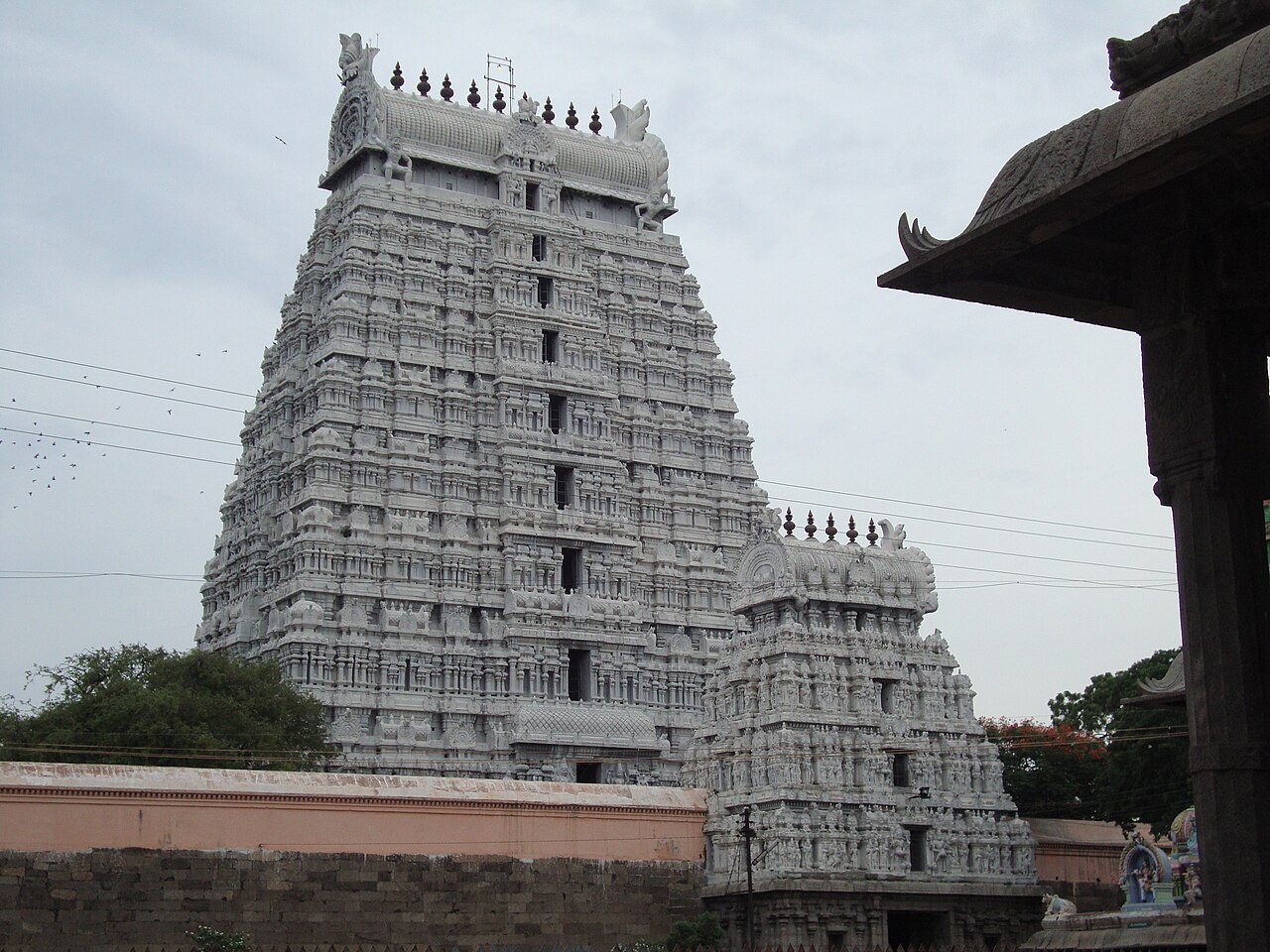
This is one of the Pancha Bhoota Sthalams, the five temples linked to the classical elements, and Arunachaleswarar represents fire. It is enormous. The complex covers around 25 acres and is guarded by tall gopurams, the eastern tower being one of the highest temple gateways in India. Walking in past the pillared halls and tanks gives you a sense of scale that photographs never quite manage.
Entry is free. There are paid queue options and special darshan arrangements on busy days, but you do not need them on a quiet morning. Dress modestly, leave your shoes at the stands outside, and be ready for stone floors that get hot by midday. Cameras and phones are restricted in certain areas, so follow the signs and the staff. Early morning and evening are the best times for both atmosphere and comfort.
Girivalam: walking around the hill
Girivalam, sometimes written Giripradakshina, is the practice of walking the full circle around Arunachala hill. The route is roughly 14 km on paved road, traditionally done barefoot and clockwise. On ordinary days a steady stream of people walk it. On Pournami, the full moon night, the crowd swells into the hundreds of thousands and the road closes to most traffic.
The full circuit takes most people three to four hours at an unhurried pace, with small shrines, lingams and tea stalls to pause at. A few practical notes. If your feet are not used to barefoot walking, be realistic, as the road can be rough and hot in patches, and there is no shame in wearing sandals. Do the walk in the cooler hours, before dawn or in the evening once the sun is low. On full moon nights the crowds mean you should keep valuables close and agree a meeting point, because phone signal struggles when the road is busiest.
Ramana Ashram and the caves
At the foot of the hill sits Sri Ramana Maharshi Ashram, built around the sage who lived and taught here in the first half of the twentieth century. It is a calm, well-kept place that welcomes visitors for meditation and quiet time in the halls, with a bookshop and dining hall, and the atmosphere is deliberately low-key. Nearby you will also find Seshadri Swamigal Ashram, dedicated to a contemporary of Ramana.
For those who want to climb, two spots on the hillside are worth the effort. Virupaksha Cave, where Ramana stayed for years, is reached by a stone path above the ashram. Higher up is Skandashramam, another of his former dwellings, with fine views over the temple and town. The climb is not long but steep in places, so wear proper footwear here rather than going barefoot, and carry water.
Gingee Fort on the way
If you are driving and have the time, Gingee Fort makes a good half-stop on the Chennai side of Tiruvannamalai. It is a dramatic hill fort spread across three rocky hills, once held by the Nayaks, the Marathas, the Mughals and later the French and British. The climb up to the main citadel is steep and exposed, so it suits earlier in the day rather than the afternoon heat. There is a small entry fee. Treat it as an add-on, because a proper visit adds a couple of hours to your day.
Where to eat
This is a pilgrim town, so the food is largely simple, vegetarian and cheap. Around the temple and ashram you will find plenty of small places serving South Indian standards.
- Idli, dosa, pongal and filter coffee for breakfast at any of the busy tiffin joints near the temple.
- Full veg meals, the banana-leaf thali, served at lunchtime for very little money at local mess-style eateries.
- The dining hall at Ramana Ashram, which serves simple sattvic food to visitors at set times, worth checking in advance.
- Roadside tea and snack stalls all along the Girivalam route for a mid-walk break.
We would steer you towards the places full of local families and pilgrims, as they tend to be freshest and best value. Standards are basic but generally clean.
Where to stay
If you decide to stay the night, there is a decent spread of options for different budgets.
- Ashram guest houses and dharamshalas offer the cheapest beds, often from around Rs 300 to Rs 800, though many prioritise devotees and fill up fast on full moon dates, so book ahead.
- Budget hotels in town sit roughly in the Rs 800 to Rs 1,500 range for a basic double.
- Mid-range hotels and a few nicer resorts on the edge of town run from about Rs 2,000 to Rs 4,500, some with a pool and hill views.
Prices climb sharply around Pournami and during Karthigai Deepam, and rooms sell out well in advance, so plan early if your visit lands on a festival or full moon.
Best time to visit
The comfortable window runs from October to March, when the weather is cooler and the long walks are actually pleasant. April to June gets fiercely hot, which makes both the temple stones and the Girivalam road hard going.
The town’s biggest event is Karthigai Deepam, usually in November or December, when a huge fire is lit on top of the hill and the crowds are immense. It is extraordinary to witness but genuinely packed, so go only if you are prepared for that intensity. Every full moon also brings big Girivalam crowds, so for a calmer visit, pick an ordinary weekday outside festival season.
Tips for the trip
- Dress modestly for the temple, with shoulders and knees covered, and be ready to remove footwear at the entrance.
- For Girivalam, wear comfortable sandals if you are not used to walking 14 km barefoot, and go in the cool of early morning or evening.
- Carry cash, as many small shops, stalls and some guest houses do not take cards, and ATMs can run dry on festival days.
- Expect very large crowds on Pournami and during Karthigai Deepam, and agree a meeting point with your group in case phone signal fails.
- Start early from Chennai to beat the traffic and the heat, ideally on the road by 6am for a day trip.
- Carry water, a hat and sun cream if you plan to climb to the caves or visit Gingee Fort.
Tiruvannamalai rewards a little patience. Rush it as a day trip and you will still come away moved by the scale of the temple and the pull of the hill. Give it an overnight, walk the circuit slowly, sit quietly at the ashram, and you start to understand why so many people keep coming back.
View Tiruvannamalai on the map →
Keep exploring Chennai
- Chennai to Thanjavur: The Big Temple and Chola Country Guide
- Chennai to Trichy: Temples, Rockfort and Travel Guide
- Kanchipuram Day Trip from Chennai: Temples, Silk Sarees and How to Get There
- Pondicherry Guide from Chennai: French Quarter, Auroville, Beaches and How to Get There
- Best One Day Trip from Chennai: 8 Easy Escapes