Guide details
Best time to visit
Early morning or evening, year round
How to get there
Located in Mylapore, central Chennai
Highlights
Dravidian gopuram, temple tank, Mylapore lanes
Good for
Culture and heritage lovers, photography
Price range
Free entry
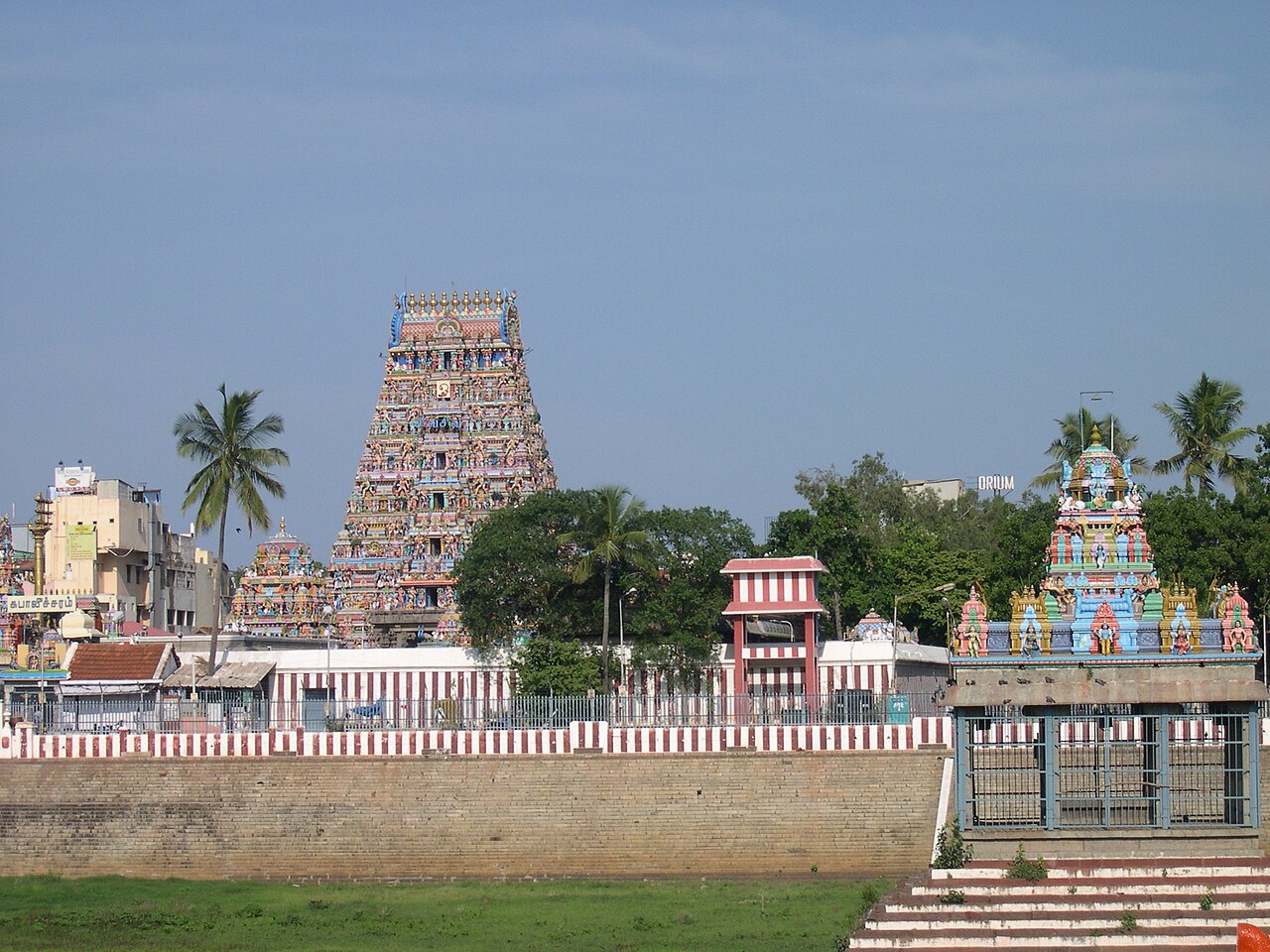
Kapaleeshwarar Temple is the spiritual heart of Mylapore and one of the oldest, most recognisable landmarks in Chennai. Dedicated to Lord Shiva as Kapaleeshwarar and his consort Parvati as Karpagambal, its tall pink and gold gopuram is one of the first things people picture when they think of old Chennai, and a visit here gives you a proper feel for the city’s roots long before it became the metropolis it is today.
History of the temple
The original Kapaleeshwarar temple is believed to have stood much closer to the coast, in what’s now the Santhome area, before it was destroyed during Portuguese colonisation in the 16th century. The temple was rebuilt further inland at its current site in Mylapore, and the structure you see today largely dates from around the 7th century onwards, with major additions made through the Vijayanagara period. The temple tank, or kulam, in front of the eastern entrance is one of the oldest surviving elements and has long been a gathering point for the local community.
Legend has it that Parvati worshipped Shiva here in the form of a peacock (mayil in Tamil), which is where Mylapore, meaning the place of the peacock, is said to take its name. You’ll spot peacock motifs carved throughout the temple as a nod to this story.
Architecture
The temple is built in classic Dravidian style, with its most striking feature being the towering rajagopuram at the eastern entrance, rising to roughly 37 metres and covered in brightly painted stucco figures depicting scenes from Hindu mythology. A second, smaller gopuram stands at the western entrance. Inside, the complex is organised around a series of courtyards and pillared halls, with separate shrines for Kapaleeshwarar and Karpagambal, along with smaller shrines for other deities dotted around the perimeter. The temple tank, framed by stone steps, is particularly photogenic in the soft light of early morning.
Kapaleeshwarar Temple timings
The temple is generally open daily from around 5.00am to 12.30pm, and again from 4.00pm to 9.30pm, though timings can shift slightly around major festivals, so it’s worth checking locally if you’re planning around a specific ritual or ceremony. Mornings are quieter and cooler, and give you a chance to watch the early rituals before the crowds build up. As with most active temples in Tamil Nadu, non-Hindu visitors are typically welcome to walk around the outer courtyards and admire the architecture, though access to the innermost sanctum is usually reserved for worshippers.
Mylapore, the neighbourhood around the temple
Mylapore is one of Chennai’s oldest residential areas, and the streets immediately around the temple are worth exploring in their own right. Kutchery Road and North Mada Street are lined with shops selling flowers, brass lamps, silk and traditional jewellery, many run by families who’ve traded here for generations. This is also a good spot to try authentic Tamil breakfast, with idli, dosa and filter coffee served in unpretentious local eateries that have been feeding the neighbourhood for decades.
A short walk from the temple brings you to Luz Church and, a little further on, Santhome Cathedral Basilica, which marks the traditional burial site of St Thomas the Apostle. It’s a nice reminder that Chennai’s old neighbourhoods carry a genuinely layered history, with temples, churches and old trading streets all sitting within a few minutes’ walk of each other.
Festivals at Kapaleeshwarar Temple
The temple’s biggest annual celebration is the Panguni Peruvizha, also known as the Brahmotsavam, held over ten days in the Tamil month of Panguni, usually falling in March or April. The festival features processions of the temple deities through the streets of Mylapore on elaborately decorated vehicles, culminating in a large car festival (ther), when a giant wooden temple chariot is pulled through the streets by devotees. It’s a spectacular, noisy, joyful event, and if your visit coincides with it, it’s well worth staying on to watch.
- Best visited early morning for a peaceful atmosphere and good light for photos
- Modest dress is expected, and footwear must be removed before entering
- Combine your visit with a walk through Mylapore’s old market streets
- Time your trip around the Panguni Peruvizha in March or April for the full festival
- Nearby Santhome Cathedral and Marina Beach make easy add-ons to a Mylapore morning
Even a short visit to Kapaleeshwarar Temple gives you a real sense of Chennai’s older, quieter identity, one that’s easy to miss amid the traffic and glass towers of the wider city.