Guide details
Best time to visit
Tamil Nadu has festivals in almost every month, but three windows stand out. January brings Pongal, Thaipusam and the Margazhi music season in Chennai. April and May bring the Tamil New Year and Madurai’s Chithirai festival. November and December bring Karthigai Deepam and the start of the Margazhi season. Because festival dates follow the Tamil calendar rather than fixed Gregorian dates, check a current Tamil panchangam before booking travel.
How to get there
Festivals are celebrated right across Tamil Nadu, from Chennai’s neighbourhood temples to small village shrines, so there is no single point of arrival. The biggest and most famous celebrations are tied to particular towns, notably Madurai for the Chithirai festival, Tiruvannamalai for Karthigai Deepam, and Palani for Thaipusam. All of these are well connected by road, rail and air, with Chennai serving as the main gateway and regular bus and train services linking the temple towns.
Highlights
Pongal, Thaipusam, Chithirai festival, Aadi Perukku, Karthigai Deepam, Navaratri Golu, the Margazhi music season, temple car festivals
Good for
Culture and festival travellers, those planning a trip around a particular celebration, families, photographers, and anyone wanting to experience living Tamil traditions rather than just monuments
Price range
Watching a festival is generally free, since these are public and temple occasions rather than ticketed events. What costs more is everything around them: travel and accommodation in temple towns rise sharply and can book out well ahead of major festivals, so budget accordingly and reserve early.
Tamil Nadu keeps one of the richest and most distinctive festival calendars anywhere in India. It is shaped by the Tamil solar calendar, by centuries of temple tradition, by the rhythms of harvest and monsoon, and by a devotional life that runs through daily existence rather than sitting apart from it. Across the year, the state moves through grand temple car festivals, harvest thanksgivings, festivals of light, and festivals of water, each rooted in a particular month, star or season. Many of these follow the Tamil months rather than the Gregorian calendar, so their dates shift a little from year to year. This guide offers an overview of the major celebrations, roughly in the order they fall through the year, with links to fuller guides for the biggest of them.
How the Tamil calendar shapes festival dates
Tamil festivals are generally reckoned by the Tamil solar months: Chithirai, Vaikasi, Aani, Aadi, Aavani, Purattasi, Aippasi, Karthigai, Margazhi, Thai, Masi and Panguni. Many festivals are further tied to a specific star or lunar day within that month, which is why a festival might fall in mid-January one year and a few days earlier or later the next. If you are planning a visit around a particular celebration, it is always worth checking a current Tamil calendar or panchangam for the exact date rather than relying on the previous year’s dates.
January: harvest, devotion and music
The Tamil year’s most important festival by common consent is Pongal, the four day harvest thanksgiving that falls in the Tamil month of Thai, in mid-January. It opens with Bhogi, when old belongings are cleared out and bonfires are lit, moves through Thai Pongal itself, when the new rice is boiled in milk until it overflows the pot as an offering of gratitude, continues with Mattu Pongal, honouring cattle, and closes with Kaanum Pongal, a day for visiting family. In parts of the state, particularly around Madurai, Pongal season is also associated with jallikattu, the traditional bull taming sport. Pongal is the closest thing Tamil Nadu has to a single defining festival, celebrated by Tamil families everywhere, not only within the state.
Later in the same month, or sometimes into February, comes Thaipusam, the great festival of Lord Murugan, timed to the Pusam star in the month of Thai. Devotees carry the kavadi, a ceremonial burden often decorated with peacock feathers, and some undertake acts of penance including piercing the skin with the vel, Murugan’s spear. Palani and the other major Murugan temples see the largest gatherings, with processions and chanting that continue through the night.
January also hosts two celebrations of a gentler kind. The Thyagaraja Aradhana at Thiruvaiyaru draws Carnatic musicians from across the country to honour the composer saint Thyagaraja, while Chennai’s Margazhi season, which actually begins in the preceding Tamil month of Margazhi in December, runs through into January with weeks of Carnatic music and classical dance performed across the city’s sabhas.
February to April: Shivaratri to the Tamil New Year
Maha Shivaratri, the great night of Shiva, falls in the Tamil months of Masi or Panguni, usually in February or March, and is marked by night long vigils and worship at Shiva temples throughout the state. Around the same time, Chidambaram hosts Natyanjali, a festival of classical dance offered in tribute to Nataraja, the dancing form of Shiva enshrined there. Once every twelve years, the town of Kumbakonam holds Mahamaham, when the tank at the centre of town is believed to be blessed by the sacred rivers of India; in the intervening years a smaller annual observance, Masi Magam, is still marked at temples along the coast and rivers.
As the year moves into the Tamil month of Panguni, roughly March into April, many temples celebrate Panguni Uthiram, marking the celestial weddings of various deities, among the most widely observed being that of Murugan and Deivanai. This leads directly into the first day of the Tamil month of Chithirai, in mid-April, which is celebrated as Puthandu, the Tamil New Year, with new clothes, a ceremonial first sight of the year known as kanni, and family gatherings.
April and May: Madurai’s grand temple festival
The Tamil month of Chithirai also gives its name to the Chithirai festival at Madurai, one of the largest and most spectacular temple festivals in the state. Its central episode is the celestial wedding of the goddess Meenakshi to Lord Sundareswarar, celebrated with enormous processions through the streets around the Meenakshi Amman Temple. In another strand of the same festival, Lord Kallazhagar journeys towards the Vaigai river, an episode watched by huge crowds gathered along the riverbanks. Together these make Chithirai one of the defining temple festivals of Tamil Nadu, and worth planning a trip around if timing allows.
The monsoon months: Aadi to Purattasi
The Tamil month of Aadi, falling across July and August, is closely associated with the goddess and with the rivers that sustain the state. Its best known observance is Aadi Perukku, held on the eighteenth day of the month, when communities gather at riverbanks, tanks and wells to give thanks to the Cauvery and to water itself, often floating lamps and offerings on the current. The month also carries a run of Amman worship, including Aadi Amavasai, Aadi Pooram, and the Aadi Fridays, when goddess temples see especially large crowds of devotees.
As Aadi gives way to Aavani, roughly August into September, Vinayaka Chaturthi is celebrated with clay images of Ganesha installed in homes and public pandals before being immersed at the close of the festival. September also brings the Velankanni feast on the Tamil Nadu coast, a major Christian pilgrimage occasion at the Basilica of Our Lady of Good Health, drawing pilgrims of several faiths.
Autumn: Navaratri to Deepavali
September into October brings Navaratri, nine nights honouring the goddess in her many forms, marked in Tamil homes by the Golu, an arranged display of dolls and figurines that families and neighbours visit over the course of the festival. The final days bring Saraswati Pooja, honouring the goddess of learning, and Vijayadashami, also observed as Ayudha Pooja, when tools, vehicles and instruments of one’s trade are worshipped.
Later in the Tamil month of Aippasi, October into November, Skanda Sashti commemorates Murugan’s victory over the demon Soorapadman, celebrated with particular grandeur at Tiruchendur. This period also brings Deepavali, the festival of lights, observed across the state with an early oil bath, the lighting of lamps, crackers and an exchange of sweets, and Nagore Kanduri, a major Muslim festival at the Nagore Dargah on the Tamil Nadu coast that also draws devotees from other communities.
November and December: light and music
The Tamil month of Karthigai, falling across November and December, gives its name to Karthigai Deepam, one of the oldest festivals of the Tamil calendar. Homes and temples are lined with rows of oil lamps over several nights, and the festival reaches its peak with the lighting of the Maha Deepam, a great beacon atop the hill at Tiruvannamalai that can be seen for miles around.
As the year closes into the Tamil month of Margazhi, December into January, Vaikunta Ekadashi is observed at Vaishnavite temples across the state, most notably at Srirangam, where the Paramapada Vasal, the gateway to Vaikuntha, is opened for devotees to pass through. This is also when Chennai’s Margazhi music season begins in earnest, filling the city’s sabhas with Carnatic music and dance until the new year.
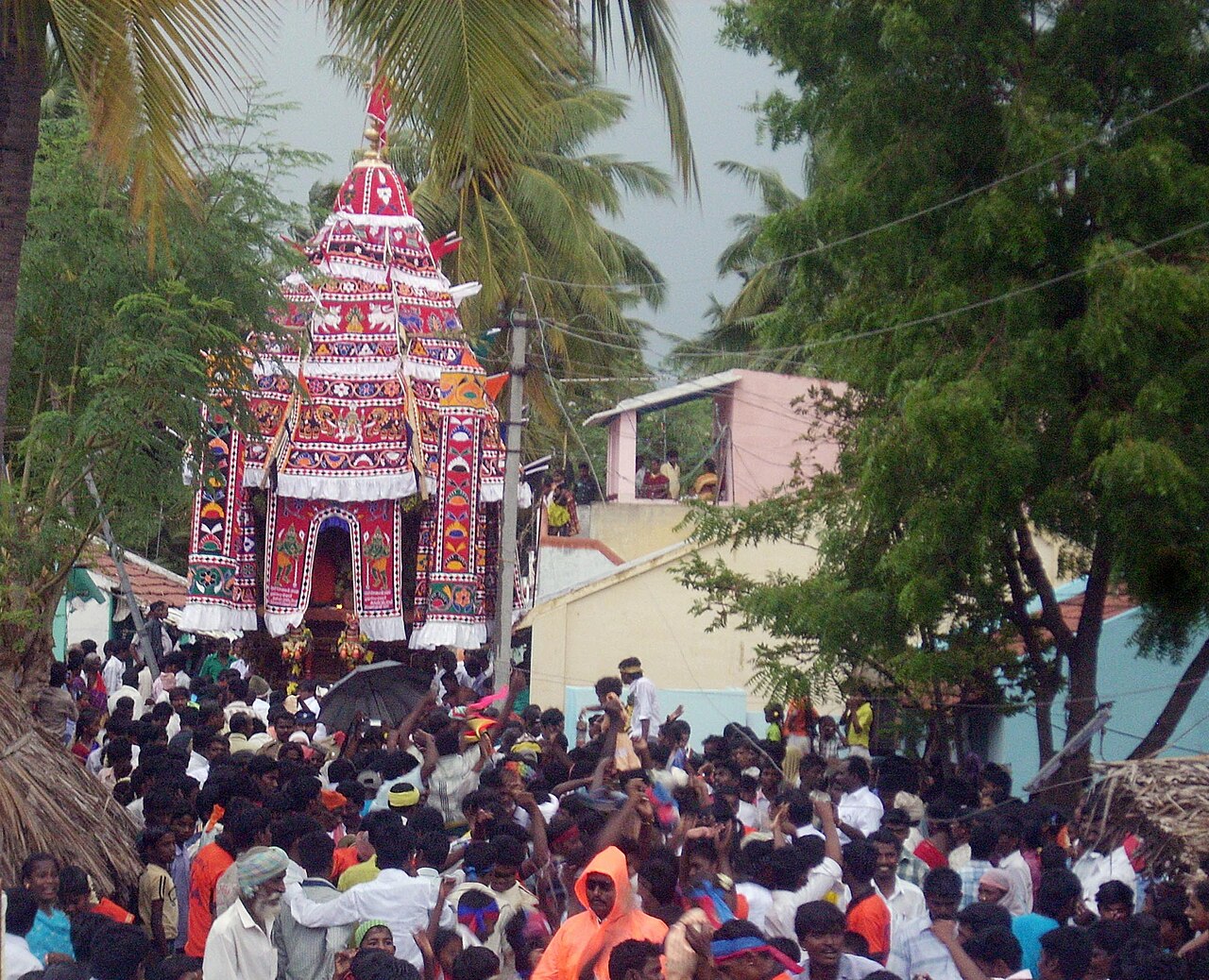
Alongside these named festivals, most temple towns hold their own annual car festival, or ther thiruvizha, when the temple deity is drawn through the streets in a large wooden chariot pulled by devotees, a tradition repeated in one form or another at temples across the state throughout the year. These local car festivals rarely appear on a general calendar, but they are often the most atmospheric way to see a festival up close, since the crowd is largely local rather than visiting.
Tamil Nadu’s festival life is not confined to Hindu observance either. The Velankanni feast and Nagore Kanduri, already mentioned above, sit alongside countless smaller church feasts and mosque urs celebrations held through the year, and in many towns Hindu, Christian and Muslim neighbours turn out for one another’s occasions. This interweaving of traditions is part of what gives the state’s festival calendar such richness and depth.
Best time to visit for festivals
There is genuinely something happening most months, but three periods are especially rewarding for a festival focused visit. January combines Pongal, Thaipusam, the tail of the Margazhi music season and the Thyagaraja Aradhana. April and May bring the Tamil New Year and the Chithirai festival at Madurai. November and December bring Karthigai Deepam and the start of the Margazhi season. Do bear in mind that festival dates mean festival crowds, and that accommodation in temple towns can book out well in advance, so plan ahead if you are timing a trip around a particular date.
Visiting a Tamil festival
Attending a festival is one of the best ways to experience living Tamil culture rather than simply its monuments. Temple towns take on a different character entirely when the streets fill with processions, music and the smell of festival cooking. It is worth remembering, though, that these are acts of worship rather than performances staged for visitors, so modest dress and quiet, respectful behaviour go a long way, particularly inside temple precincts. Expect crowds, expect noise, and expect to be swept up in it a little; the food stalls, the drumming and nadaswaram music, the flower sellers, the processions and the rows of oil lamps are all part of the experience.
Tamil Nadu’s festivals are, in the end, the living, beating heart of its culture: a year round cycle of harvest, light, water, music and devotion that turns the whole state into a kind of ongoing celebration. Timing a visit to coincide with one, whether it is the four days of Pongal, the lamps of Karthigai Deepam or the great procession at Madurai, is one of the most rewarding ways there is to get to know the real Tamil Nadu.