Guide details
Best time to visit
October to March is most comfortable, with cooler weather for temple visits. Tuesdays are the busiest day due to the temple’s Mars associations. The temple’s Brahmotsavam and Skanda Sashti festivals draw larger crowds. Summer months are hot and best avoided.
How to get there
Vaitheeswaran Koil is roughly 260 to 290 km from Chennai, about 5.5 to 6.5 hours by road. The town has its own railway station on the Mayiladuthurai line, though services can be limited. The nearest bigger railhead is Mayiladuthurai, about 15 km away, with Sirkazhi also nearby. The nearest airports are Tiruchirappalli (Trichy) and Puducherry. Regular buses connect it with Mayiladuthurai, Sirkazhi and Kumbakonam.
Highlights
Sri Vaidyanathaswamy Temple, Shiva as Vaidyanatha the divine healer, Thaiyal Nayaki shrine, Selva Muthukumaraswamy (Murugan) shrine, Siddhamirtham temple tank, Angaraka (Mars) Navagraha shrine, Naadi astrology readers, Cauvery delta Navagraha temple circuit
Good for
Pilgrims and devotees, those interested in Navagraha and Mars-related worship, travellers curious about Naadi astrology as a cultural practice, temple architecture and heritage enthusiasts, day trips from Kumbakonam or Mayiladuthurai
Price range
A modest temple town with a few simple budget lodges and pilgrim rest houses near the temple. Most travellers base themselves in Mayiladuthurai or Kumbakonam, which offer a wider range of accommodation, and visit Vaitheeswaran Koil as a day trip. Food locally is simple, inexpensive vegetarian South Indian fare. Check current rates locally.
Vaitheeswaran Koil, also spelled Vaitheeswaran Kovil, is a small temple town in the Cauvery delta of Nagapattinam district, Tamil Nadu, tucked between Mayiladuthurai and Sirkazhi. It is one of those places in the delta where a single temple defines the identity of the whole settlement. The town takes its name from the presiding deity of its temple, worshipped here as Vaitheeswaran or Vaidyanatha, meaning the Lord of Medicine or the divine physician. For generations, pilgrims troubled by illness, chronic pain or a general sense of unease have travelled here hoping for relief, making the Sri Vaidyanathaswamy Temple one of the more emotionally charged pilgrimage stops in Tamil Nadu. Vaitheeswaran Koil carries two further distinctions that draw visitors from well beyond the delta: it is one of the nine Navagraha temples of Tamil Nadu, this one dedicated to Angaraka, the planet Mars, and it is by far the most famous centre in India for Naadi astrology, the tradition of palm-leaf readings said to record an individual’s destiny.
The Sri Vaidyanathaswamy Temple
At the heart of the town stands the Sri Vaidyanathaswamy Temple, where Shiva is worshipped in his form as Vaidyanatha, the healer god and physician deity. His consort here is known as Thaiyal Nayaki, also called Balambika, and shrines to her form part of the temple’s essential rounds. Within the same complex is a shrine to Selva Muthukumaraswamy, a form of Murugan or Skanda who holds particular significance at this temple. Devotees connect him closely with the site’s healing and Angaraka traditions, and he draws a steady stream of worshippers in his own right. The temple’s architecture is typical of the delta’s Chola-era and later temples, with a gopuram, pillared mandapams and several subsidiary shrines within the outer walls, but it is the atmosphere rather than the scale that visitors tend to remember. Because so many pilgrims arrive seeking relief from genuine physical or emotional distress, there is an unusually earnest, hopeful mood inside the temple. Visitors should treat the space accordingly, as an active site of worship and personal hope for local families, not a monument to be viewed from a distance.
The Healing Tradition and the Siddhamirtham Tank
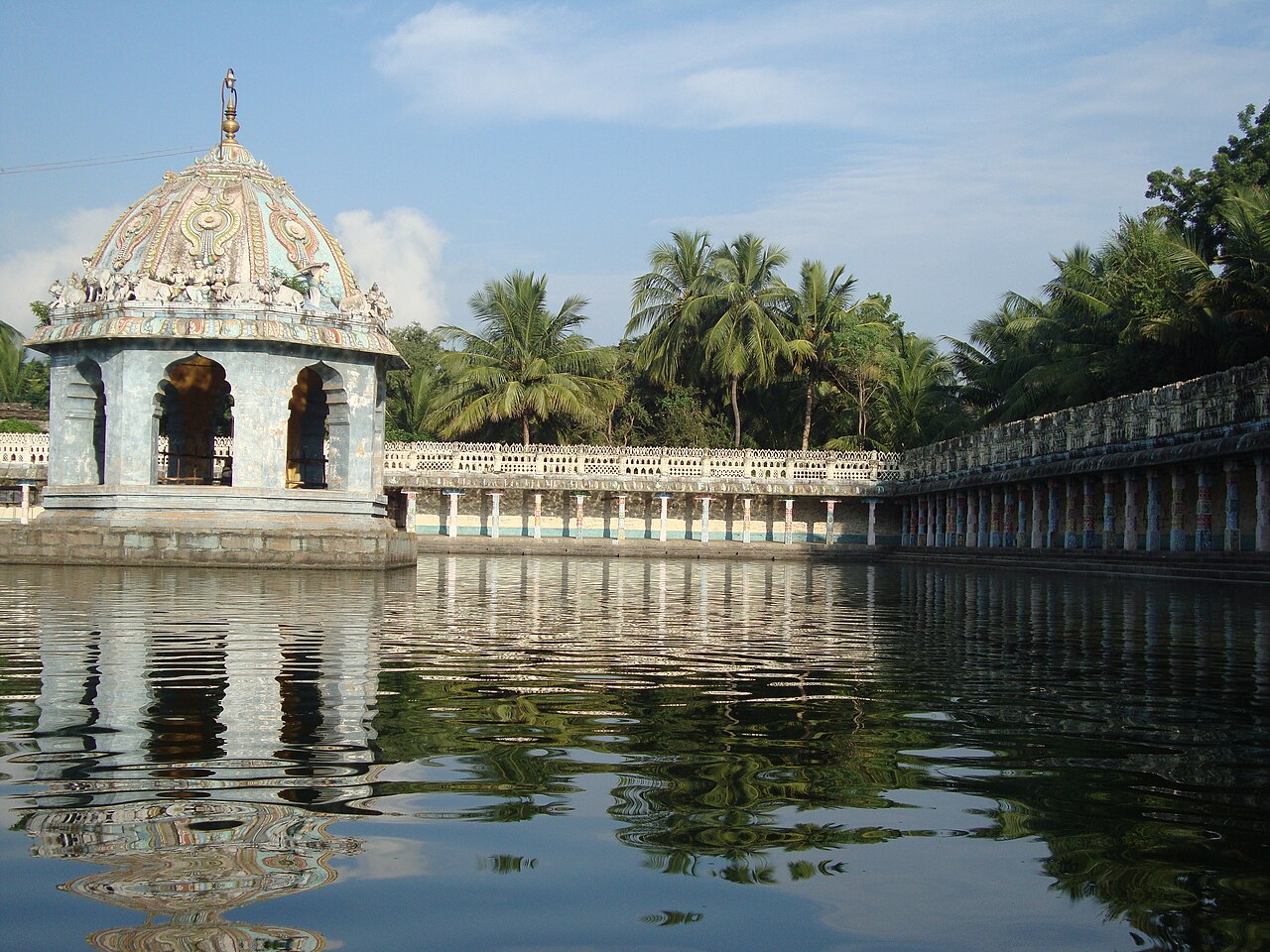
Central to Vaitheeswaran Koil’s reputation is its temple tank, the Siddhamirtham, whose waters are believed by devotees to carry curative properties. Pilgrims bathe here, or apply the water, as part of a ritual appeal for relief from illness. A distinctive local custom involves devotees preparing a paste or powder, together with offerings of salt, pepper and jaggery, which are dissolved into the tank waters while prayers are offered for the health of the sick person. Sacred ash, or vibhuti, distributed at the temple is also widely regarded by devotees as carrying healing significance, and some pilgrims roll small portions of ash and other substances as part of their personal offering. These are devotional customs rooted in long-standing faith rather than medical treatments, and this guide describes them as belief and cultural practice, not as claims about actual cures. Anyone dealing with a genuine health concern should continue to rely on qualified medical care, and may choose to visit the temple alongside that, as many local families do, as a matter of faith and comfort rather than a substitute for treatment.
A Navagraha Shrine: Angaraka and Mars
Vaitheeswaran Koil is one of nine Navagraha temples scattered across the Cauvery delta, each associated with one of the nine celestial bodies of traditional Hindu astrology. This temple’s planet is Angaraka, known in Tamil as Chevvai or Sevvai, corresponding to Mars. Devotees who believe their horoscope shows an unfavourable placement of Mars, sometimes referred to as Chevvai dosham and traditionally considered relevant in marriage matching, come here to perform parihara, or remedial worship, hoping to ease its effects. As with the healing rituals at the main shrine, this is a matter of traditional astrological belief rather than a scientifically verifiable outcome, and visitors are best served by treating it as a cultural and spiritual practice to observe or take part in according to their own convictions. Tuesdays, associated with Mars in Tamil tradition, are considered especially significant here, and the temple tends to be busier on that day than on others through the week.
Naadi Astrology: The Palm-Leaf Readers
Beyond the temple itself, Vaitheeswaran Koil is widely known as the principal centre in India for Naadi astrology, sometimes written Naadi Jyotisham. The practice involves readers, often working from small offices clustered around the temple, who claim to be custodians of ancient palm-leaf manuscripts said to contain individualised readings, originally recorded, according to tradition, by sages of the past. A visitor is typically asked for a thumbprint, which the reader uses to attempt to locate the specific leaf said to correspond to that person, from which details of the person’s life and family are then read out. This is a deeply held tradition for many visitors, and a significant part of why some travellers make the journey to this particular delta town. At the same time, it is a matter of personal faith rather than an established or independently verifiable science, and this guide describes it neutrally, without endorsing its claims and without dismissing what is a genuine, long-running cultural practice for many. Readings are commercial transactions, fees vary between operators, and travellers considering a session are best advised to ask about costs clearly beforehand, to be wary of pressure to pay for additional or costlier readings partway through, and to use their own judgement throughout, much as they would with any paid consultation from a stranger.
Exploring the Cauvery Delta Temple Circuit
Vaitheeswaran Koil rarely stands alone on an itinerary. It forms part of the wider Navagraha temple circuit spread across the Cauvery delta, with other planetary shrines nearby, including Thiruvenkadu, associated with Mercury. Karaikal lies within easy reach and is the usual base for visiting Thirunallar, the temple dedicated to Saturn and one of the most visited of the nine Navagraha shrines. Kumbakonam, the delta’s biggest temple town and a natural hub for the region, is also within comfortable reach and makes a sensible base for travellers wanting a wider choice of accommodation and food while exploring the Navagraha circuit. Nearby Sirkazhi and Mayiladuthurai each have significant temples of their own and are worth a stop if time allows, while Nagapattinam and the coastal town of Poompuhar lie further along the delta towards the sea, for those with extra days to spare.
Vaitheeswaran Koil is one of the nine planetary shrines on the Navagraha temples circuit of the Cauvery delta, which our full guide covers in detail.
Food and Where to Stay
Vaitheeswaran Koil itself is a modest, unhurried temple town rather than a tourist hub, and its accommodation reflects that. A handful of simple budget lodges and pilgrim rest houses operate close to the temple, adequate for an overnight stop but limited in choice compared with larger towns. Many visitors instead base themselves in Mayiladuthurai or Kumbakonam, both of which have a broader spread of hotels, and visit Vaitheeswaran Koil as a day trip or a stop along the delta circuit. Food in the town is simple, vegetarian South Indian fare served in small local eateries near the temple, tasty and inexpensive rather than elaborate. Travellers wanting more variety are better served basing themselves in one of the nearby larger towns.
Best Time to Visit
Like much of the Cauvery delta, Vaitheeswaran Koil is at its most pleasant from October through to March, when temperatures are cooler and more comfortable for temple visits and walking around town. Summer brings considerable heat and is best avoided where possible. Tuesdays, given the temple’s Mars associations, tend to be the busiest day of the week, so travellers who prefer a quieter visit might choose another day. The temple’s festival calendar includes an annual Brahmotsavam and celebrations around Skanda Sashti in honour of Muthukumaraswamy, both of which draw larger crowds and add a festive atmosphere for those who time their visit accordingly.
Getting There
Vaitheeswaran Koil sits roughly 260 to 290 km from Chennai, a road journey of about five and a half to six and a half hours depending on the route and traffic through the delta towns. The town has its own railway station on the Mayiladuthurai line, convenient for pilgrims travelling by train, though services can be limited, so checking timings locally is worthwhile. The nearest larger railhead is Mayiladuthurai, around 15 km away, with more frequent connections, and Sirkazhi is another nearby option. The closest airports are at Tiruchirappalli (Trichy) and Puducherry, both requiring a further road journey of a couple of hours or more into the delta. Regular bus services connect Vaitheeswaran Koil with Mayiladuthurai, Sirkazhi, Kumbakonam and other delta towns, making it easy to combine with a wider circuit even without a private vehicle.
Practical Tips
As with any active Tamil Nadu temple, modest dress is expected, and men are often asked to remove shirts before entering the inner sanctum in keeping with local custom, so it helps to check current practice on arrival. Footwear is left outside, and stone floors can be hot underfoot in the middle of the day, so early morning or late afternoon visits are more comfortable. If you take part in the tank rituals or healing offerings, follow the lead of temple staff or local devotees rather than guessing at the correct procedure. For Naadi astrology sessions, take your time choosing an operator, ask about fees upfront, and remember this is a matter of personal belief rather than a guaranteed service, so proceed only if you are comfortable doing so. Pairing the visit with Kumbakonam or Karaikal makes for a fuller and more efficient delta itinerary than visiting Vaitheeswaran Koil in isolation.
Vaitheeswaran Koil is not a grand monument built for spectacle, but a working temple town shaped by centuries of faith in Shiva the healer, by its place among the Navagraha planetary shrines, and by the singular reputation of its Naadi astrology readers. It rewards travellers who approach it with curiosity and respect rather than expecting sightseeing highlights, and it fits naturally into a longer exploration of the Cauvery delta’s temple towns, best experienced unhurried, alongside neighbouring stops such as Kumbakonam and Karaikal.