Guide details
Best time to visit
October to March is the most comfortable time, with cool mornings good for the climb and the walk around the hill. The Panguni Uthiram festival (March/April) and Skanda Sashti (October/November) are the biggest occasions but draw very large crowds, so visit early in the day if you come then. Summer months are hot and better avoided for midday visits.
How to get there
Thiruparankundram sits on the edge of Madurai, about 8 km from the city centre, so the easiest route is to reach Madurai first, roughly 460 km from Chennai by road, rail or air, and then make the short local hop. Thiruparankundram has its own railway station, and it is well connected by Madurai city buses and autos. Madurai airport is very close by, making this one of the most convenient temple visits to combine with a Madurai trip.
Highlights
rock-cut cave temple carved into Thiruparankundram hill, sanctum of Subramanya believed to be the site of Murugan’s celestial wedding to Deivanai, Pandya-era rock sculptures of Durga, Vinayaka, Shiva and Vishnu, Nayak-period mandapams and gopuram, dargah near the hill summit reflecting the site’s shared sanctity, panoramic views over Madurai, Panguni Uthiram and Skanda Sashti festival celebrations
Good for
pilgrims and devotees of Murugan, couples seeking blessings for marriage, history and temple architecture enthusiasts, day-trippers from Madurai, festival travellers
Price range
Most visitors base themselves in Madurai, which has a full range of hotels from budget to upscale, and treat Thiruparankundram as a short excursion. Local lodging right at Thiruparankundram itself is limited, so Madurai remains the practical base. Check current entry and darshan arrangements locally, as these can change.
Of the six sacred abodes of Lord Murugan, the Arupadai Veedu revered across Tamil Nadu, Thiruparankundram holds the distinction of being the first. It is also one of the most accessible, lying barely 8 km from the heart of Madurai, close enough that many visitors treat it as a half-day extension of a Madurai temple trip rather than a separate journey. Yet its modest distance from the city belies its antiquity and importance. The Thiruparankundram Murugan Temple, also known as the Arulmigu Subramania Swamy Temple, is carved partly into the living rock of a hill that rises abruptly from the plain, and it is celebrated in some of the oldest surviving Tamil literature. Few temples in the state combine such deep antiquity with such everyday convenience for the traveller.
This temple is one of the Arupadai Veedu, the six sacred abodes of Lord Murugan. For the full circuit and the story that links them, see our Arupadai Veedu guide.
The Temple: A Rock-Cut Shrine of the Pandya Era
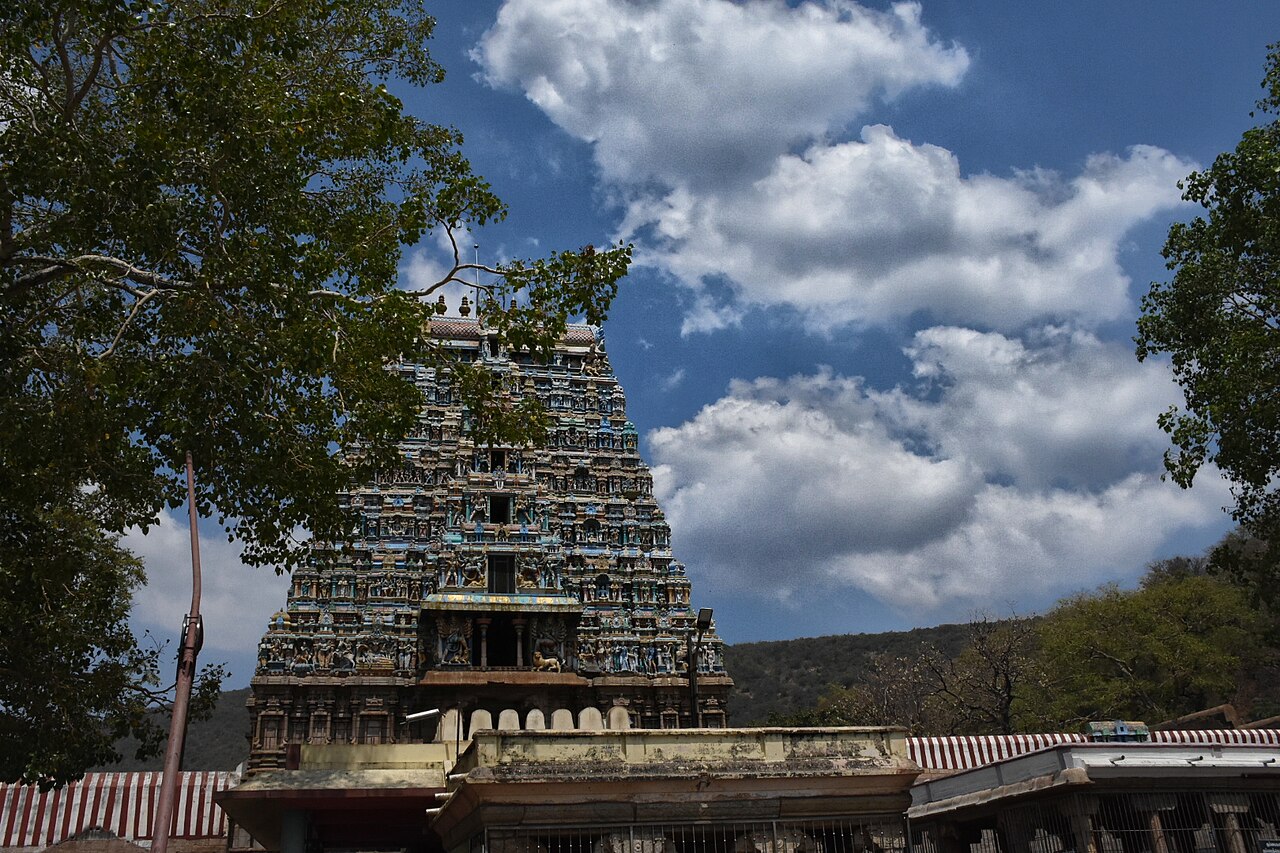
The heart of Thiruparankundram is a cave temple cut directly into the hillside, work generally attributed to the Pandya kings, whose capital at Madurai lay just a short distance away. This rock-cut core is what gives the temple its distinct character among the six abodes, most of which stand as free structures rather than carved sanctuaries. Over succeeding centuries, particularly under the Nayak rulers, the temple was extended outward with pillared mandapams, a gopuram and subsidiary shrines, so that today a visitor moves from open, brightly painted halls into the cooler, quieter interior of the original cave sanctum. The layering of periods is part of what makes a visit rewarding: the temple is not a single moment frozen in stone but a building that has been added to, generation after generation, without losing its rock-cut heart.
The Marriage of Murugan and Deivanai
What sets Thiruparankundram apart from the other Arupadai Veedu sites is its association with marriage. Tradition holds that after Murugan defeated the demon Surapadman, he was married here to Deivanai, daughter of Indra, king of the celestials. Where other abodes are more closely tied to Murugan’s valour or his ascetic aspect, Thiruparankundram is remembered as the place of his wedding, and this shapes much of the devotional life of the temple. Couples come here specifically to seek blessings for marriage and married life, and the temple has a strong association with weddings and auspicious beginnings. It is worth keeping this in mind when visiting, since it is common to see wedding parties and newly married couples offering worship, especially on auspicious dates.
Sculptures and Rock-Cut Architecture
The rock-cut sanctum area is notable for housing several deities in close proximity, a feature that reflects both the antiquity of the site and the way devotion here has grown to encompass more than Murugan alone. Within the temple complex, worshippers will find shrines and sculptural representations connected to Durga, Vinayaka, Shiva and Vishnu, carved with the restrained, confident artistry typical of Pandya rock work. The pillared halls added in later centuries provide a striking contrast to the cave shrines, their columns carved with more elaborate figures typical of the Nayak period. Visiting involves a certain amount of walking and some steps, particularly around the cave sanctum, so comfortable footwear that can be removed easily is worth bringing, since temple etiquette requires bare feet within the premises.
The Hill and Its Shared Sanctity
Thiruparankundram hill, sometimes called Parangi Malai, is sacred in more than one tradition. Alongside the Murugan temple at its base, the hill is associated with a dargah near its summit, linked to Hazrat Sikandar Badusha, which draws its own stream of devotees. Historically, the hill has also been connected with Jain ascetic beds from an earlier era, evidence of the many communities that have regarded this outcrop as worthy of reverence over the centuries. This layered, interfaith character of the hill is worth approaching with respect and curiosity rather than surprise. It is a reminder that sacred landscapes in Tamil Nadu often carry more than one story. Those who make the climb are also rewarded with wide views over Madurai and the surrounding plain, a pleasant, quiet contrast to the activity within the temple below.
Festivals at Thiruparankundram
The temple’s festival calendar is busy throughout the year, but two occasions stand out. Panguni Uthiram, usually falling in March or April, commemorates the celestial wedding of Murugan and Deivanai and is celebrated here with particular significance given the temple’s own association with that event. Skanda Sashti, typically in October or November, marks Murugan’s victory over Surapadman and draws large numbers of devotees, many observing fasts in the lead-up. Thai Poosam is also observed with kavadi processions, a familiar sight at Murugan temples across the state. On all these occasions, expect substantial crowds and plan for longer waits, particularly if visiting for darshan rather than simply to see the temple.
Its Place Among the Six Abodes
Thiruparankundram’s standing as the first of the Arupadai Veedu is well established in Tamil devotional literature, including the Thirumurugatruppadai, an early guide poem to Murugan’s six abodes, and in references scattered through Sangam-era Tamil poetry. This antiquity, combined with its cave architecture, gives the site a particular weight among the six. Devotees who undertake the full circuit of the Arupadai Veedu will find themselves travelling considerable distances across Tamil Nadu, since the abodes are spread from the hills near Madurai to sites near Chennai. Among them, Palani is perhaps the best known and most visited, and travellers doing a wider Murugan pilgrimage often plan to see both Thiruparankundram and Palani, even though they lie some distance apart and are usually visited on separate legs of a trip.
Getting There
Because Thiruparankundram is effectively on the edge of Madurai, roughly 8 km from the city centre, the practical approach is to think of it as part of a Madurai visit rather than a separate destination. Madurai itself is about 460 km from Chennai, reachable by road, rail or air, and once there, Thiruparankundram is a short and simple journey away. The town has its own railway station, making it easy to reach directly by train for those coming from within Tamil Nadu, and it is also served by city buses and autos from central Madurai. Madurai’s airport lies close to Thiruparankundram as well, which is useful to know if flying in, since some visitors choose to see the temple on their way into or out of the city.
Where to Stay
There is limited dedicated lodging right at Thiruparankundram, and most visitors do not need it. Madurai, just a short distance away, offers a full range of accommodation from simple budget lodges to comfortable mid-range and upscale hotels, and staying there makes it easy to combine a visit to Thiruparankundram with Madurai’s other attractions, above all the Meenakshi Amman Temple. Treating Thiruparankundram as a half-day or morning excursion from a Madurai base is by far the most common and practical approach.
Practical Tips
- Dress modestly and be prepared to remove footwear before entering the temple; comfortable shoes that slip on and off easily help, since there are some steps and walking involved.
- Visit early in the morning if possible, especially outside the cooler October to March season, and particularly on or around Panguni Uthiram and Skanda Sashti, when crowds are heaviest.
- Because of the temple’s association with marriage, it is common to encounter wedding-related worship and ceremonies; observe quietly and respectfully if you find yourself present during one.
- Approach the hill’s dargah with the same respect shown to the temple, keeping in mind the site’s long shared history among different communities.
- Check locally for current timings, entry arrangements and any fees, as these can change and are best confirmed on arrival rather than assumed in advance.
- Pair the visit with time in Madurai itself, since the short distance makes it easy to see both without a separate overnight stay.
Thiruparankundram rewards a traveller willing to look past its modest size and short distance from Madurai. As the first of Murugan’s six abodes and the traditional site of his celestial wedding to Deivanai, it carries a depth of devotion and history that few short excursions can match. Between its rock-cut Pandya sanctum, its Nayak-era halls, the layered sanctity of the hill above, and the warmth of its wedding associations, a visit here offers something genuinely distinct, easily and rewardingly folded into any trip to the temple city on its doorstep.