Guide details
Best time to visit
October to March, when the coastal heat eases, is the most comfortable time to visit. The Skanda Sashti festival in October or November is the spiritual highlight of the year but draws very large crowds, so plan ahead if attending. Summer months are hot and humid and best avoided if possible.
How to get there
Tiruchendur is roughly 600 to 630 km from Chennai, a journey of about 11 to 13 hours by road, so it is best treated as a multi-day trip into the deep south of Tamil Nadu. The town has its own railway station and is well connected to Tirunelveli and Thoothukudi. The nearest airports are Tuticorin, about 40 km away, and Madurai, about 160 km away.
Highlights
Arulmigu Subramania Swamy Temple, sea-facing gopuram, Nazhi Kinaru sacred well, sea bath before darshan, Skanda Sashti and Soorasamharam re-enactment, Bay of Bengal sunrise, Tiruchendur beach, Manapad coastal village nearby
Good for
Pilgrims and devotees of Murugan, families visiting the Arupadai Veedu circuit, temple architecture and history enthusiasts, coastal sunrise walks, travellers combining a southern Tamil Nadu temple trail with Kanyakumari and Tirunelveli
Price range
Mostly budget and pilgrim-style lodges in Tiruchendur town, some run by the temple Devasthanam, suited to modest overnight stays. Greater choice of mid-range and standard hotels is available in nearby Thoothukudi and Tirunelveli for those wanting more comfort. Check current rates locally rather than relying on fixed figures.
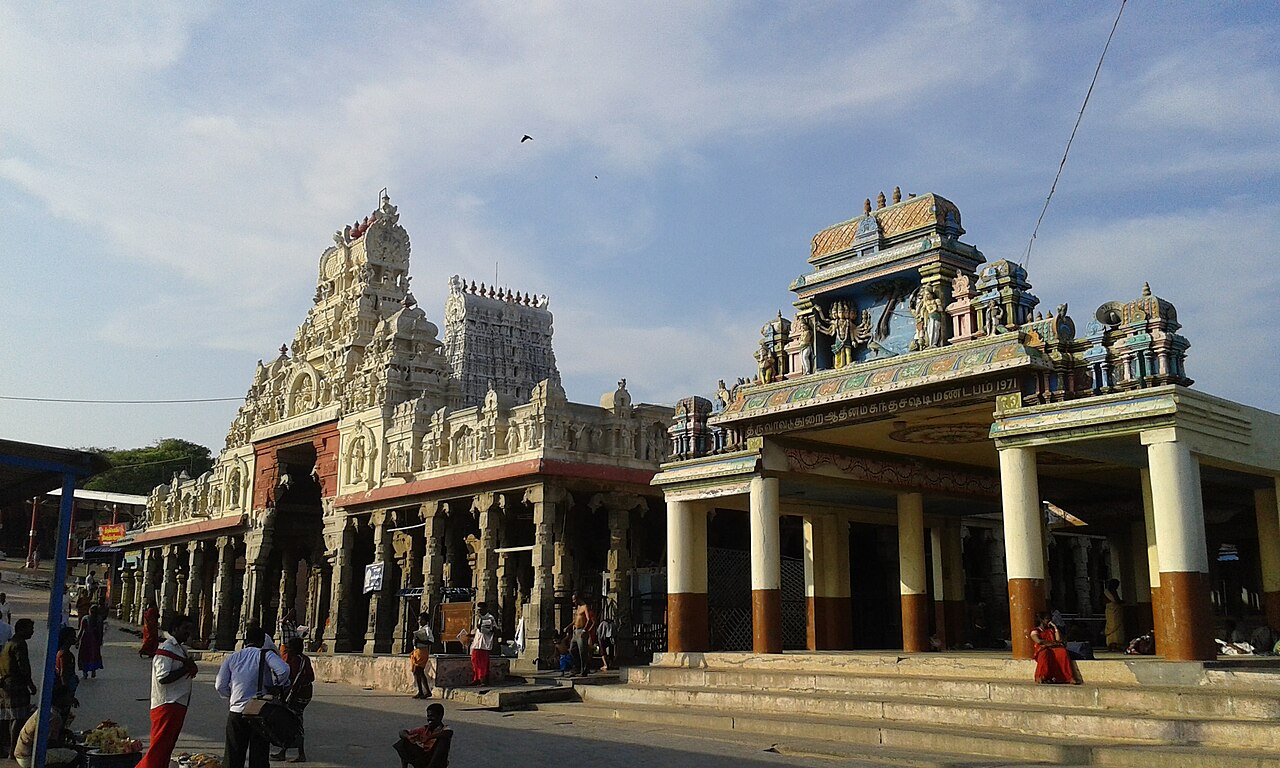
Tiruchendur holds a special place among the Arupadai Veedu, the six sacred abodes of Lord Murugan, also known as Subramanya or Kartikeya. Of these six shrines scattered across Tamil Nadu, five sit atop hills, but Tiruchendur alone stands directly on the seashore, its sanctum almost within reach of the waves. The Arulmigu Subramania Swamy Temple rises on the coast of Thoothukudi district, in the deep south of Tamil Nadu, facing the wide expanse of the Bay of Bengal. For centuries it has drawn pilgrims from across the state and beyond, and it remains one of the busiest and most beloved Murugan temples in the country.
The setting itself gives Tiruchendur its distinct character. Where other Murugan shrines require a climb, here the approach is flat and coastal, and the temple’s soaring gopuram can be seen from a considerable distance across the open land, a landmark for pilgrims and fishermen alike long before they reach the town.
This temple is one of the Arupadai Veedu, the six sacred abodes of Lord Murugan. For the full circuit and the story that links them, see our Arupadai Veedu guide.
The Arulmigu Subramania Swamy Temple
The presiding deity of Tiruchendur is worshipped as Senthil Andavar, a form of Subramanya celebrated here as the victorious warrior god. The temple architecture reflects centuries of patronage and expansion, with tall gateway towers, wide corridors and sculpted pillars typical of South Indian temple building traditions, though the site itself is believed to be far older than its present structures. Part of the temple is understood to be cut into rock, a feature that adds to its sense of antiquity and sanctity.
Within the temple precincts lies the Nazhi Kinaru, a small well whose water remains fresh even though it sits so close to the sea. Pilgrims regard this quietly remarkable feature as one of the temple’s many signs of divine grace, and it is pointed out to visitors as part of any proper tour of the complex.
The Legend of Soorasamharam
Tiruchendur’s sanctity is tied closely to one of the central episodes in the Murugan legend. It is here, tradition holds, that Murugan paused to worship Lord Shiva before marching on to confront the demon Surapadman. The ensuing battle, and Murugan’s eventual victory, is known as Soorasamharam, and it is regarded as having unfolded along this very coast. The temple therefore is not simply a place of worship but a site tied to a specific, much-loved story of good triumphing over evil, one that is retold every year with great devotion and spectacle.
Sea Bath and Temple Rituals
As at several coastal shrines in Tamil Nadu, many pilgrims begin their visit to Tiruchendur with a sea bath, known locally as the theertham, in the Bay of Bengal just beside the temple. This ritual dip is considered an act of purification before entering the sanctum, and it is common to see families and groups of devotees wading into the surf early in the morning before proceeding, still slightly damp, towards darshan. Visitors intending to take part should carry a change of clothes and be mindful of the sea conditions.
The temple, like most major shrines in Tamil Nadu, is administered by a Devasthanam and generally offers both free darshan and special darshan arrangements for those wishing a quicker or more unhurried visit. A conservative dress code is expected within the temple, and it is worth checking current timings, darshan options and any entry requirements locally before travelling, since these details can change.
Skanda Sashti: The Great Festival
The single biggest event on Tiruchendur’s calendar is Skanda Sashti, usually falling in October or November, which commemorates Murugan’s victory over Surapadman. Over several days, the temple builds towards a dramatic re-enactment of the Soorasamharam battle staged on the beach itself, complete with elaborate ritual drama that draws enormous crowds from across Tamil Nadu and further afield. Devotees also perform kavadi, carrying decorated ritual offerings as a form of penance and devotion, a practice closely associated with Murugan worship generally. Anyone planning to attend Skanda Sashti should expect very heavy crowds, book accommodation well ahead, and be prepared for a long and intensely devotional occasion rather than a quiet visit.
A Temple Steeped in History
Tiruchendur’s roots run deep into Tamil devotional literature. The site is associated with the Tirumurugatruppadai, one of the celebrated Sangam-era works in praise of Murugan, and it features in later hymns composed by the Nayanmars and other devotional poets, underlining its long-standing place in Tamil religious life. Successive dynasties, including the Nayak rulers, contributed to the temple’s structures over the centuries, gradually shaping it into the complex seen today.
One chapter of the temple’s history that is often recounted locally concerns the seventeenth century, when the temple’s idols were taken away during a period of Dutch, or VOC, activity along this coast. The idols were later recovered and restored to the temple, an episode that local tradition still recalls with a mixture of sorrow and quiet pride, and which is frequently mentioned by temple guides and historians as part of Tiruchendur’s story.
The Coastal Town of Tiruchendur
Beyond the temple itself, Tiruchendur is a modest, sun-baked coastal town with a strong fishing character. The beach beside the temple is a popular spot to watch the sunrise over the Bay of Bengal, with fishing boats often visible just offshore and the temple gopuram catching the first light of the day. The surrounding landscape is the flat, hot coastal plain typical of this part of southern Tamil Nadu, and visitors should be prepared for strong sun and humidity, particularly outside the cooler months.
Nearby Places Worth Exploring
Tiruchendur makes a natural base for exploring this stretch of the Tamil Nadu coast. Thoothukudi, also known as Tuticorin, is the region’s main port city and lies about 40 km away, offering more facilities, transport connections and a glimpse of the state’s maritime trade. Tirunelveli, a historic temple town in its own right, is within easy reach as well. Further along the coast sits Manapad, a smaller and quieter village with a long Catholic history, an old church, and a rocky cape associated with the missionary Francis Xavier, worth a detour for its very different but equally interesting character. Travellers with more time can push further south to Kanyakumari, at the very tip of the Indian peninsula.
Those drawn to Tiruchendur often go on to visit the other Arupadai Veedu shrines elsewhere in Tamil Nadu, completing something of a pilgrimage circuit devoted to Murugan. Palani, another of the six abodes and among the most visited hill temples in the state, is a common next stop for many devotees continuing their journey.
Where to Stay
Accommodation directly in Tiruchendur tends to be simple, consisting largely of budget lodges and pilgrim-oriented guesthouses, some of them run by the temple Devasthanam itself. These are practical rather than luxurious, aimed at devotees who are in town primarily for darshan rather than a leisure stay. Travellers wanting a wider choice of hotels, including more comfortable or mid-range options, generally find better selection in Thoothukudi or Tirunelveli, both a short drive away. Many visitors treat Tiruchendur as one stop within a broader southern Tamil Nadu temple circuit rather than a standalone destination, basing themselves in a larger town nearby.
Best Time to Visit
The cooler months from October through March are generally the most comfortable time to visit Tiruchendur, when the coastal heat is easier to manage and mornings by the sea are genuinely pleasant. The Skanda Sashti festival, usually in October or November, is the spiritual peak of the year, but it also brings the largest crowds by far, so it suits those prepared for a busier, more intense pilgrimage experience. Summer months bring considerable heat and humidity along this stretch of coast and are best avoided unless necessary.
Getting to Tiruchendur
Tiruchendur sits roughly 600 to 630 km from Chennai, and the road journey typically takes around 11 to 13 hours, making this very much a multi-day trip rather than a quick getaway. The town has its own railway station and is well connected by rail and road to both Tirunelveli and Thoothukudi, which serve as useful gateways for onward travel. The nearest airport is at Tuticorin, about 40 km away, with Madurai’s airport, roughly 160 km distant, offering another option for those flying in from further afield. It sits about 40 km from Thoothukudi and around 75 km from Tirunelveli, both natural stops on the way south. For a full breakdown of routes and travel time, see our Chennai to Tiruchendur guide.
Practical Tips
- Carry a change of clothes if you plan to take the sea bath before darshan.
- Arrive early to catch the sunrise over the Bay of Bengal and to avoid both the heat and the busiest darshan queues.
- Follow the temple’s dress code and general etiquette as an active place of worship.
- Book transport and accommodation well in advance if visiting during Skanda Sashti.
- Consider combining Tiruchendur with Thoothukudi, Tirunelveli or Kanyakumari to make the long journey south more worthwhile.
- Check current darshan timings, fees and any special arrangements locally, as these can change.
Tiruchendur is a rare and moving place, the only one among the six sacred abodes of Murugan where the sea itself becomes part of the worship. Its towering gopuram against the Bay of Bengal, the story of Soorasamharam retold each year on its beach, and the quiet devotion of pilgrims taking their sea bath before darshan all combine to make it a destination well worth the long journey south. For anyone tracing the Arupadai Veedu circuit, or simply seeking a temple town of great beauty and depth of feeling, Tiruchendur deserves an unhurried visit and a place on any southern Tamil Nadu itinerary.