Guide details
Best time to visit
Early morning or late afternoon, avoiding the midday heat, on any day the memorial is open
How to get there
In Nungambakkam, central Chennai, reachable by metro, bus or auto rickshaw within minutes of Nungambakkam High Road
Highlights
33 metre stone temple chariot, life size statue of Thiruvalluvar, all 1330 Thirukkural couplets inscribed on granite, one of Asia\u2019s largest auditoriums
Good for
literature and culture lovers, architecture fans, history buffs, a quick central Chennai stop, families and students
Entry
A modest entry ticket, generally a small sum for adults with children often free or discounted. Always confirm current rates at the counter
Some monuments need a whole day. Valluvar Kottam is not one of them, and that is part of its charm. Tucked into Nungambakkam in the heart of Chennai, it is the kind of place you can visit in under an hour and still walk away having learned something real about Tamil culture. It will not overwhelm you the way a temple town or a museum complex might, but it rewards a slow, unhurried look.
This is a guide to what Valluvar Kottam actually is, what you will see when you get there, and how to fold it into a day out among the other places to visit in Chennai. We have tried to keep the practical details honest rather than polished, because ticket prices and hours do shift and you deserve to know that upfront.
What is Valluvar Kottam?
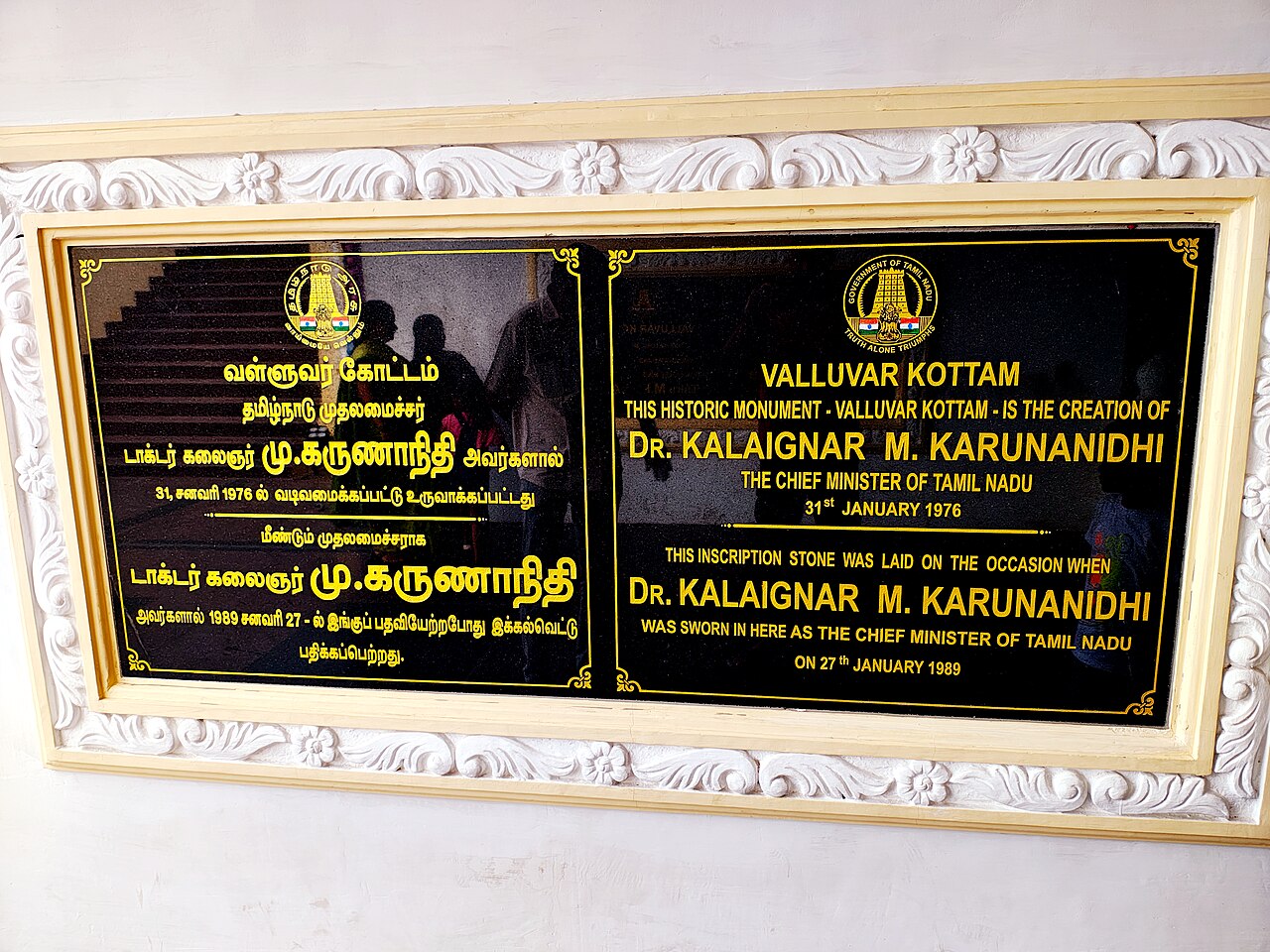
Valluvar Kottam is a memorial built in 1976 to honour Thiruvalluvar, the ancient Tamil poet saint whose name is inseparable from Tamil literary identity. Thiruvalluvar is best known as the author of the Thirukkural, a work of 1330 couplets on ethics, government, love and everyday conduct that is still quoted in Tamil Nadu the way other cultures quote scripture or classical philosophy.
The memorial was conceived not just as a statue or a plaque but as a full architectural statement, a way of giving Thiruvalluvar and his writing a physical home that Chennai residents and visitors alike could walk through. It sits on a fairly open, green plot, which makes it feel more spacious than many city centre monuments.
The temple chariot and the Thirukkural
The centrepiece of Valluvar Kottam is a huge stone structure shaped like a temple chariot, or ther, the kind that is pulled through the streets during South Indian temple festivals. This one is carved from granite, stands about 33 metres tall, and was modelled on the temple car of Thiruvarur, one of the most famous temple chariots in Tamil Nadu.
Inside the chariot is a life size statue of Thiruvalluvar himself. It is a quiet, almost solemn space, and most visitors pause here longer than they expect to.
Around the base of the memorial, in the corridors and galleries that lead toward the auditorium, all 1330 kurals of the Thirukkural are inscribed on granite panels. Walking past them, even without reading Tamil, gives you a sense of the sheer scale of the work, and for anyone who does read Tamil, this is essentially a stone library you can walk through.
The auditorium
Attached to the chariot structure is the Valluvar Kottam auditorium, which is regularly described as one of the largest in Asia, with seating for several thousand people. It has hosted large scale public events, cultural performances and political gatherings over the decades, and it remains an active venue rather than a museum piece.
Visitors on a casual sightseeing trip will mostly view the auditorium from outside or through its entrance, since access depends on whether an event is scheduled, but its scale alone is worth noting as you walk the grounds.
What to expect on a visit
Valluvar Kottam is not a place with cafes, gift shops or long queues. It is a quiet, largely outdoor and semi open site with a clear cultural and architectural focus. Most visits are short, thoughtful, and a welcome change of pace from Chennai’s busier attractions.
- The 33 metre granite temple chariot, best appreciated from a distance first, then up close
- The statue of Thiruvalluvar inside the chariot structure
- Granite panels inscribed with the Thirukkural couplets along the corridors
- The exterior of the large auditorium building
- Open grounds that are pleasant for a slow walk, particularly in the morning
- A generally calm, uncrowded atmosphere compared with more famous Chennai landmarks
Timings and entry
Valluvar Kottam charges a modest entry ticket and keeps set opening hours, typically with a break at some point in the day and one weekly closed day at many similar Chennai monuments. Because these details can and do change, we would rather be honest than guess precisely, so please confirm the current ticket price, opening hours and any closed day directly at the gate or through the Tamil Nadu tourism department before you plan your visit around it.
As a rule of thumb, arriving earlier in the day tends to mean fewer crowds and cooler walking conditions, since much of the site is outdoors.
How to get there
Valluvar Kottam sits in Nungambakkam, one of central Chennai’s most convenient neighbourhoods to reach, close to Nungambakkam High Road, the US Consulate area and Cathedral Road. This central position is one of the memorial’s biggest practical advantages.
Chennai Metro has a station within easy reach of the memorial, making it one of the simplest ways to arrive without worrying about traffic. City buses running along Nungambakkam High Road and nearby arterial roads also stop close by, and autos and app based cabs can get you to the gate directly from almost anywhere in the city. If you are staying in Nungambakkam, T Nagar or Egmore, this is an easy add on rather than a special trip.
Nearby and tips
Because Valluvar Kottam sits right in central Chennai, it pairs naturally with a wider day of sightseeing rather than standing alone. Cathedral Road, the Semmozhi Poonga botanical garden, and several museums and galleries in the surrounding area are all within a short ride, so it is worth checking a broader list of places to visit and building a loop around this part of the city.
- Carry water and wear comfortable shoes, since much of the visit involves walking outdoors
- Photography is generally allowed in the outer areas, but check current rules at the entrance, especially near the auditorium
- Visit slowly rather than rushing, this is a site to absorb rather than tick off
- If you can read even a little Tamil, take time with a few of the inscribed kurals, they are genuinely worth pausing over
- Combine it with other central Chennai stops on the same day to make the most of the location
Valluvar Kottam will not take up your afternoon, but it stays with you a little longer than its size suggests. It is a rare kind of monument, one built around a poet and a book rather than a king or a battle, and that alone makes it worth the short detour.