Guide details
Best time to visit
October to March for cooler, more comfortable temple visits, with early mornings and evenings the most pleasant times of day. The Chithirai festival in April or May is spectacular but hot and extremely crowded. The nightly bedchamber ceremony is worth timing your visit around.
How to get there
The temple stands at the very centre of Madurai, so the first step is reaching Madurai itself, roughly 460 km from Chennai and well connected by road, rail and its own airport. Once in the old city, the temple is impossible to miss, since streets and markets radiate outward from its gopurams in every direction.
Highlights
the four main gopurams, the Thousand Pillar Hall and musical pillars, the Golden Lotus Tank, the gold-plated vimanas of Meenakshi and Sundareswarar, the nightly palanquin ceremony, the Chithirai festival, the Float Festival at Mariamman Teppakulam
Good for
pilgrims and devotees, architecture and history enthusiasts, photographers, festival travellers, families exploring Tamil Nadu’s temple heritage, first time visitors to Madurai
Price range
Entry to the temple is generally free, with optional paid routes for quicker or special darshan; check current arrangements locally on arrival. Madurai itself offers everything from budget lodges to upscale hotels, so a stay to suit most budgets is easy to find near the temple.
In the heart of Madurai, rising above the rooftops of the old city in a riot of colour and stone, stands one of the most extraordinary religious monuments in the world. The Meenakshi Amman Temple, also known as the Meenakshi Sundareswarar Temple, is not merely a place of worship but the living, breathing centre of an entire city that has organised itself around this sacred space for centuries. Dedicated to the goddess Meenakshi, a form of Parvati, and her consort Sundareswarar, a form of Shiva, the temple is unusual among India’s great shrines in that the goddess is honoured as the primary and ruling deity, with the god as her consort rather than the other way round. It is a vast, ancient complex, regularly named among the finest examples of Dravidian temple architecture anywhere, and it has appeared on shortlists and popular polls for the wonders of the modern world. For anyone travelling through Tamil Nadu, it is simply essential.
The legend of Meenakshi
The story of Meenakshi is one of the most beloved in Tamil devotional tradition. According to legend, a Pandya king performed a great yajna in the hope of a son to succeed him. From the sacred fire emerged not a boy but a girl, extraordinary in two respects: she had three breasts, and her eyes had the elongated, striking shape of a fish, which is how she came to be called Meenakshi, from the Tamil and Sanskrit for fish eyed. A divine voice told the astonished king to raise her as he would a son and that her third breast would vanish the day she met the man destined to be her husband.
Meenakshi grew into a formidable warrior queen. She took up her father’s throne, led armies, and set out to conquer the world, region by region, until at last her campaign brought her to Mount Kailash, the abode of Shiva. There, on meeting Shiva in his form as Sundareswarar, the beautiful lord, her extra breast disappeared exactly as foretold, and she understood in that instant that she had found her destined consort. The two were married in a celestial wedding at Madurai, an event of such cosmic significance that it is re-enacted every year during the Chithirai festival, drawing enormous crowds who come to witness the union of the goddess and the god all over again. Meenakshi is worshipped not as a subordinate deity but as the sovereign of Madurai, and the temple’s entire layout and daily ritual life reflect her primacy.
A masterpiece of Dravidian architecture
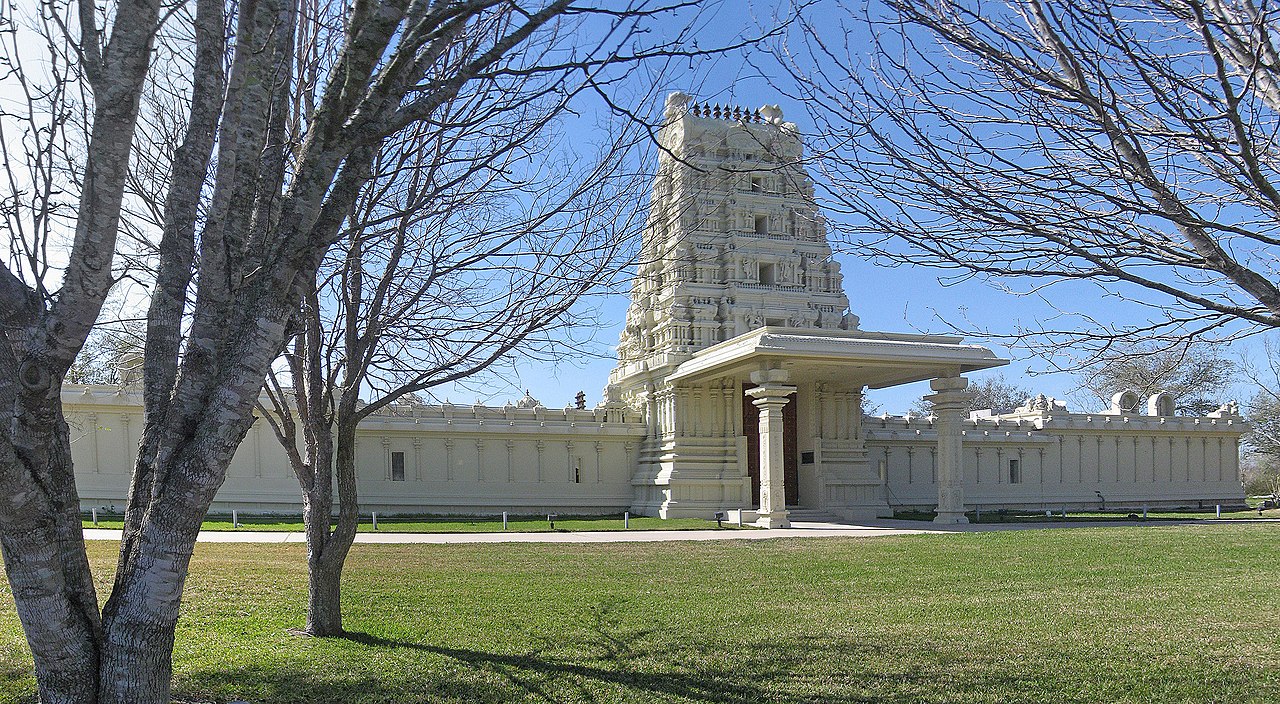
The temple complex is immense, enclosed within high walls that shut out the noise of the city and preserve within them an atmosphere unlike anywhere else in Madurai. What strikes every visitor first, often from a considerable distance across the rooftops, are the gopurams, the soaring gateway towers that mark the entrances to the sacred enclosure. There are fourteen of these towers in total, the tallest reaching somewhere around fifty metres, and each one is covered from base to summit with thousands of brightly painted stucco figures depicting gods, goddesses, demons, celestial beings and scenes drawn from mythology. The colours are vivid and are repainted periodically to keep the towers looking as vibrant as tradition demands, which is part of why the temple remains one of the most photographed sights in South India. Four of the gopurams face the cardinal directions and mark the main outer entrances to the complex, while the others lead deeper into the inner precincts. Standing beneath one of these towers, craning your neck to take in the sheer density of carved and painted figures stacked tier upon tier, gives a genuine sense of the ambition behind this building.
Inside the temple
At the heart of the complex lie the two principal shrines, one dedicated to Meenakshi and the other to Sundareswarar, each crowned with its own gold plated vimana, the tower that sits directly above the sanctum. These inner sanctums are the most sacred spaces in the temple and access to them is generally restricted, but the surrounding halls, corridors and courtyards are extensive enough to occupy visitors for hours.
Among the most celebrated spaces is the Ayirakkal Mandapam, better known as the Thousand Pillar Hall, a vast columned hall containing close to nine hundred and eighty five intricately carved pillars, each one different from the next. Part of the hall now functions as a temple art museum, displaying sculpture and artefacts connected to the temple’s long history. Among the pillars are the famous musical pillars, carved in such a way that tapping them produces distinct musical notes, a feat of acoustic engineering that continues to fascinate visitors and scholars alike.
Nearby is the Potramarai Kulam, the Golden Lotus Tank, a large sacred water tank surrounded by covered walkways and steps. Tradition holds that the Sangam poets of old would test the merit of their verses here, tossing their palm leaf manuscripts into the water in the belief that inferior work would sink while genuine literary merit would keep the leaf afloat. The tank remains one of the most tranquil and photogenic corners of the complex. Elsewhere visitors will find the Kilikoondu Mandapam, or parrot cage hall, once home to caged parrots trained to repeat the names of the goddess, the Meenakshi Nayakkar Mandapam, and the Ashta Shakti Mandapam near the eastern entrance, its pillars carved with the eight forms of the goddess’s shakti. Corridor after corridor is lined with sculpture, much of it worn smooth by centuries of touch and devotion.
The temple’s history stretches back to the Pandya dynasty, who established Madurai as their capital and built early shrines on this site, though what stands today owes an enormous debt to later rulers. The most significant expansion came under the Nayak dynasty, particularly during the reign of Thirumalai Nayak in the sixteenth and seventeenth centuries, when much of the temple’s present grandeur, including many of its halls and gopurams, took shape. The result is a building that has been added to, embellished and rebuilt across many centuries, yet reads as a coherent and unified whole.
Rituals and daily life
What makes the Meenakshi Amman Temple so compelling is that it is not a museum piece but an intensely active place of worship. Priests conduct poojas throughout the day, incense and camphor smoke drift through the corridors, and the sound of temple bells and chanting is a constant presence. Perhaps the most touching of all the daily rituals takes place each night, when the image of Sundareswarar is carried in a palanquin procession from his shrine to Meenakshi’s chamber, a ceremony known as the palli arai or bedchamber ceremony. It is a nightly re-enactment of the divine couple retiring together, performed with quiet devotion by the priests and watched by those visitors who make a point of staying late enough to see it. Temple elephants were historically part of daily life here as they were at many great South Indian temples, and the streets immediately surrounding the complex still buzz with flower sellers, garland makers and small stalls supplying the puja items devotees need before entering.
The Chithirai festival and the Float Festival
No account of this temple is complete without its festivals. The grandest by far is the Chithirai festival, held in the Tamil month of Chithirai, corresponding to April and May, when Madurai comes alive for the Meenakshi Thirukalyanam, the celestial wedding of Meenakshi and Sundareswarar, re-enacted with elaborate processions, enormous temple chariots and crowds that number well over a million people across the festival period. It is one of the largest and most important temple festivals anywhere in Tamil Nadu, and while it is an unforgettable spectacle, visitors should be prepared for intense heat and very significant crowds.
A gentler and cooler counterpart is the Float Festival, or Theppam, usually held around January or February at the Mariamman Teppakulam tank a short distance from the main temple, when temple deities are taken out on beautifully illuminated floats across the water. Both festivals reveal a side of the temple’s life that daily visits, however moving, cannot quite capture.
Visiting the temple: practical advice
A visit here calls for a degree of preparation out of respect for the sanctity of the place. Modest clothing is expected, covering the shoulders and knees, and footwear must be removed before entering, with cloakroom or footwear counters available near the entrances to look after your shoes while you explore. Photography rules can change and are often restricted inside the complex, particularly around the inner sanctums, so it is worth checking the current position on arrival rather than assuming cameras or phones are freely permitted throughout.
Non-Hindu visitors are generally not permitted into the innermost sanctums housing the main deities, but this restriction covers only a small part of what is an enormous complex, and the vast majority of the temple, including the gopurams, the pillared halls, the tank and the many outer shrines and corridors, remains open to all visitors regardless of faith. The temple typically closes for a few hours around the middle of the day before reopening for the afternoon and evening, so it is sensible to plan a visit around this break rather than arriving unannounced. Allowing two to three hours gives a reasonable sense of the complex without feeling rushed. Both free general darshan and quicker paid darshan options are usually available, and it is worth asking locally about current arrangements, since these details can change. In places where it is permitted, climbing to a rooftop or viewpoint overlooking the temple gives a wonderful perspective on the gopurams from above, and hiring a local guide at the entrance is a good way to make sense of the vast amount of sculpture and symbolism on display.
The temple’s place in Madurai
It would be a mistake to think of the Meenakshi Amman Temple as simply one attraction among many in Madurai. The old city was in fact laid out around the temple in a series of concentric streets and squares, a plan that still governs how Madurai functions today, with markets, lodgings and daily life all arranged in rings radiating outward from the temple walls. To understand Madurai at all is to understand that this temple is not located within the city so much as the city has grown up around it.
Best time to visit
The cooler months from October to March are generally the most comfortable for exploring the temple at a relaxed pace, with early mornings and evenings offering softer light and smaller crowds. The Chithirai festival in April or May is an extraordinary spectacle and well worth planning a trip around if the heat and crowds do not deter you, but for a calmer, more contemplative visit the cooler season is kinder. Whenever you choose to come, try to stay long enough into the evening to witness the nightly bedchamber ceremony, a small, quiet ritual that captures something of what makes this temple so beloved.
A living heart of devotion
Few buildings anywhere manage to be simultaneously a supreme achievement of architecture and engineering, a working centre of daily worship, and the literal heart of a city’s civic life. The Meenakshi Amman Temple manages all three. Whether you come as a pilgrim, a student of temple architecture, or simply a curious traveller passing through Tamil Nadu, the sight of its towering, colour-drenched gopurams and the atmosphere of devotion within its ancient walls is something that stays with visitors long after they leave Madurai.