Guide details
Best time to visit
Early morning or evening, outside the midday closing, and avoid the peak festival crush unless you want to see it
How to get there
In Thiruvanmiyur on Chennai\u2019s south coast, close to Thiruvanmiyur MRTS station and served by buses along LB Road and the ECR
Highlights
Tall Dravidian gopuram, large temple tank, pillared corridors, Shiva and Tripurasundari Amman shrines, healing associations
Good for
Devotees, temple architecture fans, culture and heritage travellers, anyone exploring Thiruvanmiyur and the south Chennai coast
Entry
Free entry to the main temple, with small paid charges (typically a few hundred Rs at most) for special darshan or archana
Tucked into the older part of Thiruvanmiyur, a few streets back from the coast road, Marundeeswarar Temple is one of those Chennai temples that locals visit far more often than tourists notice. It is not a monument kept for viewing. It is a working shrine where people bring their health worries, their gratitude, and their Monday routines, and that gives it a different kind of atmosphere from the sights further north in the city.
The temple is dedicated to Shiva in his form as Marundeeswarar, and that name alone tells you what makes this place distinctive. We think it is worth visiting slowly, not rushed, because so much of what matters here is in the small details of worship rather than in a single dramatic view.
About Marundeeswarar Temple
Marundeeswarar Temple is a Shiva temple in Thiruvanmiyur, a coastal neighbourhood towards the southern end of Chennai, on the way to the ECR and OMR corridor. The name Marundeeswarar means God of medicines, or God of healing, and it is this association that shapes the temple’s character. Devotees have long come here to pray for good health, for recovery from illness, and for relief from ailments, believing that Shiva in this form has a particular power to heal.
Alongside the main sanctum for Shiva, the temple has a shrine dedicated to his consort, worshipped here as Tripurasundari Amman. Like most large Shaivite temples in Tamil Nadu, the goddess shrine is an essential part of a visit, not an afterthought, and many devotees pray at both before leaving.
History and legend
Marundeeswarar Temple has ancient roots. It is counted among the temples sung by the Tamil saint poets, the Nayanmars, whose devotional hymns form part of the Tevaram and give many of Tamil Nadu’s Shiva temples their historical anchor. A temple praised in these hymns is generally understood to have existed in some form well over a thousand years ago, even where the buildings we see today are later.
Local tradition also links the site to two sages associated with Tamil learning and healing, Agastya and Markandeya. The stories vary in detail depending on who tells them, but the thread running through all of them is the same: this was a place where sages sought and received healing from Shiva, which is how the temple came to be associated with medicine and health in the first place.
As with many ancient shrines along this stretch of coast, the temple structure we see now owes a great deal to later expansion, particularly during the Chola period, when temple building and patronage flourished across the region. Subsequent centuries added further halls, corridors, and the tank, so what stands today is really a layered building, its oldest core wrapped in newer construction.
The temple and what to see
Marundeeswarar Temple has the scale and layout typical of a major Dravidian temple, and there is genuinely a lot to take in if you walk it properly rather than heading straight to the sanctum.
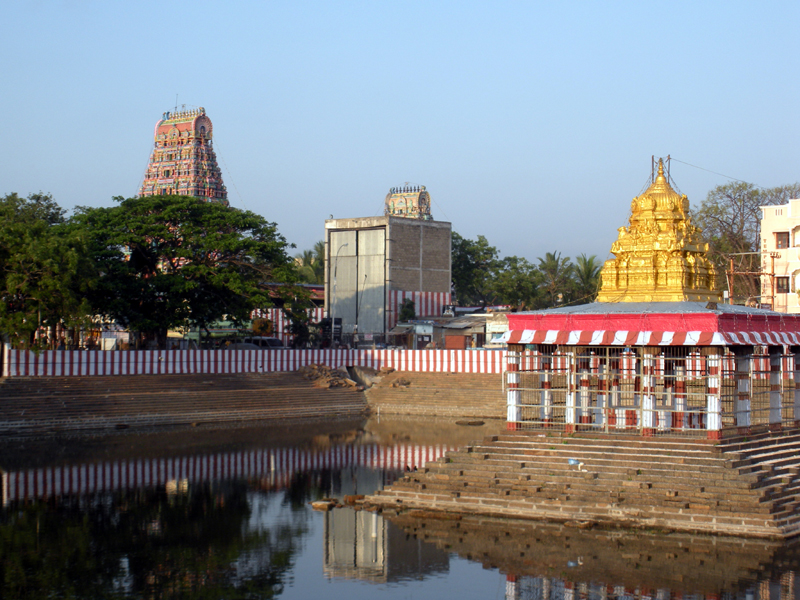
- A tall gopuram, the tiered entrance tower, which is visible above the surrounding streets and marks the temple from a distance.
- A large temple tank, used historically for ritual bathing and still an important feature of the complex, offering a calm spot to sit once you have completed your darshan.
- Long pillared corridors running around the inner courtyards, typical of temples expanded over centuries, with columns that reward a slow walk rather than a quick pass through.
- The main sanctum housing Shiva as Marundeeswarar, along with subsidiary shrines to other deities usually found in a Shaivite temple of this size.
- The Tripurasundari Amman shrine, a separate and significant stop on any visit.
None of this is showy in the way some newer temples are. The appeal is in the age of the stone, the quiet of the corridors outside the busiest hours, and the sense that generations of the same families have been coming here for the same reasons.
Worship and festivals
Mondays hold particular significance at Marundeeswarar Temple, as they do at most Shiva temples in Tamil Nadu, and you will notice larger crowds on that day compared with the rest of the week. Shivratri is the other major point in the calendar, drawing devotees through the night for extended worship, along with the wider round of Shaivite festivals observed here across the year.
What sets this temple apart is the particular focus of the prayers offered. Because of its healing associations, many devotees come specifically to pray for good health, whether for themselves or for family members who are unwell, and this gives the daily worship at Marundeeswarar Temple a slightly different tone from a purely ceremonial visit.
Visiting: timings, entry and etiquette
Entry to the temple is free. Like most active Tamil temples, it follows a split schedule, open in the morning and again in the evening, with a midday closing in between. We would rather be honest here than guess at exact hours: timings can shift around festivals and change over time, so it is worth confirming the current schedule locally or by phone before you plan your visit around it.
If you want a special darshan or an archana performed in your name, there is a small paid charge for that, on top of the free general entry. This is standard practice and the amounts are modest.
Dress modestly, as you would at any working Hindu temple, and be ready to remove your footwear before entering the temple precincts. Photography rules can vary inside the sanctum areas, so it is sensible to ask rather than assume.
How to get there
Marundeeswarar Temple sits within Thiruvanmiyur, on Chennai’s south coast, not far from Thiruvanmiyur Beach. The neighbourhood is well connected for a temple visit: Thiruvanmiyur MRTS station is close by, and buses running along LB Road and the wider ECR corridor stop within easy reach. If you are coming from the city centre or from further along the ECR and OMR belt, this makes the temple a manageable stop rather than a long detour.
Nearby and tips
Thiruvanmiyur’s biggest draw beyond the temple is the beach itself, a good spot for a walk before or after your visit, especially in the cooler part of the day. The neighbourhood also sits conveniently between the older city and the newer IT corridor, so it is easy to combine with other stops if you are working your way through places to visit in Chennai. Devotees who enjoy temple architecture often pair a visit here with the Kapaleeshwarar Temple in Mylapore, another major Shiva temple with its own distinct gopuram and history, though the two have quite different atmospheres worth experiencing separately.
- Go early morning or evening, both for the light and for a calmer darshan.
- Carry a small bag for your shoes if the temple’s footwear area is busy.
- Mondays are the liveliest day, which is wonderful for atmosphere but means longer queues.
- Combine the visit with a walk at Thiruvanmiyur Beach, which is close by.
- Keep some small change for archana or offerings.
Marundeeswarar Temple rewards a visitor who is willing to slow down. It will not overwhelm you the way some of Chennai’s grander landmarks might, but spend an hour here, watch how people pray, and you will understand why this particular temple has held its place in local life for so long.