Guide details
Best time to visit
October to February, cool and dry after the monsoon; avoid June to September and the retreating monsoon in October to November if you want dry days
How to get there
Train roughly 15 to 17 hours, flight about 1 hour 15 to 1 hour 30 minutes, road roughly 700 to 780 km taking 12 to 14 hours, bus roughly 13 to 16 hours overnight
Highlights
Sree Padmanabhaswamy Temple, Kovalam beach, Kuthiramalika Palace Museum, Napier Museum, Kanyakumari day trip, Varkala cliff, Poovar backwaters, Kerala sadya
Good for
temple visits, beach breaks, heritage and museums, honeymoon and couple trips, family holidays, food lovers, monsoon greenery seekers
Price range
Budget stays from around Rs 1200 to 2000 a night, mid range Rs 2500 to 5000, resorts in Kovalam from Rs 6000 upwards; a sadya meal typically Rs 150 to 350
Chennai to Trivandrum is one of the longer hauls on the south Indian travel map, but it is also one of the most rewarding, because Thiruvananthapuram, still called Trivandrum by almost everyone, sits right at the southern tip of Kerala’s west coast with the sea, a famous temple and some of the state’s best beaches all within reach of each other. It is not a quick weekend dash the way Chennai to Pondicherry is, so it helps to know honestly what each mode of travel involves before you book anything.
Depending on the route you take, the distance works out to roughly 700 to 780 km. That is a proper long distance trip, and the right way to cover it changes quite a bit depending on whether you have a day to spare or a whole week. Below we have laid out every option, the temple and beaches waiting at the other end, and a nearby side trip to the very tip of India at Kanyakumari.
Chennai to Trivandrum distance and travel time
A quick summary before the detail:
- By train: roughly 15 to 17 hours, several direct trains to Thiruvananthapuram Central
- By flight: about 1 hour 15 minutes to 1 hour 30 minutes, several daily flights
- By road: roughly 700 to 780 km, about 12 to 14 hours by car
- By bus: roughly 13 to 16 hours, overnight sleeper and semi sleeper services
By train
The train is the most popular way to make this journey, and for good reason. Several direct trains run from MGR Chennai Central and from Chennai Egmore down to Thiruvananthapuram Central, station code TVC, with the total journey usually taking somewhere between 15 and 17 hours depending on the specific train and how many stops it makes along the way. Some services run overnight, which suits most travellers well since you sleep through a large part of the distance and wake up close to Kerala. There are also daytime options if you would rather watch the countryside change from the dry Tamil Nadu plains to the palm lined Kerala backwaters as you go south past Madurai and Tirunelveli.
Classes on offer range from Sleeper class for budget travellers up through AC 3 tier, AC 2 tier and AC First Class on the better equipped trains, so there is something for most budgets. Because this is a heavily travelled route, especially around festivals, the temple season and school holidays, tickets in AC classes fill up fast. Booking through IRCTC a few weeks ahead is a sensible habit rather than a luxury on this route. If your plans are flexible, checking a couple of different train options rather than fixating on one departure time will usually get you a confirmed berth more easily.
By flight
Flying is by far the fastest way to cover this distance. Chennai (MAA) to Trivandrum International Airport (TRV) takes about 1 hour 15 minutes to 1 hour 30 minutes in the air, with several flights operating daily across different airlines. Fares vary a great deal depending on how far ahead you book and the season, so it is worth comparing a few dates if your travel is flexible.
One genuinely useful thing about Trivandrum airport is how close it sits to the city, only a few kilometres from the centre and from the Padmanabhaswamy Temple area, so you are not stuck in a long transfer the way you might be in some other cities. That makes flying in for a short trip, even a long weekend, a realistic option, something the train timings do not really allow for.
By road and bus
If you are driving, the usual route runs south through Madurai and Tirunelveli before crossing into Kerala near Nagercoil, covering roughly 700 to 780 km in about 12 to 14 hours including breaks. There is also a coastal alternative further east that some drivers prefer for the scenery, though it tends to add time rather than save it. Either way this is a genuinely long drive, and doing it in one stretch without an overnight halt is tiring, so plan for a stop, or accept an early start and a late finish.
Bus services are plentiful and reasonably comfortable for an overnight route. Government operators, KSRTC from the Kerala side and TNSTC from Tamil Nadu, run regular services, and there are also plenty of private sleeper and semi sleeper coaches on this corridor. Journey times run roughly 13 to 16 hours depending on the operator, the route taken and how many stops are made. A sleeper bus overnight is a fair budget alternative to the train, particularly if train tickets are sold out.
Which option should you choose?
If time matters most and your budget allows it, fly. It turns a two day commitment into an afternoon. If you enjoy train travel, want to save money without sacrificing too much comfort, and do not mind an overnight journey, the train in an AC class is the sensible middle path most travellers end up choosing. If you are travelling on a tight budget or want the flexibility to break the journey at Madurai on the way, the bus or a self driven car works, though be honest with yourself about how tiring 13 to 17 hours on the road actually is.
Sree Padmanabhaswamy Temple
This is Trivandrum’s defining landmark and one of the richest and most revered temples in India, dedicated to Lord Vishnu reclining on the serpent Anantha. It has long been closely associated with the Travancore royal family, who remain its custodians, and its vaults have drawn worldwide attention for the wealth found within them. The temple’s Dravidian architecture, with its towering gopuram and the long corridor of stone pillars, is striking even from outside.
The dress code is strict and enforced. Men are expected to wear a mundu or dhoti without a shirt, and women are expected to wear a sari or the traditional mundum neriyathum, or a similar full length traditional dress; clothes can usually be rented near the entrance if you have not brought the right thing. Entry into the inner sanctum is restricted to Hindus, a rule the temple applies firmly, and photography is not allowed inside. Visitors of other faiths can still appreciate the temple’s exterior architecture and the atmosphere of the surrounding streets, and it is worth treating the whole area with the same quiet respect you would show any active place of worship.
Kovalam and the beaches
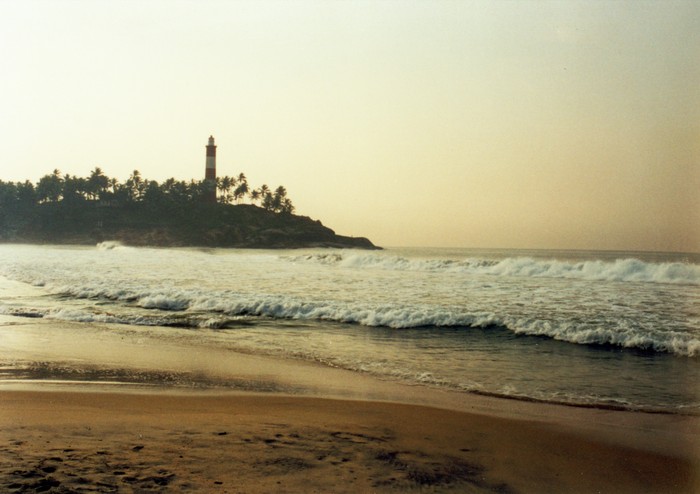
Kovalam, just a short drive south of the city, is Kerala’s best known beach town, built around a set of coves. Lighthouse beach is the liveliest, with the red and white striped lighthouse itself as the obvious landmark, restaurants along the promenade and a good stretch of sand for swimming within the marked safe zones. Hawa beach next door is quieter, more of a fishing village feel with fewer crowds.
Further south, Poovar is where a river estuary meets the sea, and boat trips through the calm backwater channels here, sometimes on a houseboat, are a peaceful contrast to the beach crowds, with mangroves and quiet villages along the banks. In the other direction, about an hour north of the city, Varkala offers something different again, a dramatic red laterite cliff running along the beach with shops, cafes and guesthouses perched on top and steps down to the sand below. Many visitors treat Varkala as a day trip from Trivandrum, though it easily rewards an overnight stay.
Museums, palace and the city
Back in the city itself, the Napier Museum is worth an hour or two, an ornate Indo-Saracenic building housing bronze idols, ivory carvings and historical artefacts, set in pleasant grounds that also hold the Thiruvananthapuram Zoo, one of the older zoos in the country and known for its layout among trees rather than bare enclosures.
Close to the Padmanabhaswamy Temple stands the Kuthiramalika Palace, also known as Puthenmalika, a wooden palace built by a former Travancore ruler and named for the row of carved horses along its eaves. Inside are royal artefacts, musical instruments, portraits and furniture that give a real sense of Travancore court life, and the building’s woodwork alone justifies the visit.
Kanyakumari day trip
Many travellers combine Trivandrum with Kanyakumari, roughly 2.5 to 3 hours further south by road, at the very tip of the Indian peninsula where the Arabian Sea, the Bay of Bengal and the Indian Ocean are said to meet. It is famous for sunrise and sunset views over open water, the Vivekananda Rock Memorial and the towering Thiruvalluvar statue just offshore, reachable by a short ferry ride. It can be done as a long day trip from Trivandrum or, better, as an overnight stop if you want to catch both a sunset and a sunrise without rushing.
Food in Trivandrum
Food here is a genuine highlight. A Kerala sadya, the traditional vegetarian feast served on a banana leaf with rice, sambar, avial, pachadi and a string of other small dishes finished off with payasam, is worth seeking out at least once, particularly around festival time or at an old style vegetarian restaurant. Appam with a mild vegetable or meat stew is a classic breakfast worth having more than once. Given the coastline, seafood is excellent and often cooked in distinctly Travancore style, with plenty of coconut, curry leaf and tamarind rather than the coconut milk heavy Malabar style further north. Filter coffee is everywhere and reliably good, and it is worth trying both the city’s vegetarian meal traditions and its non vegetarian, seafood led side, since Trivandrum does both very well.
Where to stay and best time to visit
Budget rooms in the city or near Kovalam start from around Rs 1200 to 2000 a night, comfortable mid range hotels run roughly Rs 2500 to 5000, and Kovalam’s better beach resorts start from about Rs 6000 upwards and climb steeply for sea facing rooms. Staying in the city puts the temple, museums and palace within easy reach; staying at Kovalam or Varkala suits a more relaxed, beach focused trip with the city as a day excursion.
The monsoon runs roughly June to September, with a retreating monsoon bringing further rain around October and November, so the roads and beaches can be genuinely wet and grey through much of that stretch, though the countryside is at its greenest then if you do not mind the rain. The pleasant season, cool, dry and comfortable for sightseeing and the beach, runs roughly October to February, and this is when most visitors choose to come.
Tips for the trip
- Book train tickets in AC classes well in advance, especially around festivals and school holidays
- Carry or rent appropriate traditional dress for the Padmanabhaswamy Temple; the dress code is strictly enforced
- Remember entry to the temple’s inner sanctum is restricted to Hindus; other visitors can still see the outer architecture
- If flying, remember the airport is unusually close to the city, so plan taxis accordingly rather than budgeting extra transfer time
- Break a long road journey with an overnight halt around Madurai if driving from Chennai
- Pack for rain if travelling June to November, even outside the core monsoon months
- Combine Kovalam, Poovar and Varkala if you have more than two or three days, since each has a different character
- Keep a spare day for Kanyakumari if sunrise or sunset views matter to you
Chennai to Trivandrum is a proper journey, not a quick trip, but that is rather the point. Whichever way you travel down, the temple, the beaches and the coastline waiting at the other end make the distance worth covering.