Guide details
Best time to visit
Early morning or early evening, outside festival days and Fridays if you want a quieter visit
How to get there
In Mylapore, near Luz and Santhome, an easy walk from Chennai Metro or a short auto ride from most parts of the city
Highlights
37 metre painted gopuram, Karpagambal shrine, temple tank (theppakulam), Arupathimoovar festival, Mylapore heritage streets
Good for
Culture and heritage, first time visitors to Chennai, photography of temple architecture, festival watching, families
Entry
Free entry for general darshan. Small paid tickets only for special darshan or archana on busy days. Always confirm current rates at the counter
If you only visit one temple in Chennai, it will probably be this one. Kapaleeshwarar Temple sits at the heart of Mylapore, one of the oldest parts of the city, and its tall painted tower is as much a symbol of Chennai as the Marina beach. Locals simply call it the Mylapore temple, and on any given evening you will find the streets around it full of flower sellers, tiffin stalls and people walking in for a quick darshan on their way home.
This guide is meant to help you actually plan a visit, not just admire photographs of the gopuram. We cover what the temple is dedicated to, the story behind Mylapore itself, what to expect at the gate, and how to fold it into a wider day out in the neighbourhood.
About Kapaleeshwarar Temple
Kapaleeshwarar Temple is dedicated to Lord Shiva, worshipped here as Kapaleeshwarar, with his consort Parvati honoured as Karpagambal. It is a classic example of Dravidian temple architecture, built around a central sanctum with several smaller shrines, wide pillared corridors and an enclosing wall pierced by grand gateway towers.
The temple you see today largely dates from around the 16th century, built during the Vijayanagara period after an earlier temple nearer the coast was lost. That older shrine is thought to have stood closer to what is now Santhome, and its story is tied up with the arrival of the Portuguese in the area. What survives now is still a working temple with centuries of continuous worship behind it, not a museum piece, and that is part of what makes a visit here feel different from simply sightseeing.
The gopuram and architecture
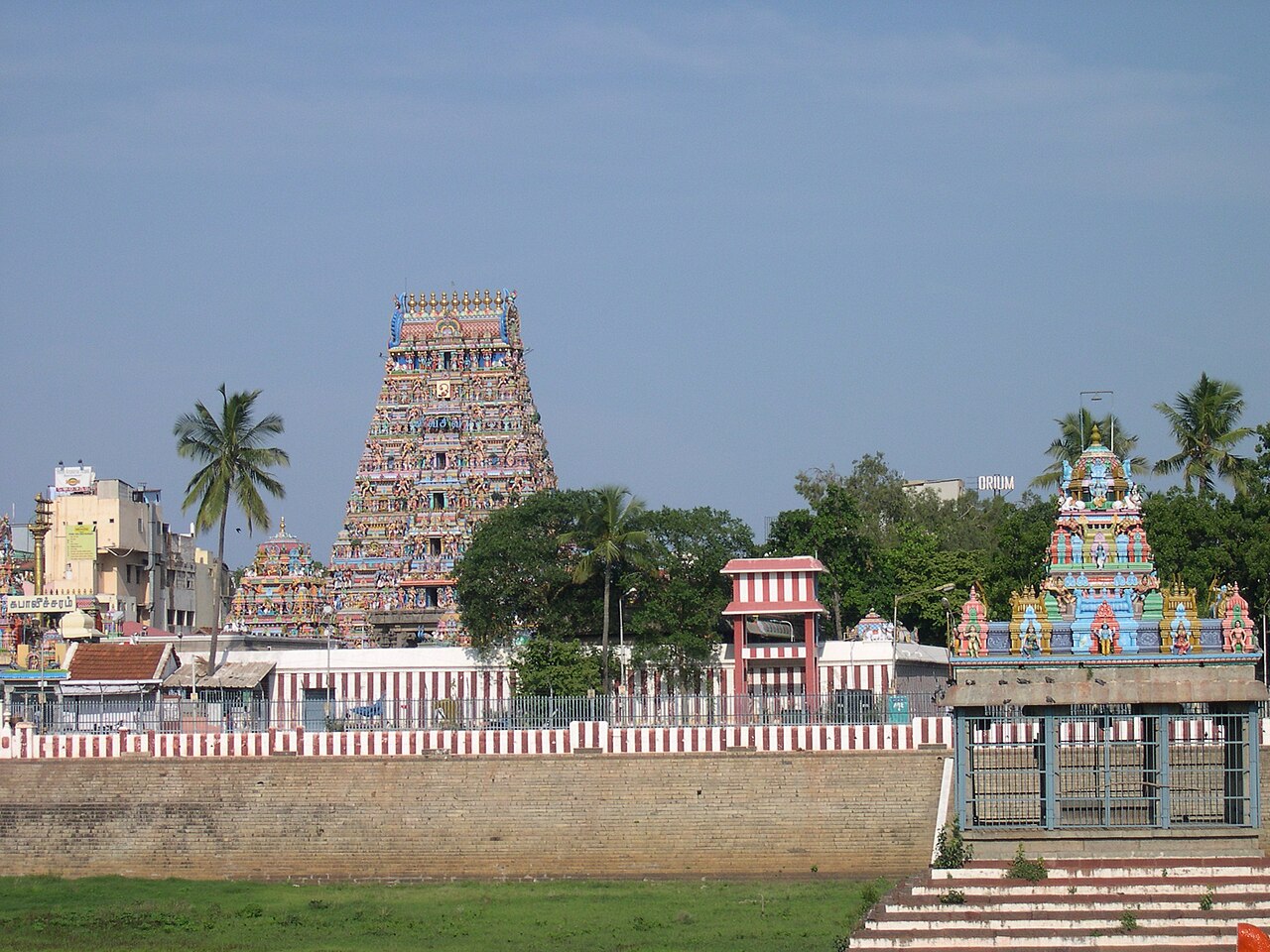
The first thing you notice from the street is the gopuram, the towering gateway that rises to around 37 metres above the eastern entrance. It is covered from base to tip in sculpted figures from Hindu mythology, painted in bright colours that are refreshed periodically so the tower always looks vivid rather than weathered.
Look closely and you will pick out gods, celestial beings, guardian figures and mythological scenes stacked in tiers, a typical feature of South Indian temple towers where the entire structure works as a kind of visual storybook. Inside the complex, the pillared halls and smaller shrines are quieter and less ornate than the gopuram, but worth slowing down for. The main sanctum itself is fairly modest compared to the tower above it, which is common in temples of this age, where the gateway rather than the inner shrine became the great showpiece over time.
The legend and the temple tank
Mylapore takes its name from a lovely piece of temple mythology. According to the legend, Parvati once worshipped Shiva here in the form of a peahen, or mayil in Tamil, and the area came to be known as Mayilapur, the town of peacocks. You will still see peacock motifs used around the temple and in the neighbourhood as a nod to this story, and it is one of the more charming origin tales among Chennai temples.
Directly opposite the main entrance is the temple tank, known locally as the theppakulam. Temple tanks like this once served a genuine practical purpose for ritual bathing and water storage, and they remain an important part of temple life today, particularly during float festivals when deities are taken out onto the water on decorated rafts. Even outside festival time, the tank is a good spot to pause, watch the daily rhythm of the temple and take in the gopuram reflected in the water in the early morning light.
Festivals
Kapaleeshwarar Temple is at its busiest and most spectacular during the Arupathimoovar festival, held during the Tamil month of Panguni, usually falling in March or April. Over several days, the temple takes out grand processions through the streets of Mylapore, most famously carrying the bronze idols of the 63 Nayanmars, the revered Shaivite saints, through the neighbourhood on ceremonial vehicles.
This is one of the great set piece events among Chennai festivals, drawing enormous crowds from across the city and beyond. If you can time a visit to coincide with it, it is an extraordinary thing to witness, though you should expect serious crowds, closed roads around the temple and very little personal space. If crowds are not your thing, it is worth deliberately avoiding these dates and choosing a quieter week instead.
Visiting: timings, entry and dress code
Entry to Kapaleeshwarar Temple is free for general darshan. On busier days the temple sometimes offers a paid special darshan queue for a faster route inside, and there are small charges for specific archana or puja requests if you want a priest to perform a particular ritual on your behalf. None of this is compulsory, and a general visit costs nothing beyond whatever donation you choose to leave.
Like most working Tamil temples, Kapaleeshwarar follows a split day, opening early in the morning, closing for a few hours around midday, then reopening in the evening until fairly late. Exact opening and closing times do shift, so rather than quote hours that may be out of date by the time you read this, we would honestly rather tell you to check with your hotel or search for the current timings on the day of your visit.
Dress modestly. This is an active place of worship, not a tourist attraction, and the temple expects visitors to cover shoulders and legs. Footwear must be removed before entering the temple compound, and there are stalls nearby where you can safely leave your shoes for a small fee. Photography is sometimes restricted inside the inner areas of the temple, so keep your camera or phone away unless you can see others openly taking photos, and always be ready to put it down if asked.
How to get there
Kapaleeshwarar Temple sits in the middle of Mylapore, close to the Luz junction and not far from Santhome and the coast. If you are travelling by Chennai Metro, the nearest stations are a short walk or a quick auto ride away, and this is generally the easiest way to reach the area if you are coming from further out in the city, avoiding the notoriously congested traffic in central Mylapore.
Local buses run through Mylapore regularly and stop within easy walking distance of the temple, though route numbers change over time so it is worth confirming your service before you set off. An auto rickshaw is the simplest option from elsewhere in Chennai, and most drivers know the temple well since it is one of the most recognised landmarks in the city.
Nearby in Mylapore
Mylapore is one of the great heritage neighbourhoods of Chennai, and the temple is really only the start of what there is to see. The streets around it are lined with flower and fruit markets, traditional silk and jewellery shops, and some of the oldest coffee and tiffin houses in the city, many of them still run by the families who started them generations ago.
A short walk or drive away is Santhome, home to the striking San Thome Basilica, a Roman Catholic church built over the tomb of St Thomas the Apostle, and one of only a handful of churches in the world built on the burial site of an apostle. The contrast between the Dravidian temple architecture of Kapaleeshwarar and the neo Gothic basilica down the road says a lot about the layered religious history of Chennai, and pairing the two into one outing is one of the better half day itineraries in the city. For more ideas on building out your day, our wider guide to places to visit in Chennai has other Mylapore and heritage stops worth adding.
Tips for your visit
- Go early in the morning or in the evening. Both are cooler, calmer and give you the best light for photographs of the gopuram.
- Fridays are considered auspicious for Parvati worship here, so the temple is noticeably busier than other days of the week. Plan around this if you prefer a quieter visit.
- Check festival dates before you go, especially Arupathimoovar in Panguni. Wonderful to see once, but not the moment for a relaxed, unhurried visit.
- Wear simple, modest clothing that covers shoulders and knees, and wear shoes that are easy to slip off and on at the entrance.
- Keep small change handy for footwear stalls, donations or archana if you choose to make an offering.
- Move quietly through the inner shrine areas. This is a functioning place of worship, and other visitors are there to pray, not to be part of your photo.
- Combine your visit with a walk through Mylapore market and a trip to San Thome Basilica to make the most of the neighbourhood.
Kapaleeshwarar Temple rewards a slow visit far more than a rushed one. Sit by the tank for a few minutes, let your eyes travel up the gopuram, and you will understand quickly why this small corner of Mylapore has stayed at the centre of Chennai life for so many centuries.