Guide details
Best time to visit
Early morning or evening, outside the midday closure
How to get there
Triplicane, close to Marina Beach; reachable by auto-rickshaw, bus or a short taxi ride from central Chennai
Highlights
Ancient gopuram, shrines to five forms of Vishnu, Pallava-era origins, Triplicane neighbourhood
Good for
History lovers, temple architecture, cultural visitors
Price range
Free entry; donations optional
Tucked into the narrow, busy lanes of Triplicane, a short walk from the sea, the Parthasarathy Temple is one of the places that reminds you how old Chennai really is. Long before the city grew up around it, this shrine was already a centre of worship, and it still is, every single day.
We think it is one of the most rewarding temples to visit in the city, not just for its age or its architecture, but for what it represents: a living Divya Desam where five forms of Vishnu are worshipped under one roof, in a neighbourhood that has kept its own character even as Chennai has changed around it.
About Parthasarathy Temple
Parthasarathy Temple stands in Triplicane, known locally as Thiruvallikeni, one of the oldest residential neighbourhoods in Chennai. It is dedicated to Vishnu, worshipped here in his form as Parthasarathy, and it ranks among the oldest temples in the city, older than Chennai itself in any modern sense. The temple sits close enough to the coast that many visitors combine a morning here with a walk along the seafront, the two together giving a good sense of old and new Triplicane, sacred and secular, side by side.
Unlike some of Chennai’s grander temple complexes, Parthasarathy Temple has a compact, densely packed feel, hemmed in by the streets and houses that have grown up around it over centuries. That closeness is part of its charm. This is a temple a neighbourhood has worshipped at for well over a thousand years, not one built for tour buses.
The meaning of Parthasarathy
The name Parthasarathy comes from Sanskrit and Tamil devotional tradition and means the charioteer of Partha, Partha being another name for Arjuna, the Pandava warrior of the Mahabharata. It refers directly to the episode at Kurukshetra when Krishna served as Arjuna’s charioteer and counsellor, delivering the teaching that later became the Bhagavad Gita.
What makes the deity here unusual is the way that story is carried into the image itself. The main deity is shown with a moustache, a rare detail in Vishnu iconography, and tradition holds that he bears the marks of arrows from the war, even though Krishna himself did not take up weapons in that battle. It is a striking piece of storytelling in stone, a god shown not as a distant figure but as one who stood in the middle of a human war and carried its marks.
History: Pallavas, Cholas and Vijayanagar
The temple’s origins go back to the 8th century, under the Pallava king Narasimhavarman I, also known as Mamalla, the same ruler associated with the rock cut monuments at Mahabalipuram further down the coast. What began under the Pallavas was expanded significantly over the following centuries.
The Chola dynasty, which dominated much of Tamil Nadu from around the 9th to the 13th century, added to the temple and supported its rituals, as the Cholas did for many major Vaishnavite and Shaivite shrines across the region. Later, under the Vijayanagar rulers, the temple saw further building work, including additions that gave it much of the structure visible today. What you see now is not the work of a single era but of at least three distinct periods of South Indian history layered on top of one another.
A Divya Desam and the five forms of Vishnu
Parthasarathy Temple is one of the 108 Divya Desams, the sacred abodes of Vishnu celebrated in the hymns of the Alvars, the Tamil Vaishnavite saint poets whose devotional verses form the backbone of Sri Vaishnava tradition. Being a Divya Desam gives the temple a level of religious standing well beyond its size, and it draws devotees from across Tamil Nadu and beyond, particularly during the major festival season.
One of the more unusual features of the temple is that it does not enshrine just one form of Vishnu. Within the complex you will find five: Krishna, worshipped here as Parthasarathy himself, along with Rama, Narasimha, Varaha, and Gajendra Varadaraja, the form of Vishnu associated with the story of rescuing the elephant king Gajendra from the grip of a crocodile. Having five avatars represented in a single temple complex is genuinely rare, and it is one of the details that sets Parthasarathy Temple apart from most other Vishnu temples in the state.
The temple and what to see
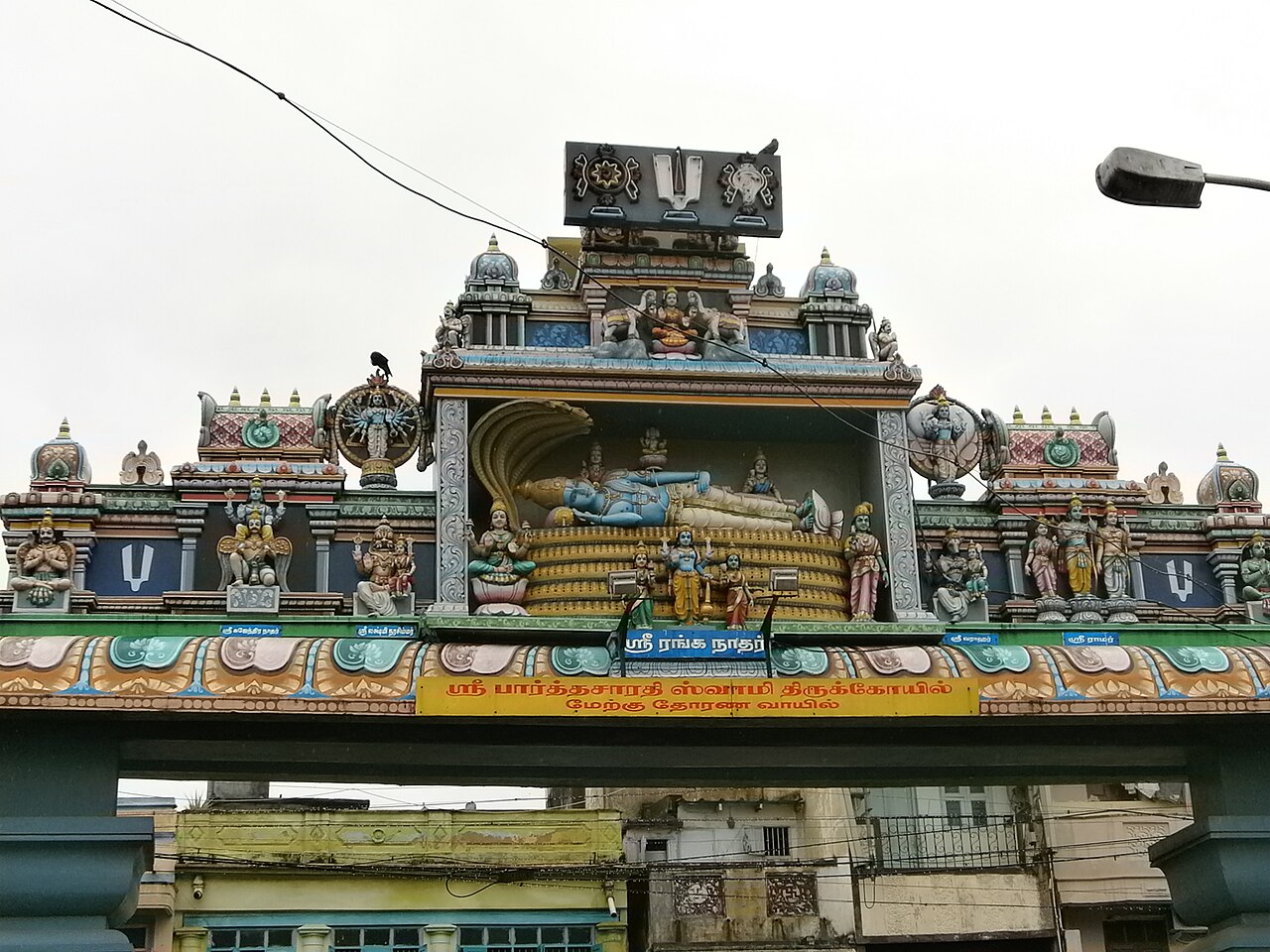
The temple is built in the Dravidian style typical of Tamil Nadu, with tall gopurams, pillared halls and a series of shrines arranged within a walled complex. It has two main towers, an east facing gopuram and a west facing one, both visible from some distance across the rooftops of Triplicane, and both useful landmarks if you are trying to find your way through the surrounding lanes.
Close to the temple is the Kairavini Pushkarani, also known as the Triplicane tank, a large temple water tank that has long played a role in the temple’s rituals and festivals, including ritual bathing and float festivals.
- The east and west gopurams, each with their own tiers of sculpted figures
- The main sanctum of Parthasarathy, showing Krishna with his distinctive moustache
- The shrines to Rama, Narasimha, Varaha and Gajendra Varadaraja within the same complex
- Pillared mandapams used for rituals, processions and festival gatherings
- The Kairavini Pushkarani, the temple tank, a short distance from the main entrance
Take your time here rather than rushing through. Because the complex is compact, it rewards a slow walk around rather than a quick dash from one shrine to the next.
Festivals
Like most temples of this age and standing, Parthasarathy Temple has a full festival calendar, but one occasion stands well above the rest: Vaikunta Ekadasi, usually falling in December or January. This is one of the most important dates in the Vaishnavite calendar, when the Paramapada Vasal, the gate of heaven, is symbolically opened, and devotees believe passing through it on this day carries special significance. Crowds on this day are enormous, and if you plan to visit specifically for Vaikunta Ekadasi, you should expect long queues, tight security and a very different atmosphere from an ordinary weekday visit.
Beyond that, the temple observes Brahmotsavam, an extended annual festival with processions over several days, along with Rama Navami, marking the birth of Rama, and Krishna Jayanthi, also known as Janmashtami, celebrating Krishna’s birth. Various Alvar related observances tied to the Divya Desam tradition also bring devotees through the year.
Visiting: timings, entry and etiquette
Parthasarathy Temple is a functioning place of worship, not a museum, and it is worth keeping that in mind while you visit. Entry is free for general darshan, though paid special darshan and archana services are available if you want a quicker route in or wish to have a particular ritual performed on your behalf.
Like most Tamil temples, it follows a split schedule, open in the morning, closed through the middle of the day, then open again in the evening. Timings can and do shift around festivals and for maintenance, so rather than rely on any specific hours here, it is best to check locally or ask at the temple on the day, particularly if you are planning your visit around Vaikunta Ekadasi or another major festival.
Dress modestly, as you would at any active Hindu temple in Tamil Nadu, and be ready to remove your footwear before entering, leaving it at the designated stands outside. Photography is often restricted inside the sanctum areas, so ask before taking pictures, and consider simply enjoying the atmosphere with your camera put away.
How to get there
The temple sits in Triplicane, in central east Chennai, close enough to the coast that it is genuinely walkable from Marina Beach if you do not mind a bit of a stroll through busy streets. Many visitors combine the two in a single outing, spending the morning at the temple and the evening by the sea, or the other way round.
Getting there by bus or auto rickshaw is straightforward from most parts of the city, and Triplicane is well served by both. If you prefer the metro, a short onward ride or auto trip from the nearest station will get you into the neighbourhood. Traffic in Triplicane’s lanes can be dense, so allow extra time, especially before major festivals when the roads around the temple fill quickly.
Nearby and tips
Triplicane and the wider Marina area reward a bit of wandering. The neighbourhood’s old houses, small eateries and busy markets sit only minutes from the sea, and it is easy to spend half a day exploring on foot without ever feeling like you have left the historic core of the city. If temples are your particular interest, it is worth pairing a visit here with the Kapaleeshwarar Temple, another of the city’s great Dravidian shrines, and browsing our wider guide to places to visit in Chennai for other spots nearby.
- Visit early morning or early evening to avoid both the heat and the midday closure
- Carry a small bag for your shoes if the footwear stands look crowded
- Keep valuables close, as the lanes around the temple can get crowded, especially on festival days
- If you want to witness Vaikunta Ekadasi, arrive well ahead of time and be prepared for large crowds
- Combine your visit with Marina Beach and a walk through old Triplicane for a fuller half day out
Parthasarathy Temple is not a grand, sprawling complex, but what it lacks in scale it makes up for in depth, in history stretching back to the Pallavas, and in a devotional life that has never really paused. Spend an hour here and you come away with a much better sense of what Triplicane, and old Chennai, are really about.