Guide details
Best time to visit
September/October for Bathukamma, the signature Telangana festival; July/August for Bonalu; Ramzan for the old city of Hyderabad, though its dates vary; the Medaram Jatara falls every two years, usually around February. Note that most festival dates shift each year with the lunar calendar, so it is worth checking locally before you travel.
How to get there
Telangana is well connected by air, rail and road. Hyderabad’s Rajiv Gandhi International Airport is the main gateway to the state and Hyderabad is also a major rail hub with links across South India. Hyderabad and Secunderabad are the places to be for Bonalu and Ramzan, while the lakes and Tank Bund area are popular spots for Bathukamma immersions. Medaram, the site of the Sammakka Saralamma Jatara, lies near Warangal and is best reached via Warangal town during the festival.
Highlights
Bathukamma the flower festival, Bonalu and its pot-bearing processions, Ramzan nights around the Charminar, the Khairatabad Ganesh, Ugadi, the Medaram Sammakka Saralamma Jatara, Bhadrachalam Sri Rama Navami, temple brahmotsavams
Good for
Culture and festival travellers, photographers, families, folk-tradition and women’s-festival enthusiasts, spiritual travellers, anyone wanting to see living Telangana identity
Price range
Most festivals are free to watch and take part in as a respectful onlooker, though the Medaram Jatara and other big temple festivals draw enormous crowds and require careful planning. Accommodation in Hyderabad and near major festival sites tends to rise in price during peak festival periods, so it pays to book ahead. No fixed figures can be given, as costs vary by season and provider.
Telangana is a young state with an old soul, and nowhere is that more visible than in its festival calendar. Formed in 2014, Telangana has spent the years since statehood pouring civic pride and public investment into its own folk festivals, chiefly Bathukamma and Bonalu, elevating them from village and neighbourhood traditions into markers of state identity celebrated with genuine fervour across cities, towns and villages alike. Alongside these homegrown celebrations sits the wider Telugu Hindu festival calendar shared with neighbouring Andhra Pradesh, the richly layered Deccani Muslim traditions of Hyderabad built up over centuries of Nizami rule, and a network of rural jataras and temple festivals that draw pilgrims from across the region. Together they give Telangana a festival identity that feels distinctly its own rather than a footnote to its larger neighbours.
As with most festivals rooted in the Hindu and Telugu lunar calendars, exact dates shift from year to year rather than falling on a fixed day of the Gregorian calendar. Where this guide gives a month, treat it as a general window and check locally closer to the time, since local temple committees and government calendars are the most reliable sources for confirmed dates.
Bathukamma: the flower festival
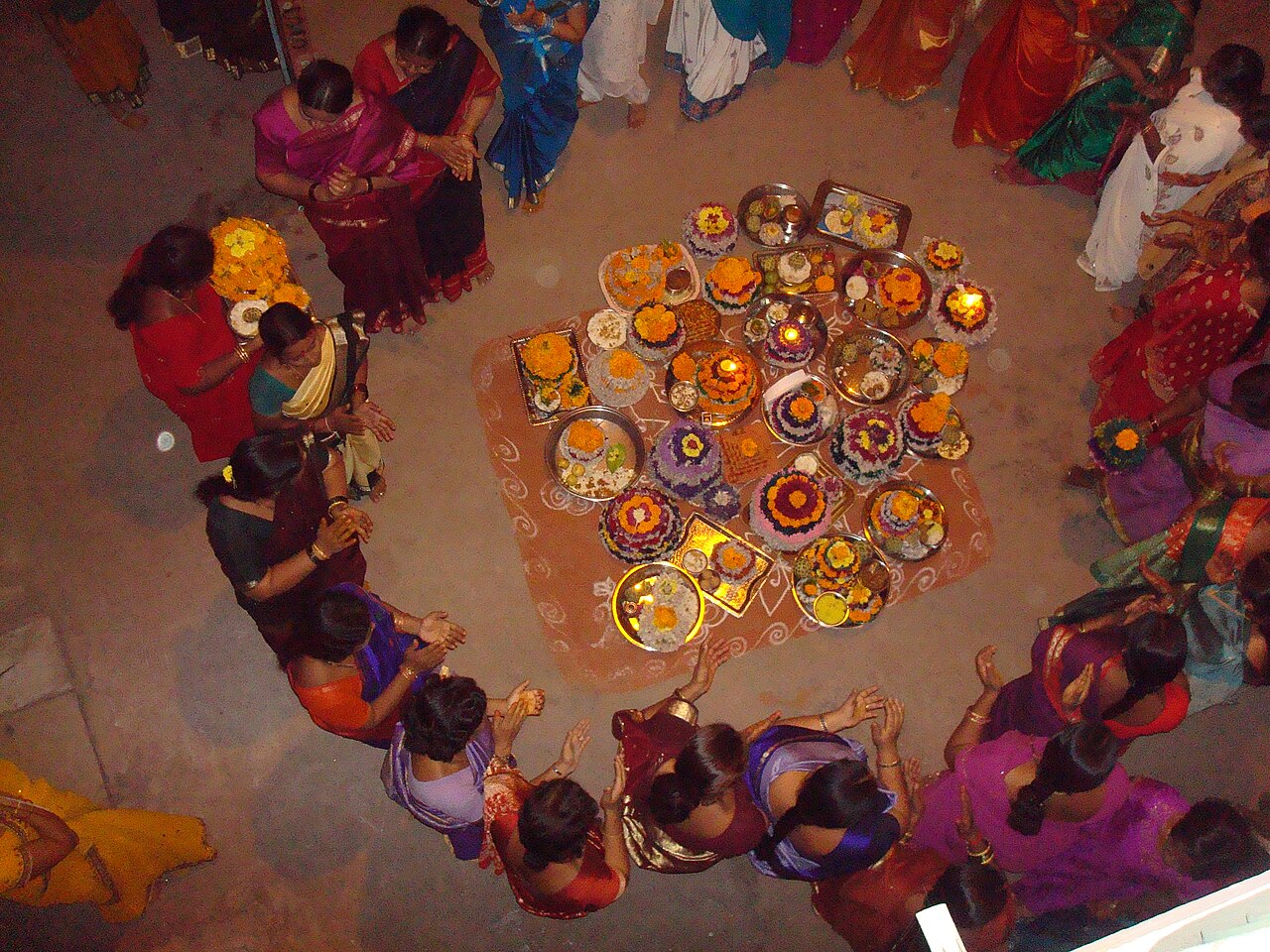
Bathukamma is widely regarded as Telangana’s own festival, and it is arguably the most visually beautiful expression of the state’s culture. It usually falls in September or October, around the time of Dussehra and Navaratri, in the Telugu month of Ashwayuja, and it runs for nine days, ending on what is known as Saddula Bathukamma. The festival is celebrated predominantly by women and girls, who gather each evening to build the bathukamma itself: a conical, tiered stack of seasonal flowers such as gunugu, tangedu (tanner’s cassia), marigold and celosia, carefully arranged in concentric layers on a brass or metal plate.
Once built, the flower stacks are placed in a courtyard or open space and women gather around them in the evening light to sing traditional Bathukamma songs and dance in slow circles, clapping and swaying as they sing. The songs themselves are an oral tradition in their own right, touching on nature, family, mythology and the changing seasons. According to tradition, the festival honours the goddess Gauri, worshipped here in her form as Bathukamma, or Maha Gauri, and is understood as a celebration of womanhood, of nature’s bounty at the end of the monsoon, and of community. On the final day, the flower stacks are carried in procession to a local tank, lake or other body of water and ceremonially immersed, accompanied by more singing and dancing. A traditional food offering called maleeda, a sweet mixture often based on jaggery and wheat or rice, along with sattu, is prepared and shared during the festival. For visitors, the sight of hundreds of flower stacks glowing at dusk beside a lake, surrounded by singing women in bright silk sarees, is one of the most memorable scenes South Indian festival travel has to offer.
Bonalu: the goddess of the pots
Where Bathukamma belongs to the cooler months after the monsoon, Bonalu belongs to the monsoon itself, usually falling in July or August, in the Telugu month of Ashada. It is a festival dedicated to Mahakali and the wider family of village goddesses collectively known as Ammavaru, believed by devotees to protect communities from disease and misfortune, a belief with roots in older traditions of goddess worship tied to the rains and the agricultural cycle.
The central ritual gives the festival its name: women carry bonam, decorated earthen or brass pots containing cooked rice, milk, jaggery and curd, balanced on their heads as they walk in procession to the temple as an offering to the goddess. The pots are often topped with neem leaves and a small lamp, and the processions are accompanied by drumming, dancing and considerable colour. A striking figure in these processions is the Pothuraju, a bare-chested man, traditionally seen as the goddess’s brother, who leads the way cracking a whip and dancing energetically to clear the path and set the tone for the procession. Another notable ritual is the Rangam, in which a woman believed to be possessed by the goddess enters a trance atop an earthen pot and is consulted by the gathered crowd for predictions about the year ahead. The festival closes with the Ghatam procession, in which the ghatams, metal pots representing the goddesses, are taken out in a grand final procession.
Bonalu is celebrated across Telangana, but it reaches its grandest scale in Hyderabad and Secunderabad, particularly around the Golconda Fort temple, the Ujjaini Mahankali Temple in Secunderabad and the Lal Darwaza temple in the old city, where the festival becomes a genuinely enormous public event stretching over several weeks as different neighbourhoods take their turn to host it.
Ramzan and the old city
Hyderabad’s old city carries a distinct Deccani Muslim heritage, shaped by centuries of Qutb Shahi and Nizami rule, and this comes vividly to life during Ramzan, the month of fasting observed by Muslims. Through the month, the lanes around the Charminar transform after sunset into a bustling nightscape of food stalls, sweet shops and shoppers, with the fragrant, slow-cooked meat and wheat dish haleem becoming something of a citywide obsession during this period, sold from specialist stalls that queue up customers late into the night. The atmosphere of iftar, the breaking of the daily fast, and the general old city buzz through the month is one of Hyderabad’s most distinctive cultural experiences, blending Deccani and Hyderabadi food culture with genuine religious devotion.
The month culminates in Eid-ul-Fitr, marked by large congregational prayers at sites such as the Mecca Masjid and the Eidgah grounds, followed by family celebrations and charitable giving. Later in the year comes Eid-ul-Adha, or Bakrid, along with other observances such as Milad-un-Nabi, marking the birth of the Prophet, and Muharram, a period of mourning observed with processions in various parts of the state. Hyderabad’s old city is also known for its urs celebrations at various dargahs, anniversary gatherings honouring Sufi saints, which reflect the same Ganga-Jamuni, syncretic culture that runs through much of the city’s older quarters, where Hindu and Muslim traditions have long existed side by side.
Telugu Hindu festivals across the state
Telangana also shares in the broader Telugu Hindu festival calendar. Ugadi, the Telugu New Year, usually falls in March or April and is marked by the preparation of Ugadi pachadi, a dish deliberately combining sweet, sour, bitter, salty and spicy flavours as a symbol of life’s varied experiences, along with panchanga sravanam, the reading aloud of the new year’s almanac. Sri Rama Navami is celebrated with particular devotion at Bhadrachalam, where the temple hosts the Sitarama Kalyanam, a ceremonial re-enactment of the divine wedding that draws large numbers of pilgrims and is one of the more significant temple events in the state calendar.
Dasara, or Vijayadashami, generally coincides with the closing days of Bathukamma, giving the season a particularly festive overlap in Telangana. Vinayaka Chavithi, honouring Lord Ganesha, is celebrated on a grand scale in Hyderabad, most famously through the Khairatabad Ganesh, one of India’s tallest Ganesh idols each year, whose immersion procession into Hussain Sagar lake draws vast crowds and heavy security. Sankranti, the harvest festival, is observed here as elsewhere in South India, though it is Bathukamma and Bonalu that are considered more distinctly Telangana in character. Maha Shivaratri is marked with particular devotion at temples such as Vemulawada and the Kaleshwaram temple, while Deepavali is celebrated across the state in the customary manner with lamps, sweets and fireworks.
The Medaram Jatara and temple festivals
Among Telangana’s most remarkable religious gatherings is the Sammakka Saralamma Jatara, held at Medaram, a forest village near Warangal, usually every two years around February. Devotees and scholars alike describe it as one of the largest religious gatherings anywhere in the world, with millions of pilgrims, many of them from the Koya and other tribal communities, converging on the site over four days to honour the tribal goddesses Sammakka and Saralamma. A distinctive tradition sees devotees offering bangaram, jaggery weighed to match the devotee’s own body weight, as a mark of gratitude and devotion. The scale of the gathering, set against a forest clearing rather than a conventional temple town, makes it a profoundly moving spectacle and a logistical undertaking for the state authorities who manage crowd flow and infrastructure for the event.
Beyond Medaram, Telangana’s temples hold their own annual brahmotsavams, multi-day festivals of processions, rituals and celebration, with those at Yadadri, Vemulawada and Bhadrachalam among the better known. Elsewhere, the Komuravelli Mallanna Jatara draws large numbers of devotees to its hilltop temple, and countless smaller village jataras take place through the year, each rooted in local deities and local memory, offering a quieter but no less genuine window into Telangana’s religious life.
Planning your visit
If you can only time a trip around one festival, Bathukamma in September or October is the signature choice, offering the flower stacks, the women’s songs and the evening immersions, with the lakes and Tank Bund area in Hyderabad among the best places to witness the closing ceremonies. For Bonalu, aim for July or August and head to the old city, Golconda or Secunderabad to see the pot processions and temple gatherings at their most elaborate. Ramzan nights around the Charminar are worth experiencing for the food culture alone, particularly the haleem stalls and the late-night shopping atmosphere, though the exact dates shift each year according to the moon sighting. The Medaram Jatara, held only every two years, requires more careful planning given the sheer scale of the crowds; if your visit coincides with a Jatara year, allow extra time and expect very large gatherings.
Whichever festival you attend, a little respect goes a long way: dress modestly at religious sites, ask before photographing devotees closely, and remember that for millions of people these are not performances but living acts of faith. Because dates move with the lunar calendar each year, always confirm locally, through the state tourism department, local news or your accommodation, before finalising travel plans around a specific festival.
The living heart of a young state
Telangana’s festivals are the proud, beating heart of its identity: the tiered flower stacks and women’s songs of Bathukamma glowing on the water at dusk, the pot-bearing processions and trance rituals of Bonalu, the haleem-scented Ramzan nights around the Charminar, and millions of tribal pilgrims gathering in a forest clearing at Medaram. To visit during one of them is to see a young state celebrate an ancient soul, and to come away with a far deeper understanding of what makes this corner of South India so distinctive.