Guide details
Best time to visit
October to February, running into early March, is the best time to visit, with pleasant cooler weather ideal for sightseeing. Summers from April to June are very hot across the Deccan plateau, while the June to September monsoon greens the landscape and fills waterfalls, though it is worth checking road conditions locally. Festivals such as Bathukamma and Bonalu generally fall around September and October, and Ramzan and its haleem season vary each year.
How to get there
Hyderabad has a major international airport (Rajiv Gandhi International) and is a major rail hub with Secunderabad, Hyderabad and Kacheguda junctions plus a metro; well connected by rail and road (NH44) to the rest of India; Warangal and other towns are reached by road and rail from Hyderabad.
Highlights
Charminar and Hyderabad’s old city, Golconda Fort and the Qutb Shahi Tombs, Salar Jung Museum, Ramoji Film City, Warangal Fort and the Thousand Pillar Temple, Ramappa Temple (UNESCO), Hussain Sagar, Hyderabadi biryani, Pochampally ikat
Good for
History and heritage lovers, foodies, temple and pilgrimage travellers, film and culture fans, nature and fort explorers, city breaks
Price range
Options range from budget lodges through mid-range and business hotels to the Nizam-era luxury palace hotels of Hyderabad; check current rates locally as they vary by season and property.
Telangana is one of India’s youngest major states, formed in June 2014 when it was carved out of the former undivided Andhra Pradesh after decades of a distinct regional movement. Its capital, Hyderabad, is also its beating heart: a 400-year-old city of minarets, palaces and biryani that has long been one of the great cultural crossroads of the Deccan. Landlocked and sitting squarely on the Deccan plateau, Telangana is very much part of South India, Telugu-speaking at its core but layered with a strong Deccani Urdu and Hyderabadi Muslim influence that gives the state its own particular flavour. Beyond the capital, Telangana holds Kakatiya-era temples and forts around Warangal, the extraordinary carved stonework of Ramappa temple, the vast Ramoji Film City, dramatic granite outcrops and waterfalls tumbling off the plateau, and a warm, syncretic culture often called Ganga-Jamuni tehzeeb, where Hindu and Muslim traditions have mingled for centuries. This guide takes a broad look at the state, region by region, to help plan a visit.
Hyderabad: city of pearls and Nizams
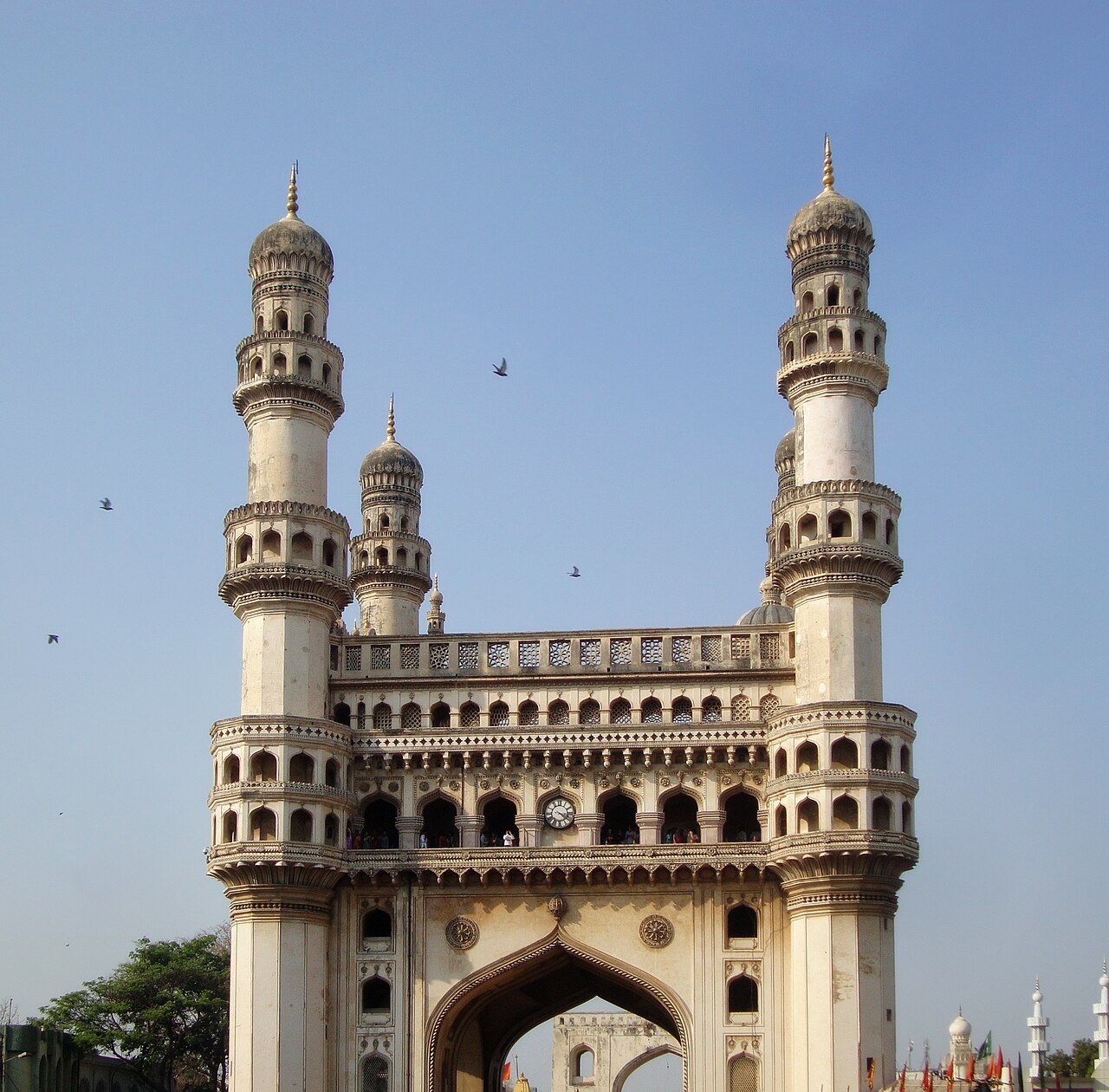
Hyderabad was founded towards the end of the sixteenth century by the Qutb Shahi sultans, who moved their capital from nearby Golconda to a new city on the banks of the Musi river. It later became the seat of the Nizams, whose princely state was, for a long stretch of its history, reckoned among the wealthiest in India, and that double heritage, Qutb Shahi and Nizami, shapes almost everything visitors come to see. The Charminar, with its four soaring minarets, is the city’s unmistakable symbol and a natural place to start any tour of the old city, with the Laad Bazaar and its bangles, and the Mecca Masjid, one of India’s oldest and largest mosques, both close by. A short drive away, Golconda Fort rises on a granite hill, its ramparts and gateways hinting at the engineering that once protected a fortress at the centre of the region’s diamond trade, a trade some believe gave the world the Koh-i-Noor; an evening sound-and-light show is a popular way to take in its history after dark, and nearby the Qutb Shahi Tombs hold the domed mausoleums of the dynasty’s rulers.
The Nizams’ more domestic side is on show at the Chowmahalla Palace, their ceremonial seat, and at the hilltop Falaknuma Palace. The Salar Jung Museum, built around one family’s private collection, is regarded as one of India’s finest museums, ranging across sculpture, textiles, manuscripts and clocks. Hussain Sagar lake offers views of the Buddha statue set on a rock in the middle of the water, along with the Tank Bund and Necklace Road promenades, while the Birla Mandir temple sits on its own hilltop above the city. Hyderabad is also home to Ramoji Film City, said to be the largest film studio complex in the world, and to HITEC City, the district that has made the city one of India’s leading IT hubs. Through it all runs the food, with Hyderabadi biryani and haleem reason enough alone to visit, alongside the pearls and bangles that earned Hyderabad its old titles of the City of Pearls and City of Nizams.
Warangal and the Kakatiya heritage
About 150 kilometres from Hyderabad, Warangal was once the capital of the Kakatiya dynasty, which ruled much of the Telugu-speaking Deccan between the twelfth and fourteenth centuries and left behind some of the region’s finest architecture. Warangal Fort still shows the scale of that ambition in its ruined ramparts and, above all, in the Kakatiya Kala Thoranam, the ornately carved stone gateways so closely associated with the dynasty that they now serve as the state emblem of Telangana. In the town itself, the Thousand Pillar Temple is a masterclass in Kakatiya stone carving, dedicated to Shiva, Vishnu and Surya, while the Bhadrakali temple, set beside its own lake, remains an active and much-visited shrine. A little further out, the Ramappa Temple, also known as Rudreshwara, stands as the crowning achievement of Kakatiya temple building. Completed in the thirteenth century, it was inscribed as a UNESCO World Heritage Site in recognition of its engineering as much as its beauty, including bricks in the superstructure said to be light enough to float, and carving of extraordinary delicacy across its pillars and ceilings. Together, Warangal and Ramappa make for a rewarding day trip or overnight excursion from Hyderabad for anyone interested in medieval Deccan history.
Temples and pilgrimage towns
Telangana is a deeply devout state, and beyond Warangal it holds several temple towns that draw pilgrims from across South India. Yadagirigutta, often shortened to Yadadri, centres on a hillside shrine to Lakshmi Narasimha that has recently been rebuilt on a grand scale, and is now one of the state’s most visited pilgrimage sites. On the banks of the Godavari, Bhadrachalam is home to the Sri Sita Ramachandraswamy temple, one of the most important Rama temples in South India, particularly lively during Sri Rama Navami celebrations. Further along the same river, Basara holds the Gnana Saraswati temple, one of only a small number of temples in India dedicated to Saraswati, the goddess of learning, where families traditionally bring young children for their aksharabhyasam, the ceremonial start of learning to write. Other notable temple towns include Vemulawada, known for its Rajarajeswara temple, Kaleshwaram, a Shiva shrine that also lends its name to a major irrigation project on the Godavari, and Komuravelli, home to the widely revered Mallanna temple. Whatever the specific deity, these towns share a common thread of continuous worship stretching back centuries, and visitors are welcome to observe, provided they do so respectfully and follow local custom regarding dress and conduct at each shrine.
Nature, forts and waterfalls
Away from its temples and monuments, Telangana’s stretch of the Deccan plateau has plenty for those who prefer the outdoors. Ananthagiri Hills, near Vikarabad, offers cool forested walking country within a couple of hours of Hyderabad, and is often the starting point for gentle treks. To the south, Nagarjuna Sagar is home to one of the world’s largest masonry dams, and boat trips from here reach Nagarjunakonda, an island holding a museum of Buddhist remains from an ancient university and monastic centre; the nearby Ethipothala falls make a good add-on, and the wider area straddles the border with Andhra Pradesh. Waterfall enthusiasts have several options worth the drive from Hyderabad, including Bogatha Waterfalls, Kuntala Falls, generally reckoned to be the tallest in Telangana, and Pochera Falls, all fullest during and just after the monsoon. For wildlife, the Kawal and Amrabad tiger reserves protect substantial forest tracts in the north and south of the state. History lovers can also seek out Medak, home to a vast cathedral counted among the largest churches in Asia, alongside its own old fort, and Bhongir, sometimes written Bhuvanagiri, where a single monolithic granite rock rises dramatically out of the plain, crowned by a fort and popular with rock climbers. Elsewhere, Pillalamarri shelters an enormous, centuries-old banyan tree, and Laknavaram lake is known for its long suspension bridge strung out over the water.
Culture, crafts and cuisine
Food is central to any visit to Telangana, and Hyderabadi cuisine has a reputation that reaches well beyond India’s borders. Hyderabadi biryani, cooked in the dum style, is the dish most people arrive hoping to try, while haleem, a slow-cooked wheat and meat preparation, is especially associated with the month of Ramzan. The city’s Irani cafes are institutions in their own right, serving Irani chai alongside Osmania biscuits, and nihari and other Nizami and Mughlai dishes sit comfortably beside simpler rural Telangana food such as jonna rotte, a millet flatbread, and sakinalu, a rice-flour snack made especially around festival time. Two festivals capture the state’s own identity particularly well. Bathukamma, a flower festival honouring the goddess, sees women arrange colourful floral stacks and sing and dance around them over several days, and is now recognised as a state festival, while Bonalu, celebrated in honour of the goddess Mahakali, brings processions and offerings in Hyderabad and across the region. On the craft side, Hyderabad’s Laad Bazaar remains the place for bangles and pearls, while Pochampally, a village given Geographical Indication status for its craft, is celebrated for its distinctive ikat weaving. Nirmal is known for its toys and paintings, and Bidri metalwork, with its dark, silver-inlaid finish, is another Deccan speciality. Underlying all of this is the Deccani Ganga-Jamuni tehzeeb, the syncretic Hindu-Muslim culture that has shaped Telangana, and Hyderabad in particular, for generations.
Best time to visit
The cooler months from October to February, running into early March, are generally considered the best time to explore Telangana, with pleasant days well suited to sightseeing in Hyderabad, Warangal and the temple towns. Summer, from April to June, is very hot across the Deccan plateau and best avoided for extensive outdoor exploring, though early mornings and evenings remain workable. The monsoon, from June to September, brings welcome rain that greens the landscape and fills waterfalls such as Kuntala and Bogatha, making it a rewarding season for nature lovers, even if some hill roads can be affected. Festival timings are worth checking locally each year: Bathukamma and Bonalu generally fall around September and October, while the dates for Ramzan and its associated haleem season vary annually.
Getting there and around
Hyderabad is comfortably the gateway to Telangana, served by Rajiv Gandhi International Airport, one of India’s major aviation hubs with a wide network of domestic and international connections. The city is equally well placed by rail, with Secunderabad, Hyderabad and Kacheguda among its principal railway junctions linking it to destinations right across the country, and the Hyderabad Metro makes getting around the city itself straightforward. By road, national highways including NH44 connect Hyderabad to the rest of India, and the state’s compact, Hyderabad-centred geography means most of its highlights can be reached comfortably. Warangal and Ramappa, for instance, are a manageable day trip or overnight excursion by road or rail, and towns such as Bhadrachalam, Basara and Nagarjuna Sagar can similarly be reached from the capital, with local transport and taxis the easiest way to cover the final stretches to temples, forts and waterfalls.
The youngest state, the oldest stories
Telangana may be India’s youngest state, but it holds some of the oldest and grandest stories on the Deccan. It is a 400-year-old city of minarets, forts and pearls, where some of the world’s best biryani is served in the shadow of the Charminar; it is Kakatiya temples carved with a precision that has outlasted seven centuries, their bricks said to float; it is the largest film studio on earth, and a landscape of giant granite boulders, hidden waterfalls and hilltop forts waiting just beyond the city limits. Add to that a proud, syncretic culture that has blended Hindu and Muslim traditions for generations, and a warmth of welcome that visitors tend to remember long after they leave, and Telangana emerges as one of the most rewarding, and still relatively undiscovered, corners of South India to explore.
Explore Telangana destination by destination
- Hyderabad – the city of Nizams
- Warangal – the Kakatiya capital
- Ramoji Film City – the world’s largest film studio
- Nagarjuna Sagar – the great dam and Buddhist island
Planning around your appetite or the calendar? See our full guides to Telangana’s famous food and Telangana’s festivals.