Guide details
Best time to visit
August to December is the ideal window, with the falls at their thundering best from around August to October just after heavy monsoon rain and remaining impressive into December. The monsoon months of June to September bring the fullest flow but also slippery steps, leeches and heavy rain, so October to December is often the sweet spot of full falls and calmer weather. Summer, from March to May, can leave the falls reduced to a trickle because of the upstream dam, so it is worth timing a visit carefully.
How to get there
Jog Falls lies in Shimoga (Shivamogga) district in Karnataka. The nearest railway station is Talaguppa, around 16 km away, with Sagara town about 30 km from the falls and better connected by road and bus. It is roughly 380 km from Bangalore, about 100 km from Shimoga city, and around 100 km from the coast near Honnavar. The nearest airports are at Hubli, Mangalore and Bangalore, all a fair distance away. The falls are best reached by road or by bus services running from Sagara and Shimoga.
Highlights
The four cascades Raja, Rani, Rocket and Roarer, the main viewpoint across the gorge, the trek down to the base, Linganamakki Dam and reservoir, Honnemaradu backwater watersports, Keladi and Ikkeri temples, monsoon rainbows
Good for
Nature and waterfall lovers, monsoon travellers, photographers, trekkers, backwater and watersports fans, coastal Karnataka trips
Price range
Accommodation runs from basic lodges and simple homestays close to the falls to more comfortable hotels in Sagara town and a handful of resorts around the Linganamakki backwaters. There is little in the way of luxury right at the falls itself, so expect modest, functional comfort unless you are willing to base yourself further afield. Check current rates locally when booking.
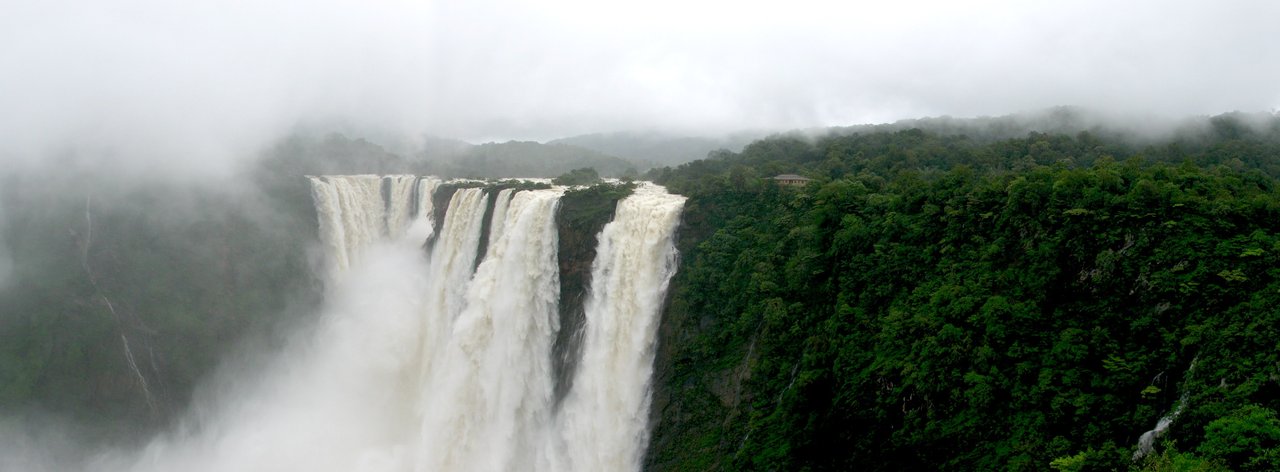
Few sights in South India stop travellers in their tracks quite like Jog Falls. Tucked into the folds of the Western Ghats in Karnataka, this is one of the most spectacular waterfalls in the country and among its tallest, formed where the Sharavathi River hurls itself off a sheer cliff in the Shimoga (Shivamogga) district, close to the Sagara taluk and not far from the Uttara Kannada border. Locally it is also known as Gerosoppa Falls or Joga Falls, names that crop up in older accounts and on some maps, but Jog Falls is what most visitors call it today.
What sets Jog apart from the many pretty cascades scattered across the Ghats is its sheer drama. This is not a gentle staircase of water tumbling over rocky ledges. In full flow it is a genuine plunge, water launching itself into thin air and falling in a long, unbroken column before crashing into the gorge far below. Add to that the fact that it arrives as four distinct, separately named falls rather than one single sheet of water, and you begin to understand why generations of travellers have made the winding drive up into the hills to see it.
Jog Falls also sits at a useful crossroads for anyone touring the region, being close enough to the coast to combine easily with a swing through Gokarna, Honnavar and Murudeshwar, so many visitors treat it as part of a wider loop rather than a standalone day trip.
The four cascades of the Sharavathi
The magic of Jog Falls lies in its four separate cascades, each with its own character and its own name, tumbling down the same cliff face within sight of one another. Raja is the grandest of the four, a single unbroken column of water that free falls with almost theatrical poise, and it is generally considered the most photogenic and most talked about of the set. Rani, sometimes called the Roarer for the noise she makes, curves and foams her way down beside Raja in a more turbulent, twisting fashion. Rocket earns her name by shooting out from the rock face in rapid, forceful jets rather than falling as a continuous sheet. And Roarer, occasionally referred to as Rover, tumbles over broken rock in a churning, chaotic rush.
Together these four falls are often cited as reaching a height of around 253 metres, or roughly 830 feet, which places Jog among the highest plunge waterfalls in India. The distinction matters to waterfall enthusiasts: unlike cascading falls that step down over a series of ledges, a plunge waterfall like Jog drops largely without touching the rock face, which is precisely what gives it that heart-stopping, free-falling quality when the river is running full.
The dam factor: why timing matters
Here is the honest bit that every visitor should know before setting out. The Sharavathi River is dammed upstream at Linganamakki, and the reservoir feeds the Sharavathi hydroelectric project, also known as the Mahatma Gandhi Hydroelectric Station. That dam is hugely important to the region’s power supply, but it also means the flow over Jog Falls is not left entirely to nature. In the dry season, particularly through the summer months, water is held back or diverted for power generation, and the falls can be reduced to a modest trickle, a pale shadow of their monsoon self.
The falls are at their absolute best during and just after the monsoon, roughly from August through to December, and especially in the weeks following heavy rain when excess water is released and all four cascades roar in full glory. Visitors who arrive in April or May expecting the postcard image can be disappointed, so it really is worth managing expectations and, where possible, timing a visit around the wetter months.
Viewing the falls
The main viewpoint sits across the gorge from the falls themselves, with a viewing deck or plaza, parking and basic facilities that give visitors a sweeping, uninterrupted view of all four cascades at once. It is, for most people, the highlight of the visit, and mornings can be particularly special, with mist rising off the gorge and rainbows forming in the spray as the sun climbs.
For those with sturdy knees and a taste for adventure, there is the option of descending roughly 1400 steps down to the base of the falls. It is a strenuous climb, both down and, more punishingly, back up, and the steps become genuinely slippery in the monsoon, so this is not an undertaking for everyone. Done with care and proper footwear, though, it rewards walkers with a completely different, thundering, close-up perspective on the falls that the top viewpoint simply cannot offer. There are also older viewpoints associated with a British-era bungalow and what is sometimes called the Watkins platform, relics of the colonial-era fascination with the falls, which offer their own angles on the gorge.
Around Jog Falls
The area around Jog Falls rewards a bit of exploring beyond the main viewpoint. The Linganamakki Dam and its large reservoir are close by, with backwaters that open up for boating in season. Not far off is Honnemaradu, a quieter spot on the Sharavathi backwaters that has become known for watersports such as kayaking and coracle rides, a pleasant contrast to the raw power of the falls themselves.
Sagara, the nearest sizeable town at around 30 km away, makes a useful base and also gives access to some worthwhile heritage sites, including the Sigandur and Kanoor forts and the Ikkeri and Keladi temples built under the Keladi Nayakas, a dynasty that once ruled this part of Karnataka. Talaguppa, the nearest railhead, lies closer still. Nature lovers should also know that the Sharavathi Wildlife Sanctuary lies in this belt of forest, home among other creatures to the lion-tailed macaque, while Kodachadri peak, a popular trekking hill with links to the Kollur Mookambika temple, is within reach for those wanting to extend their time in the Ghats. The drive itself, through dense Western Ghats forest with the road twisting through the hills, is part of the pleasure of the trip.
Things to do
- Take in the falls from the main viewing deck, ideally early in the day for softer light and fewer crowds
- Trek down the roughly 1400 steps to the base of the falls in season, with sensible footwear and caution
- Go boating on the Linganamakki reservoir or try watersports at Honnemaradu
- Visit the Keladi and Ikkeri temples near Sagara for a change of pace and some regional history
- Spend time simply enjoying the forest scenery, birdlife and the chance of spotting wildlife in the surrounding sanctuary
- Photograph the rainbows that often form in the spray on a bright monsoon morning
- Combine the visit with a run down to the coast to take in Murudeshwar, Gokarna and Honnavar
Where to stay and eat
Accommodation right at Jog Falls itself is limited, generally a handful of government-run or forest-department-style lodges alongside a few hotels and homestays near the viewpoint, so options tend to be basic rather than plush. Sagara town, around 30 km away, offers a wider spread of hotels and is the more comfortable base for many visitors, while a few resorts have sprung up around the backwaters near Linganamakki and Honnemaradu for those wanting a quieter, nature-focused stay. During the monsoon peak season, when the falls are at their best and demand is highest, it is wise to book accommodation well ahead.
Food around the falls tends to be simple, home-style South Indian and coastal Karnataka fare served at small eateries near the viewpoint, with a wider choice available in Sagara. This is not a destination for fine dining, so it pays to eat locally, keep expectations modest and carry some water and snacks for the day, particularly if you plan to make the descent to the base of the falls.
Best time to visit
As already mentioned, August through to December, or even into January, is generally reckoned the best window, with the falls at their most spectacular roughly between August and October following good rains. The monsoon itself, from June to September, delivers the falls in their most powerful state but comes with real caveats: roads can turn slippery, leeches are common in the forest, rain can be relentless, and the steps down to the base become genuinely hazardous. Many seasoned visitors therefore prefer the period from October to December, when the falls are still running full but the weather has settled into something calmer and more manageable. Summer, from March to May, is best avoided if seeing the falls in full flow is the priority, since the dam upstream can leave them reduced to little more than a trickle.
Getting there
Jog Falls sits within Shimoga district, and the practical gateways are Talaguppa, the nearest railway station at around 16 km, and Sagara town at roughly 30 km, which has better bus connections. The falls are around 380 km from Bangalore and about 100 km from Shimoga city, while the coast near Honnavar, and by extension Murudeshwar and Gokarna, is also roughly 100 km away, making a coastal-and-Ghats combination trip an easy one to plan. The nearest airports are at Hubli, Mangalore and Bangalore, though all involve a fair drive afterwards. Most visitors find that travelling by road, whether self-driven or by bus from Sagara or Shimoga, is by far the simplest way to reach the falls, and the coastal route via Honnavar conveniently links Jog Falls with the beaches and temples of the Karnataka coast.
Tips for visiting
- Plan your trip for August to December, ideally after a good spell of rain, to see the falls at their fullest rather than a disappointing trickle caused by the upstream dam
- If attempting the roughly 1400 steps down to the base, wear proper grip footwear and take real care, since the steps get slippery in wet weather
- Arrive early in the morning for softer light, fewer crowds and a better chance of catching a rainbow in the spray
- Carry rain gear and drinking water, as facilities near the falls are limited
- Expect winding roads through the Ghats, so allow extra time for the drive and take it easy on the bends
- Weekends and holidays can get busy, so a weekday visit is generally more peaceful
- Consider combining the trip with the Linganamakki and Honnemaradu backwaters, and with a run down to the coast around Murudeshwar
- Keep an eye on road and weather conditions during heavy monsoon spells before setting out
- Respect the barriers and safety warnings at the viewpoints, since the wet rocks around the falls have caused serious accidents in the past
One of South India’s great spectacles
Seen in full monsoon flow, Jog Falls ranks among the great natural spectacles of South India, the Sharavathi River hurling itself off a Western Ghats cliff in four thundering columns while mist and rainbows rise from the gorge below. Time your visit for the weeks after the rains, pair it with a lazy afternoon on the backwaters and a day or two on the nearby coast, and the long drive up into the hills will reward you many times over.