Guide details
Best time to visit
Karthigai Deepam falls in the Tamil month of Karthigai, roughly November to December, on the day the moon aligns with the Karthigai star. For the Maha Deepam beacon, plan to be in Tiruvannamalai on the festival night itself.
How to get there
Karthigai Deepam is celebrated across all of Tamil Nadu, in homes, streets and temples, so it can be experienced almost anywhere in the state. The grandest celebration takes place at the Arunachaleswarar Temple in Tiruvannamalai, which is reachable from Chennai by road or rail. Expect very heavy crowds and traffic around Tiruvannamalai on the festival day, so plan travel and arrival times with care.
Highlights
rows of oil lamps, the Maha Deepam beacon at Tiruvannamalai, Girivalam, temple deepam poojas, kolam, festival sweets like pori urundai
Good for
culture and festival travellers, photographers, families, those interested in Tamil traditions and temple festivals
Price range
Karthigai Deepam is essentially a home and temple festival and costs nothing to experience in most towns and cities. Travel and accommodation around Tiruvannamalai cost more during the festival and rooms book out well in advance, so budget for higher prices and early booking if visiting for the Maha Deepam.
Long before strings of electric fairy lights arrived in Tamil Nadu, there was Karthigai Deepam, and it remains, for many, the loveliest of all the state’s festivals of light. Also known as Thirukarthigai or Karthigai Vilakku, it is counted among the oldest festivals in the Tamil calendar, with references to it appearing in Sangam-era Tamil literature composed many centuries ago. Some Tamil traditions hold it to be older than, or at least as ancient as, Deepavali. Whatever the exact lineage, Karthigai Deepam has a simple, powerful idea at its heart: on one appointed evening, the whole of Tamil Nadu lights rows of oil lamps and lets them burn.
The festival falls in the Tamil month of Karthigai, which corresponds roughly to November and December. It is observed on the day the moon is in conjunction with the Karthigai star, called Krittika in Sanskrit and known to astronomers as part of the Pleiades cluster, a pairing that generally falls close to a full moon. Because the date is tied to this lunar-stellar alignment rather than a fixed calendar day, it shifts a little from year to year, so it is worth checking the Tamil almanac before planning a trip around it.
This is one of many festivals in the Tamil calendar. For an overview of the year and the state’s other great celebrations, see our guide to the festivals of Tamil Nadu.
An Evening of a Thousand Lamps
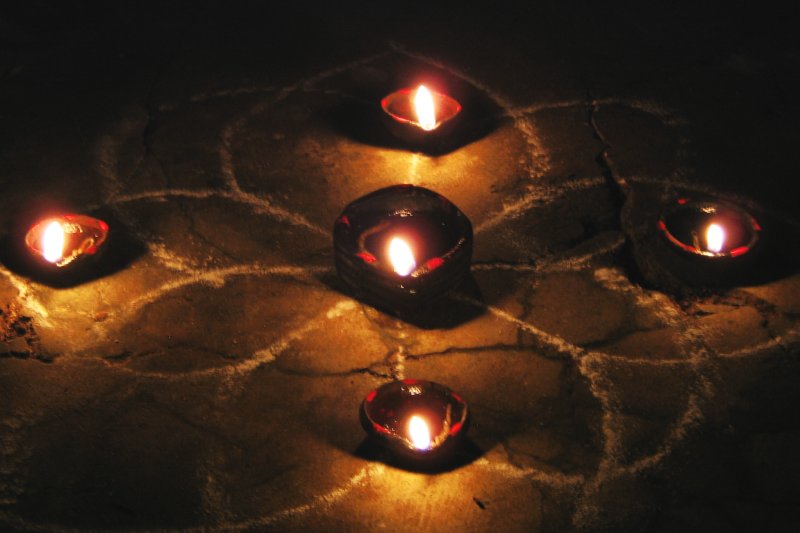
The defining image of Karthigai Deepam is the agal vilakku, the small clay or metal oil lamp that is lit in rows along doorsteps, windowsills, courtyard walls and temple corridors as the sun goes down. Families traditionally light these lamps in odd numbers, a detail rooted in old custom, and set them beside freshly drawn kolam, the intricate rice-flour patterns that mark an auspicious threshold. Streets that look ordinary by day are transformed after dusk into avenues of flickering gold, and entire neighbourhoods take on a hushed, festive glow. It is a gentle festival rather than a loud one: there are few of the fireworks associated with Deepavali, and the emphasis stays firmly on light itself, on the simple act of setting a small flame against the dark. In Tamil thought, that flame stands for the victory of light over darkness and of knowledge over ignorance, an idea that runs through the whole festival.
Shiva as the Endless Pillar of Fire
Karthigai Deepam carries deep Shaivite significance, rooted in the legend of Shiva as the jyoti lingam, the infinite column of light. According to the story, Brahma and Vishnu once fell into a dispute over which of them was supreme. Shiva intervened by manifesting as a boundless pillar of fire stretching beyond the reach of the heavens and the depths of the earth. Brahma flew upward as a swan and Vishnu dug downward as a boar, each trying to find the end of the flame, and neither could. The legend, known as lingodbhava, is understood in Tamil Shaivite tradition as proof of Shiva’s infinite, unknowable nature, and Karthigai Deepam is celebrated as a yearly re-enactment of that cosmic fire. It is this legend that gives the festival’s great beacon its meaning: the flame lit on this night is not decorative but symbolic, a small human echo of Shiva’s endless column of light.
Murugan and the Six Stars
Alongside its Shaivite associations, Karthigai Deepam is closely linked with Lord Murugan, also called Karthikeya, whose very name derives from the Karthigai or Krittika stars. Tradition holds that the infant Murugan was raised by six celestial mothers, the Krittika stars themselves, who each nursed him, and that he later merged into a single form with six faces to honour all six at once. Because the festival’s timing depends on the moon’s alignment with this same star cluster, many Tamil families and temples treat Karthigai Deepam as much as a Murugan festival as a Shiva one, and Murugan temples across the state hold their own special deepam poojas on the day, drawing on both strands of the festival’s religious meaning.
The Maha Deepam at Tiruvannamalai
The single most spectacular expression of Karthigai Deepam takes place at the Arunachaleswarar Temple in Tiruvannamalai, built at the foot of the sacred Arunachala hill, which is worshipped as the earthly form of Shiva’s element of fire. Of the five elemental Shiva temples of the south, this is the one dedicated to fire itself, which is precisely why it hosts the grandest Karthigai Deepam of all. On the night of the festival, a giant lamp is lit atop the hill using a vast cauldron of ghee fed by an enormous wick, after a smaller beacon known as the Bharani Deepam is first lit the previous day as a herald. Once kindled, the Maha Deepam burns for hours and is visible for miles across the plains around the town, a single point of fire answering the countless smaller lamps lit in homes and temples below. It is a direct, visible restaging of the lingodbhava legend, Shiva’s infinite pillar of fire brought down to a hilltop that the faithful can see with their own eyes, rather than a story told only in scripture.
Enormous numbers of devotees travel to the town for the occasion, arriving by bus, train and car from across Tamil Nadu and beyond in the days before the festival. Many undertake Girivalam, the long barefoot circumambulation of the base of Arunachala hill, considered especially meritorious on this day, and the road around the hill fills through the night with pilgrims moving slowly past shrines, resting points and stalls selling festival food. The combination of the lamp-lit town, the crowds moving around the hill through the night, and the great flame burning above it all makes this the grandest and most atmospheric Karthigai Deepam celebration anywhere in Tamil Nadu, and one that draws visitors well beyond the immediate Shaivite community.
Bonfires, Sweets and the Days Around the Festival
In many traditions, Karthigai Deepam is not a single evening but a short span of days building up to the main event, opening with the Bharani Deepam and continuing through Karthigai Deepam itself and the days that follow. In some rural parts of Tamil Nadu, the festival is marked by the Sokkappanai, a tall bonfire tower built from dried palm leaves and fronds, which is set alight after dark as a village-scale echo of the household lamps, drawing crowds who gather to watch it catch and blaze. Food plays its part too: pori urundai, balls of puffed rice bound together with jaggery syrup, is one of the festival’s signature sweets, alongside appam and adai, both made and shared within families as offerings and treats. Sugarcane, plantains and other seasonal produce are often placed near the lamps as simple offerings, and sweets are exchanged between neighbours much as they are during other Tamil festivals. Temples of every kind hold special deepam poojas through the day, with priests performing additional rounds of worship and lighting larger ceremonial lamps within the sanctum, and it is common for extended families to gather in the evening to light lamps together before sharing a festive meal.
A Festival Across Tamil Nadu
Karthigai Deepam is celebrated everywhere in Tamil Nadu, from village homes to the busiest streets of Chennai, and it sits alongside Pongal and Deepavali as one of the great fixtures of the Tamil festival calendar. Where Pongal marks the harvest and Deepavali is celebrated widely across India, Karthigai Deepam is regarded by many Tamils as the more distinctly and anciently Tamil of the light festivals, tied as it is to Sangam-era literature and to temple traditions that predate much of what is now celebrated elsewhere. Even without the scale of Tiruvannamalai’s beacon, the sight of an ordinary Tamil street lined with oil lamps on Karthigai Deepam night is one of the most quietly beautiful things the state has to offer.
Planning a Visit
For visitors, Karthigai Deepam is a wonderful time to be in Tamil Nadu. Any temple town glows on the night itself, and even a short evening walk through a residential street will reveal doorstep after doorstep lined with lamps and kolam. Chennai and the other cities join in fully, with temples holding their own deepam poojas and neighbourhoods lighting up after dusk. For those wanting to see the festival at its most dramatic, Tiruvannamalai and the Maha Deepam are the obvious draw, but this comes with genuinely enormous crowds, since very large numbers of devotees converge on the town for the day. Anyone planning to be there should book accommodation well in advance, expect very heavy traffic on the approach roads, and be prepared for a long, packed day on foot if joining the Girivalam. Comfortable footwear, light clothing and patience matter more than any single sightseeing plan, since the day tends to unfold at its own pace rather than to a fixed schedule. It is, above all, a religious occasion for the people taking part, so visitors are best served by treating the crowds, the queues and the heat with patience and by keeping temple etiquette in mind throughout, dressing modestly and following the lead of local devotees around the shrine and the hill.
Karthigai Deepam is, in the end, one of the oldest and most beautiful festivals Tamil Nadu has to offer: a luminous, unhurried celebration of light over darkness that turns homes, streets and temples across the state into a field of lamps, and which reaches its most awe-inspiring form in the great fire beacon that burns above Tiruvannamalai.