Guide details
Best time to visit
Tamil Nadu’s food is a year-round pleasure, since rice, lentils and coconut form the backbone of the cuisine in every season. That said, festival periods add something extra: Pongal in January brings sweet and savoury pongal dishes cooked specially for the harvest festival, while temple festivals across the state often bring out special prasadam sweets and feast-day banana leaf meals. Visiting during a festival is a wonderful way to see the food culture at its most generous.
How to get there
Tamil Nadu food is found absolutely everywhere across the state, so there is no single place you need to travel to in order to enjoy it. Every town has its meals restaurants for the banana leaf lunch, its tiffin centres for breakfast and evening snacks, its mess and military hotels for non-vegetarian food, and its sweet shops and street stalls. Chennai, as the state capital and main entry point for most visitors, is a great place to begin, with easy access onward to Chettinad, Madurai, Tirunelveli and the coastal towns where regional specialities are best enjoyed close to their source.
Highlights
banana leaf meal, idli and dosa, filter coffee, Chettinad cuisine, biryani, jigarthanda, Tirunelveli halwa, meen kuzhambu, parotta
Good for
food lovers, first-time visitors to South Indian cuisine, vegetarians and meat-eaters alike, culture travellers
Price range
Tamil Nadu offers food at every level, but some of its finest eating is also its most affordable. A tiffin breakfast or a banana leaf meals lunch at a modest local restaurant is inexpensive and filling, street stalls and mess houses charge very little for generous portions, and even a proper sit-down meal at a mid-range restaurant remains reasonable by most standards. Specialist restaurants for Chettinad cuisine, biryani or seafood sit a little higher, but exact prices vary widely by town and establishment, so it is best to check locally rather than expect a fixed figure.
Tamil Nadu’s food is one of India’s great regional cuisines, and once you have eaten your way through even a few days in the state, it is easy to see why. It is built on a handful of humble staples used with extraordinary skill: rice in its many forms, lentils cooked down into sambar and rasam, coconut grated fresh into chutneys and curries, tamarind for its clean sour edge, curry leaves for fragrance, and that unmistakable tempering, or tadal, of mustard seeds crackling in hot oil with urad dal and a pinch of asafoetida. From this small set of building blocks comes a cuisine of enormous variety and, just as importantly, enormous contrast. On one hand there is the largely vegetarian tradition associated with temple towns and Brahmin households, refined over generations into the elaborate banana leaf meal. On the other hand there are the robustly spiced, often fiery non-vegetarian traditions of Chettinad, the coastal and Muslim culinary styles, and the Nadar communities of the south. Both sit comfortably within the same food culture, and both are essential to understanding Tamil Nadu at the table. Add to this the daily ritual of the tiffin breakfast and the near-sacred institution of filter coffee, and you have a cuisine that is not just eaten but lived.
The banana leaf meal (sappadu)
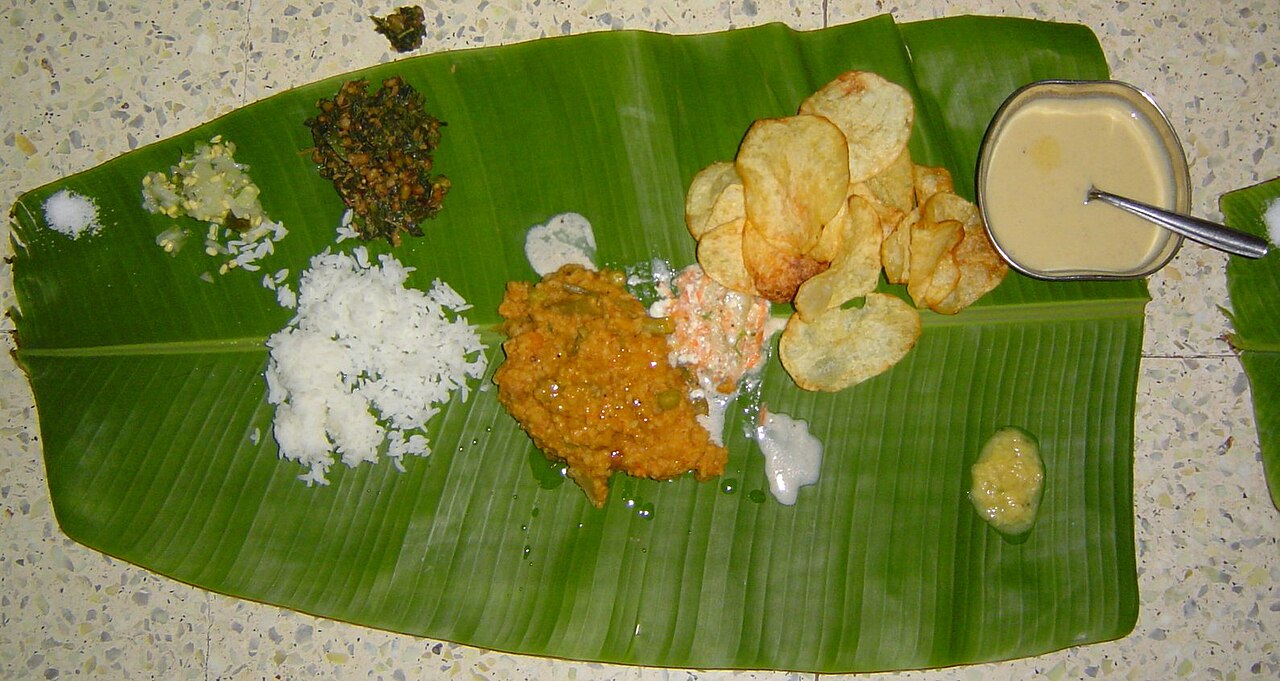
If there is one format that captures the spirit of Tamil food, it is the sappadu, the traditional meal served on a fresh banana leaf. Rice sits at the centre, and around it, in a particular order that regular diners know by heart, come sambar, a thin and peppery rasam, a vegetable kootu, one or two dry poriyal preparations, the mixed vegetable and coconut curry avial, a crisp fried appalam, a sharp spiced relish, a cooling bowl of curd, and often a spoonful of payasam to finish on a sweet note. The meal is eaten by hand, mixing rice with each accompaniment in turn, and there is a genuine etiquette to it, from the order in which items are served to the way the leaf itself is folded at the end as a quiet signal of appreciation. What makes the banana leaf meal such a treat for visitors is the generosity behind it. At the countless meals restaurants found in every Tamil town, servers move down the row of leaves with buckets and ladles, and rice, sambar and rasam are topped up again and again until you signal that you have had enough. It is unhurried, communal and enormously satisfying.
Breakfast and tiffin classics
Mornings in Tamil Nadu belong to tiffin, the term used across the south for a savoury breakfast or light meal, and the range on offer is remarkable. Idli, the soft steamed rice cake, is perhaps the most famous, often paired with fluffy pongal or crisp vada, the doughnut-shaped lentil fritter also known as medu vadai. Dosa, the thin fermented rice and lentil crepe, appears in endless forms, from the plain and simple to the spiced masala dosa filled with potato, and on to rava dosa made with semolina or the softer, onion-topped versions found at busy tiffin centres. Ven pongal, a comforting rice and lentil dish finished with cracked pepper, cumin and ghee, is a breakfast staple, as is upma, made from roasted semolina or vermicelli. Idiyappam, delicate steamed rice noodles also called string hoppers, and appam, with its lacy edges and soft centre, are especially popular along the coast, while poori served with a spiced potato masal is a hearty weekend favourite. Everything arrives with sambar, a trio of chutneys in coconut, tomato and mint, and often a spoonful of idli podi, the dry roasted lentil and chilli powder mixed with sesame oil that Tamils affectionately call gunpowder. Tiffin centres, whether grand old establishments or humble roadside stalls, are a genuine institution, busy from early morning through to the evening tiffin rush.
Filter coffee, an institution in itself
No account of Tamil food is complete without filter coffee, known locally as kaapi. Made using a traditional metal filter that slowly drips a strong decoction from coarsely ground coffee, it is then mixed with hot milk and sugar and poured back and forth between a tumbler and its accompanying dabarah, or wide bowl, to build up that characteristic froth. Served piping hot, it has a richness and depth that sets it apart from ordinary instant coffee, and connoisseurs speak reverently of degree coffee, a term rooted in the old practice of checking the purity of the milk. Filter coffee is far more than a drink here; it is a daily ritual, a reason to pause, and a fixture of both home kitchens and tiffin centres across the state.
Rice-based mains and everyday home food
Beyond the banana leaf spread and tiffin counter lies the everyday cooking that fills Tamil homes. Sambar and rasam appear at nearly every meal, alongside kootu and poriyal made with whatever vegetables are in season. Thayir sadam, or curd rice, is the great comfort food of the south, cooling and mild, often finished with a tempering of mustard seeds and curry leaves. Variety rices are equally beloved: tangy tamarind rice known as puliyodarai, zesty lemon rice, fragrant coconut rice and tomato rice are all popular for their portability as much as their flavour, making regular appearances in lunch boxes and on temple prasadam trays alike. Simple, quick and deeply satisfying, these rice dishes show a different, more domestic side of Tamil cooking.
Chettinad cuisine
Chettinad cuisine, hailing from the Karaikudi region, is one of India’s most celebrated regional culinary traditions, and rightly so. Known for its complex, freshly ground spice blends, it produces some of the most robustly flavoured food in the country, from fiery Chettinad chicken and mutton curries to the drier, intensely peppery pepper chicken and the spiced meatballs known as kola urundai. Traditional Chettinad cooking relies heavily on stone-ground masalas and sun-dried ingredients, techniques that were originally developed to preserve food for the region’s trading families and that give the cuisine its distinctive depth. It is not, however, purely a meat lover’s cuisine; Chettinad kitchens also produce excellent vegetarian dishes, built on the same foundation of carefully balanced spice.
Non-vegetarian and coastal flavours
Away from Chettinad, Tamil Nadu’s non-vegetarian and coastal traditions are just as rich. Madurai is famous for its no-nonsense non-vegetarian food, including kari dosai, a dosa topped with minced meat, alongside the city’s other great contribution, jigarthanda, a layered iced drink built from milk, almond gum, sarsaparilla syrup and ice cream. Across the state, parotta, the flaky, layered flatbread made by skilfully stretching and folding dough, is a beloved evening staple, usually torn by hand and dipped into salna, a thin spiced gravy, or a richer kurma or chicken curry. Biryani has its own distinctly Tamil character, often made with fragrant seeraga samba rice rather than the long-grain basmati used elsewhere in India, and towns such as Ambur and Dindigul, home of the well-known Thalappakatti style, have built their reputations on it. Along the coast, from Nagore down towards Kanyakumari, fish and prawn dishes take centre stage, with meen kuzhambu, a tangy tamarind-based fish curry, standing out as a true classic of Nadar and coastal Tamil cooking.
Snacks and street food
Tamil Nadu’s street food scene is a pleasure in its own right. Bajji and bonda, vegetables and lentil batter dipped and deep-fried until golden, are the classic evening snack, best eaten hot with a cup of tea. On the beaches of Chennai and other coastal towns, vendors sell sundal, a simple, spiced legume salad, from large baskets as the sun goes down. Murukku and other savoury snacks are made in households and small shops across the state, especially around festival time, while city street food scenes add their own contemporary touches, including dishes like atho influenced by nearby communities. For a proper introduction to this side of the state, the famous food of Chennai is a good place to start, since the capital brings together tiffin, street snacks, sweets and non-vegetarian specialities from across Tamil Nadu in one lively food scene.
Sweets and specials
Tamil Nadu’s sweet shops are an institution of their own. Mysore pak, a rich, ghee-laden gram flour sweet, and adhirasam, a deep-fried jaggery and rice flour treat traditionally made for festivals, are found in sweet shops throughout the state. Jangiri, a bright orange, syrup-soaked coil made from urad dal batter, is a festive favourite, while Tirunelveli is famous the country over for its wheat halwa, a glossy, chewy sweet unlike any other regional halwa. Srivilliputhur is known for its palkova, a milk sweet reduced slowly until thick and grainy, and Manapparai, near Trichy, has its own well-regarded style of murukku. Palani, one of Tamil Nadu’s important temple towns, is closely associated with panchamirtham, a naturally sweet prasadam made from a blend of fruits and honey, offered to devotees at the hilltop temple. And of course there is jigarthanda, Madurai’s iced speciality, which straddles the line between drink and dessert and is a must-try for any visitor to the city.
Regional specialities worth seeking out
Part of the joy of eating in Tamil Nadu is how closely food is tied to place. Madurai offers its bold non-vegetarian food and the refreshing jigarthanda, Tirunelveli its famous halwa, and Chettinad its stone-ground, richly spiced curries. Kumbakonam and Thanjavur, sitting in the fertile Cauvery delta, are known both for their own style of degree coffee and for the delta’s excellent rice and vegetable cooking, while Dindigul and Ambur have made their names through biryani. Along the coast, seafood dominates, with each fishing town bringing its own take on fish and prawn curries. Travelling through the state with food in mind is one of the best ways to understand its regions, since so often the local speciality tells you something about the land, the coastline or the trading history that shaped it.
Where and how to eat
Getting the most out of Tamil Nadu’s food is largely about knowing where to look. Meals restaurants, often simple and unpretentious, are the place for the banana leaf lunch, while tiffin centres handle breakfast and the evening snack rush with equal enthusiasm. Mess houses and military hotels, a name that has nothing to do with the armed forces but everything to do with brisk, no-frills service, are the traditional home of good non-vegetarian cooking. Street stalls and sweet shops round out the picture, offering everything from hot bajji to trays of glistening mysore pak. Eating with the hands is the norm for most of this food, and it is worth embracing rather than avoiding, since it genuinely changes how the meal feels. As with so much good food anywhere in the world, some of the very best Tamil cooking is found not in polished restaurants but in humble, long-running local places that have been doing one thing well for decades.
Tamil Nadu’s food cannot really be separated from its culture. It is generous almost by instinct, deeply regional in its pride, and built on centuries of tradition that show in everything from the tempering of a simple dal to the elaborate choreography of a banana leaf meal. Whether you are working your way through a tiffin breakfast, tracking down Chettinad specialities, or simply following the smell of filter coffee down a side street, eating your way across Tamil Nadu remains one of the great pleasures of travelling in this part of India.